Key takeaways
- A dimmer or app-independent physical control, so the light remains usable if Wi-Fi fails.
- Memory after power loss, which prevents the rope from returning to an unwanted bright or colored setting.
- Replaceable connectors and end caps for low-voltage systems.
- Warm-white or tunable-white LEDs if the rope will operate daily, rather than only for parties.
- Flame-retardant, UV-resistant, and flexible silicone or PVC jackets for exposed installations.
- Timer and scheduling functions for patios, holiday displays, and nighttime pathways.
The best rope lights for most decorating projects are 12V or 24V LED strips in a flexible silicone sleeve, rated at least IP65 outdoors, with dimming, a warm-white option around 2700–3000K, and cut marks no farther apart than 1–2 feet.
Quick picks by decorating situation
| Situation | Best choice | Why it fits | Watch out for |
|---|---|---|---|
| Small apartment or bedroom | Low-voltage indoor rope light, 2700–3000K, dimmable | Soft light, low heat, and a compact plug-in controller | Choose a thin profile so it does not look bulky under shelves |
| Kids, pets, or exposed floor edges | Fully sleeved LED rope, IP65 or higher | The sealed outer jacket protects LEDs from splashes, dust, and handling | Secure it firmly; loose loops can become a tripping or chewing hazard |
| Rental home | Plug-in rope light with clips, removable hooks, or tension-mounted channels | Installs without drilling or permanent wiring | Adhesive may damage paint or fail on textured walls |
| Patio or pergola | Outdoor-rated 24V rope light, IP65–IP67, with a weatherproof power supply | Handles moisture and produces more even illumination over long runs | The power adapter and connector must also be weather protected |
| Stairs or walkways | Dimmable warm-white rope in an aluminum or recessed channel | Reduces glare while making tread edges easier to see | Do not use decorative brightness as a substitute for code-compliant stair lighting |
| Color-changing entertainment area | RGB or RGBW smart rope light with app and physical controls | Offers scenes, scheduling, and color changes | RGB-only products often produce less convincing warm white |
What separates the best rope lights
Waterproof rating
Look for the IP, or Ingress Protection, rating rather than relying on “weather resistant” in a product title. IP20 is intended for dry interiors. IP44 protects against splashes from different directions and can suit a covered porch, but it is not the safest choice for exposed rain. IP65 resists dust and water jets, making it a practical minimum for most outdoor trim. IP67 adds temporary immersion protection, which is useful near damp landscaping or areas where water can pool, although it does not make every connector or power supply submersible.

Minetom Color Changing Rope Lights Outdoor, 33FT 100 LED Rope Light
Included for 'Best Rope Lights for Indoor and Outdoor Decorating' because the listing specifies 33FT 100 LED Rope Light, details this guide uses to compare options.
View on Amazon
UltraPro 16 Foot LED Rope Lights, Clear Rope, Warm White 3000K, Outdoor
Included for 'Best Rope Lights for Indoor and Outdoor Decorating' because the listing specifies Clear Rope and Warm White 3000K, details this guide uses to compare options.
View on Amazon
SILFU Neon Rope Lights, 50FT RGB LED Strip Lights
Included for 'Best Rope Lights for Indoor and Outdoor Decorating' because the listing specifies 50FT RGB LED Strip Lights, details this guide uses to compare options.
View on Amazon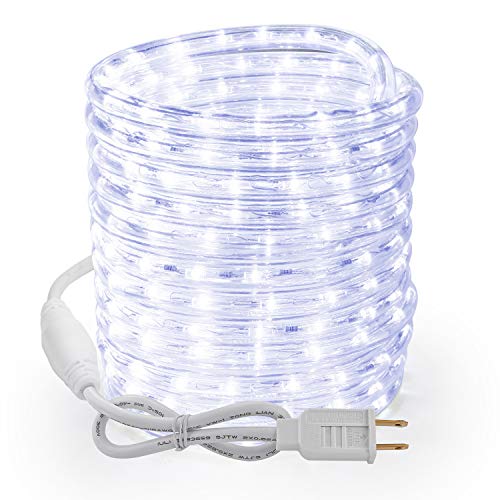
Brizled Cool White Rope Lights Connectable, 18ft 216 LED Rope Light Outdoor
Included for 'Best Rope Lights for Indoor and Outdoor Decorating' because the listing specifies 18ft 216 LED Rope Light Outdoor, details this guide uses to compare options.
View on AmazonFor an outdoor installation, match the entire system: rope jacket, end cap, joining connector, controller, and transformer. A high-rated rope connected to an indoor-only adapter is still an indoor installation. Keep connections above standing water and inside a weatherproof enclosure when the manufacturer requires it.
Brightness and light distribution
Rope lights are usually accent lighting, not a replacement for a ceiling fixture. For outlining a room, 150–400 lumens per meter is commonly sufficient. Use roughly 400–800 lumens per meter when the rope will provide useful task or pathway illumination, such as under a bar, along a dark patio edge, or beneath stair nosings. Very bright rope can create harsh points of light if the LEDs are visible.
For a smoother line, choose a dense LED layout, a frosted silicone diffuser, or an aluminum channel with a diffuser. A clear jacket often looks brighter but reveals individual LED dots. For furniture and architectural edges, continuous or high-density light is usually more polished than the cheapest low-density option.
Color temperature and color quality
Choose 2200–2700K for a candlelike, relaxed effect around a bedroom, dining area, or wood furniture. The versatile choice for most interiors is 2700–3000K. Select 3500–4000K for a cleaner appearance in a utility room, workshop, or modern outdoor space. Daylight settings above 5000K can feel stark and are rarely the best choice for decorative outlining.
If the rope will illuminate artwork, upholstery, or food, look for a color-rendering index of 90 or higher. RGB color-changing rope is excellent for atmosphere, but RGBW or tunable-white rope generally produces more natural white light for everyday use.
Cut length, voltage, and power options
Cut marks determine how neatly a rope fits your project. Some plug-in rope lights can be cut only at intervals of 18–39 inches, while low-voltage tape-style systems may allow cuts every 1–4 inches. Measure the route first and choose a cut interval shorter than the leftover section you can hide. Cut only at marked points, then seal the new end with the specified cap; an unsealed cut can defeat the outdoor rating.
Plug-in 120V rope is convenient for long, simple runs because it avoids a separate transformer. It can be thicker, harder to shorten, and less flexible around tight corners. Twelve-volt and 24V systems are easier to control and often allow shorter cut lengths, but they require a correctly sized driver. Twenty-four volts generally has less voltage drop over long runs than 12V, so the far end is less likely to appear dim.
To estimate power, multiply the light’s watts per meter by the planned length, then choose a power supply with about 20 percent spare capacity. A 6-meter rope rated at 8 watts per meter uses 48 watts; a supply of approximately 60 watts or more is a sensible target if the manufacturer permits it. Do not connect sections beyond the stated maximum run, even if the connector physically fits.
| Project | Typical length | Useful brightness target | Recommended specification |
|---|---|---|---|
| 10 x 12 ft bedroom perimeter | About 44 ft before door breaks | 150–300 lumens per meter | 2700–3000K, dimmable, indoor-rated, 24V if using multiple sections |
| Under a 6 ft kitchen cabinet run | 6–8 ft including return | 250–500 lumens per meter | 3000–4000K, high-density LEDs, diffuser channel |
| 12 ft patio railing | 12–15 ft with slack at corners | 250–600 lumens per meter | IP65 or higher, outdoor power supply, 2700–3000K |
| Eight stair treads | About 16–24 ft depending on routing | 150–400 lumens per meter | Warm white, dimmable, channel or recessed mounting, low-voltage system |
Installation methods: what works and what wears out
Clips and mounting tracks
Screw-mounted clips are the most dependable method for patios, soffits, stair rails, and rough surfaces. Space clips about every 12–18 inches on straight runs and every 6–8 inches near curves. Aluminum channels create a straight, finished line and help dissipate heat, but they add cost and require accurate cutting.
Adhesive backing and removable hooks
Adhesive is convenient beneath clean, smooth cabinets and along painted trim. Wipe away grease and dust, let the surface dry, and press the rope into place gradually rather than stretching it. Adhesive tends to fail first in heat, humidity, textured paint, and dusty outdoor locations. In a rental, removable hooks or small clip mounts are safer than applying permanent tape directly to a wall.
Indirect installation
For the most attractive room outline, hide the LEDs behind a curtain pelmet, crown molding, headboard, cabinet lip, or furniture plinth. Aim the light at a wall rather than at eye level. Leave enough clearance for the bend radius specified by the manufacturer; forcing a sharp 90-degree turn can crease the jacket or damage the internal conductors.
Plan access to the controller and plug before mounting. A rope hidden behind a bookcase is difficult to reset if its control button is unreachable. Do not run loose rope across walking paths, beneath rugs, or where a chair leg can repeatedly crush it.
How much room and clearance do you need?
For a 10-by-12-foot room, the perimeter is 44 feet, but a full continuous loop is rarely necessary. Stop at doorways, corners behind furniture, or changes in wall material and use separate sections if the system permits. Keep the rope at least 2–3 inches behind the front edge of a shelf or cabinet so the diodes are not visible from normal standing height. Under a sofa or bed, a setback of about 3–6 inches usually gives a soft glow without creating a bright line on the floor.
For stairs, position decorative rope so it cannot be caught by a shoe or snagged during cleaning. A channel beneath the handrail or under the tread nosing is safer than laying the rope on the tread surface. Keep the light out of direct eye level, particularly on stairs viewed from below.
Features worth paying for
- A dimmer or app-independent physical control, so the light remains usable if Wi-Fi fails.
- Memory after power loss, which prevents the rope from returning to an unwanted bright or colored setting.
- Replaceable connectors and end caps for low-voltage systems.
- Warm-white or tunable-white LEDs if the rope will operate daily, rather than only for parties.
- Flame-retardant, UV-resistant, and flexible silicone or PVC jackets for exposed installations.
- Timer and scheduling functions for patios, holiday displays, and nighttime pathways.
Final buying recommendation
For most indoor decorating, choose dimmable 24V LED rope or a high-density sleeved strip in 2700–3000K, with a diffuser or hidden mounting channel. For exposed outdoor features, prioritize IP65 or IP67, UV resistance, sealed connectors, and a weatherproof driver before choosing color effects. For stairs and walkways, select a lower-glare warm-white system and mount it in clips or a channel. The best rope lights are not necessarily the brightest; they are the ones whose cut length, voltage, weather protection, and mounting method match the exact route you need to illuminate.