Key takeaways
- Dual motor over single motor: Single-motor chairs move the back and footrest on one fixed arc. Dual motors let you drop the legs high while keeping the back upright — the zero-gravity-adjacent position that takes load off the lumbar discs. If your pain is disc-related, this is the feature to prioritize.
- Lumbar support that’s actually placed correctly: Heat and a pillow only help if they land at L3–L5. Sit in the chair (or check seat-back height against your torso) before committing; a lumbar zone tuned for a 5’4″ frame will hit a 6’2″ frame mid-thoracic and do nothing useful.
- Seat depth and firmness: Too deep and your pelvis rolls backward, flattening the lumbar curve. Too soft and you sink into a hammock. Look for a supportive foam core with a firmer edge, and a seat depth that leaves two fingers of clearance behind your knees.
- Upholstery finish under lamplight: High-gloss faux leather mirrors every bulb in the room, creating hot spots that read as visual noise and make a space feel harsher than it is. Matte fabric or a low-sheen leather diffuses light instead of bouncing it — worth considering if the chair sits near a lamp or window.
- Placement and clearance: Full recline needs wall clearance, and a tall chair back can block a floor lamp’s spill entirely. Measure both the reclined depth and the sightline from your light source to your reading plane before you pick a spot.
What's inside
Back pain rarely announces itself at noon. It shows up at 9 p.m., when the overhead fixture is still blazing at full output, the sofa has given up on your lumbar curve, and you’re shifting position every four minutes trying to find the one angle that doesn’t ache. As someone who designs evening light for living rooms, I’ve learned that the chair is half the equation. Posture and ambience work together: a body that can finally decompress in a supported recline responds to warm, low-glare light the way a room responds to a dimmer. Get the seat wrong, and no amount of 2700K lamplight will make the space feel restful.
This guide looks at power lift recliners through both lenses — orthopedic support and how the chair behaves in a real, lamp-lit room. I’ve weighed lumbar geometry, dual-motor versus single-motor articulation, heat and massage placement, and the practical details nobody mentions in spec sheets: whether the upholstery throws glare back at your reading lamp, whether the USB port is reachable without contorting, and whether the footprint blocks the light path from your floor lamp. Below are six strong contenders, followed by a buying framework and answers to the questions I get asked most.
As an Amazon Associate we earn from qualifying purchases.


🛒 Best Price Today on Amazon
Prime members get fast, free shipping on everything above, plus member-only deals. New members get a 30-day free trial — cancel anytime.
How to Choose a Recliner For Back Pain Consumer Reports (2026)
- Dual motor over single motor: Single-motor chairs move the back and footrest on one fixed arc. Dual motors let you drop the legs high while keeping the back upright — the zero-gravity-adjacent position that takes load off the lumbar discs. If your pain is disc-related, this is the feature to prioritize.
- Lumbar support that’s actually placed correctly: Heat and a pillow only help if they land at L3–L5. Sit in the chair (or check seat-back height against your torso) before committing; a lumbar zone tuned for a 5’4″ frame will hit a 6’2″ frame mid-thoracic and do nothing useful.
- Seat depth and firmness: Too deep and your pelvis rolls backward, flattening the lumbar curve. Too soft and you sink into a hammock. Look for a supportive foam core with a firmer edge, and a seat depth that leaves two fingers of clearance behind your knees.
- Upholstery finish under lamplight: High-gloss faux leather mirrors every bulb in the room, creating hot spots that read as visual noise and make a space feel harsher than it is. Matte fabric or a low-sheen leather diffuses light instead of bouncing it — worth considering if the chair sits near a lamp or window.
- Placement and clearance: Full recline needs wall clearance, and a tall chair back can block a floor lamp’s spill entirely. Measure both the reclined depth and the sightline from your light source to your reading plane before you pick a spot.
The Best Recliner For Back Pain Consumer Reports (2026)s Reviewed
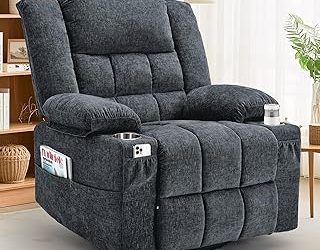
Power Lift Recliner with Vibration Massage and Lumbar Heating
A well-rounded oversized single-seater that covers the essentials — targeted lumbar heat, vibration massage, cup holder, and USB charging — without pushing into premium pricing. The generous seat width suits broader frames, though the extra bulk means you’ll want to check how it sits relative to your side lamp.
MCombo Power Lift Recliner 7040
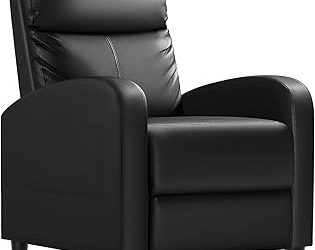
MCombo’s 7040 is the safe pick for most buyers: FSC-certified frame, multiple size options so you can match seat-back height to your torso, and both USB-A and Type-C ports. The dark brown faux leather does catch highlights, so pair it with a shaded lamp rather than a bare bulb.
Dual Motor Infinite Position Lift Recliner in Brown Leather
Infinite position is the meaningful upgrade here — independent back and footrest control means you can dial in a genuine lay-flat or legs-elevated posture that a synchronized recliner can’t reach. The included lumbar pillow and wireless charging pad make it a strong all-day chair for chronic lower-back discomfort.
Tami Tami T6015 Dual Motor Lift Chair
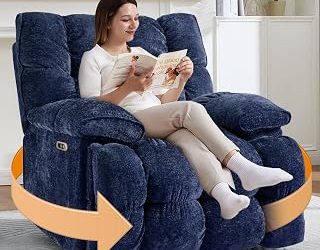
The adjustable headrest sets this one apart: cervical support is where most lift chairs quietly fail, and being able to tune neck angle independently helps if your back pain travels upward. The plush dark gray fabric is also the most light-friendly surface in this group, reading soft and matte under warm lamplight.
MAHOMICO Power Lift Recliner
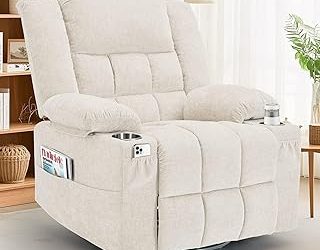
A tidy, practical option with dual cup holders, side pockets, and lumbar heating in a footprint that won’t dominate a smaller living room. Best suited to average-height users looking for straightforward relief rather than maximum articulation.
Frequently Asked Questions
Does a reclined position really reduce back pain?
Reclining to roughly 120–135 degrees reduces compressive load on the lumbar spine compared with sitting upright, which is why many people find relief in a recliner that they don’t get from a sofa. The key is maintaining lumbar contact throughout the range, not just at one angle.
Is heat or massage more useful for back pain?
Heat tends to help more consistently — it increases local blood flow and eases muscle guarding. Vibration massage is pleasant and can aid relaxation, but treat it as a bonus rather than the deciding feature.
How much space does a lift recliner need?
Budget 4–8 inches of wall clearance for the lift mechanism plus the reclined depth, which can exceed 65 inches on infinite-position models. Also check that the raised back won’t cut off light from a floor lamp positioned behind or beside the chair.
Fabric or leather for a chair I’ll use every evening?
Fabric breathes better during long sessions and diffuses lamplight, keeping the room visually calm. Leather and faux leather clean more easily but reflect light sources, which can feel glaring in a low-lit space.
Final Thoughts
If you want the most therapeutic range of motion, the Dual Motor Infinite Position Lift Recliner is the one to beat — true independent articulation is what separates real relief from a chair that simply leans back. The Tami Tami T6015 is my pick for anyone whose pain includes the neck and upper back, and its matte fabric behaves beautifully under warm evening light. For a dependable middle path with sizing flexibility, the MCombo 7040 remains the easiest recommendation to make.