Key takeaways
- Lumbar geometry over lumbar marketing: Look for a defined convex pad that meets you between the belt line and the bottom of the ribs. If the support sits too high it pushes your shoulders forward; too low and it does nothing. Sit in it, or check the backrest height against your own torso before buying.
- Recline range, not recline count: Pain relief tends to arrive somewhere between 120 and 135 degrees, where the discs unload. A chair that only offers upright or near-flat forces you into a position your back did not ask for. Infinite or multi-stop positioning is worth paying for.
- Power lift if standing is the hard part: For anyone with disc issues, stenosis, or post-surgical restrictions, the transition out of the chair causes more trouble than the sitting. A lift mechanism removes the forward-fold-and-push motion entirely.
- Seat height, then lamp height: Measure your reclined eye level before you commit to a floor lamp. A tall-back recliner drops your head roughly a foot when fully open, which puts most standard lamp shades directly in your sightline. Aim for the shade bottom to sit at or just below reclined eye height.
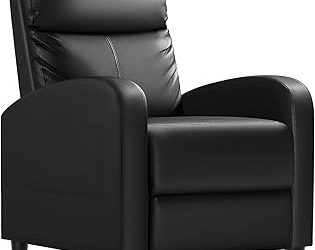
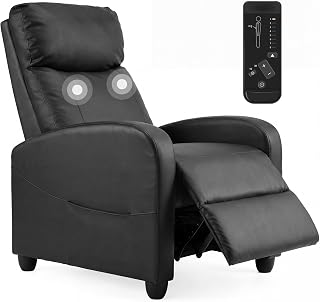
- Upholstery sheen under warm light: Glossy PU leather picks up hard specular highlights from any single overhead source and can read cheap after dark. Woven fabric diffuses light softly and keeps a room calm; if you want leather, choose a matte or lightly grained finish.
What's inside
Most of my working hours are spent deciding where people will land at the end of a day — which corner catches the last of the west light, how low a floor lamp should hang before it turns into glare, where a room stops performing and starts resting. The chair is always the anchor of that decision. And when the person sitting in it has a bad lower back, the calculus changes entirely: the seat has to hold a spine in neutral for two or three hours, not just look composed in a photograph. Showroom lighting flatters everything. A tired lumbar spine at 9pm is a far harsher critic.
This guide looks at recliners through both lenses — orthopedic support first, then how each one behaves in a real evening room, where sheen, seat height, and reclined footprint decide whether your reading lamp still works. Below are the models worth considering in 2026, with a short buying framework and answers to the questions that come up most.
As an Amazon Associate we earn from qualifying purchases.


🛒 Best Price Today on Amazon
Prime members get fast, free shipping on everything above, plus member-only deals. New members get a 30-day free trial — cancel anytime.
How to Choose a Recliner Chair For Back Pain (2026)
- Lumbar geometry over lumbar marketing: Look for a defined convex pad that meets you between the belt line and the bottom of the ribs. If the support sits too high it pushes your shoulders forward; too low and it does nothing. Sit in it, or check the backrest height against your own torso before buying.
- Recline range, not recline count: Pain relief tends to arrive somewhere between 120 and 135 degrees, where the discs unload. A chair that only offers upright or near-flat forces you into a position your back did not ask for. Infinite or multi-stop positioning is worth paying for.
- Power lift if standing is the hard part: For anyone with disc issues, stenosis, or post-surgical restrictions, the transition out of the chair causes more trouble than the sitting. A lift mechanism removes the forward-fold-and-push motion entirely.
- Seat height, then lamp height: Measure your reclined eye level before you commit to a floor lamp. A tall-back recliner drops your head roughly a foot when fully open, which puts most standard lamp shades directly in your sightline. Aim for the shade bottom to sit at or just below reclined eye height.
- Upholstery sheen under warm light: Glossy PU leather picks up hard specular highlights from any single overhead source and can read cheap after dark. Woven fabric diffuses light softly and keeps a room calm; if you want leather, choose a matte or lightly grained finish.
The Best Recliner Chairs For Back Pain (2026)s Reviewed
MCombo Power Lift Recliner 7040
This is the one I recommend most often for anyone whose back makes standing up a negotiation — the lift motor does the work your lumbar spine shouldn’t. Practical touches like USB-C charging and side pockets mean you stop reaching across your body for a cable, which matters more than it sounds.
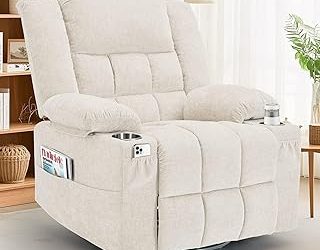
Sweetcrispy Massage Recliner in Beige
Genuinely designed for small rooms, with a compact reclined footprint that won’t strand you in the middle of the floor away from your light source. The beige fabric bounces warm light beautifully and keeps a tight space from feeling closed in.
GarveeHome Power Recliner with Heat and Massage
The tall back and generously padded seat suit larger frames, and powered adjustment lets you fine-tune your angle in single degrees rather than committing to a fixed notch. Its PU leather is on the reflective side, so pair it with a diffused shade rather than a bare bulb.
Massage Recliner Sofa Chair in Ink
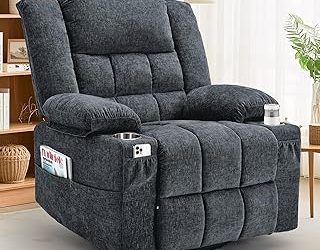
A soft-fabric option with real lumbar shaping and a home-theater-friendly recline, ideal if you want vibration therapy without a clinical look. The deep ink tone absorbs light, so it needs a nearby lamp rather than relying on ambient spill.
LAFWELL Rocking Recliner with Massage and Heat
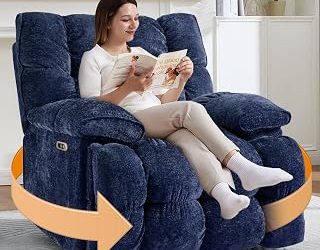
The 360-degree swivel is the underrated feature here — you can rotate toward a lamp, a window, or a conversation without shifting the whole chair. Heat plus gentle rocking is a good combination for muscular low-back tension, though the rocking base offers slightly less rigid support than a fixed frame.
Frequently Asked Questions
Can a recliner actually reduce back pain?
Reclining shifts load off the lumbar discs and onto the backrest, which reduces pressure compared with upright sitting. It helps most with mechanical and postural pain; it will not resolve an underlying condition, so treat it as relief rather than treatment.
Is heat and massage worth having?
For superficial muscle tightness, yes — warmth improves local circulation and the vibration helps you unclench. Neither reaches deep spinal structures, so choose the chair for its support first and treat these as comfort features.
Do I need a power lift model?
Only if standing up is painful or unsteady. If you can rise unaided, spend the money on better lumbar shaping and a wider recline range instead.
How should I light a reclining chair?
Use a side-positioned adjustable lamp, never an overhead downlight — once you recline, a ceiling fixture shines straight into your eyes. Warm bulbs around 2700K and a shade that hides the bulb from reclined sightlines will keep the corner restful.
Final Thoughts
If standing up is the hardest part of your day, the MCombo Power Lift 7040 is the clearest choice — the assisted rise protects your back at the exact moment it’s most vulnerable. For tighter rooms and softer light, the Sweetcrispy in beige is the one I keep specifying, while the GarveeHome Power Recliner suits taller frames that need a longer backrest and precise angle control.