Key takeaways
- Pressure ceiling, not peak numbers: Automotive clear coat and trim are happiest between roughly 1,200 and 1,900 PSI at the surface. Machines advertising 4,000 PSI and up are built for concrete; using one on paint risks lifting edges and forcing water past window seals.
- Flow rate does the rinsing: GPM carries dissolved dirt off the panel. A unit near 1.5–1.8 GPM will sheet water cleanly, which matters because a fast, even sheet leaves fewer drying spots to catch light later.
- Foam cannon quality: Thick, clinging foam buys dwell time so surfactants can release grit before anything touches the paint. A cannon with an adjustable orifice and a decent-sized bottle beats an onboard soap tank that produces watery mist.
- Nozzle range and control: You want a 40-degree fan and a soap tip in daily rotation. Zero-degree pencil jets have no place near a vehicle. More useful than tip count is how quickly you can swap without setting the wand down on gravel.
- Stability, mobility, and reach: A washer that tips mid-pass drags its inlet filter through dirt. Look for a low center of gravity, an anti-tip design, hose length that covers the whole car from one water source, and a handle geometry you can actually steer over a driveway lip.
What's inside
Anyone who works with light for a living learns to distrust a “clean” car. Under flat overcast or a garage’s diffuse ceiling panels, almost any paint job looks acceptable. Roll that same vehicle into low, raking sun or park it under a single hard source, and the truth arrives: a haze of road film scattering light in every direction, dried mineral spots acting like tiny lenses, and the fine spiderweb of swirl marks that a gritty sponge carved into the clear coat. Gloss is not a color, it is a behavior — a surface returning light in one coherent direction — and grit is what destroys that behavior permanently.
That is the real argument for a pressure washer over a bucket. Touchless removal of the abrasive layer is what preserves reflectivity over years of washes. This guide looks at machines suited specifically to automotive work, where the goal is lifting contamination without etching the surface that has to do the reflecting. Below you will find current picks, followed by the specifications that actually matter and the ones that are marketing noise.
As an Amazon Associate we earn from qualifying purchases.




🛒 Best Price Today on Amazon
Prime members get fast, free shipping on everything above, plus member-only deals. New members get a 30-day free trial — cancel anytime.
How to Choose a Pressure Washer for Washing Cars (2026)
- Pressure ceiling, not peak numbers: Automotive clear coat and trim are happiest between roughly 1,200 and 1,900 PSI at the surface. Machines advertising 4,000 PSI and up are built for concrete; using one on paint risks lifting edges and forcing water past window seals.
- Flow rate does the rinsing: GPM carries dissolved dirt off the panel. A unit near 1.5–1.8 GPM will sheet water cleanly, which matters because a fast, even sheet leaves fewer drying spots to catch light later.
- Foam cannon quality: Thick, clinging foam buys dwell time so surfactants can release grit before anything touches the paint. A cannon with an adjustable orifice and a decent-sized bottle beats an onboard soap tank that produces watery mist.
- Nozzle range and control: You want a 40-degree fan and a soap tip in daily rotation. Zero-degree pencil jets have no place near a vehicle. More useful than tip count is how quickly you can swap without setting the wand down on gravel.
- Stability, mobility, and reach: A washer that tips mid-pass drags its inlet filter through dirt. Look for a low center of gravity, an anti-tip design, hose length that covers the whole car from one water source, and a handle geometry you can actually steer over a driveway lip.
The Best Pressure Washers for Washing Cars (2026) Reviewed
4-Nozzle Pressure Washer with Foam Cannon (Bright Green)
A sensible generalist: four quick-connect tips plus a dedicated foam cannon cover the full two-stage wash without upselling accessories later. The bright housing is genuinely practical in a dim garage, since you can see where the unit sits before you trip over it.
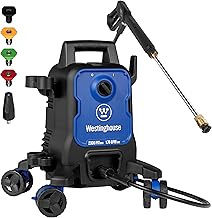
Westinghouse ePX3500
At 2,500 max PSI and 1.76 GPM, this is the strongest of the ePX line and best suited to people who wash trucks, wheel wells, and driveways as often as they wash paint. The pro-style steel wand and anti-tipping base give it a composure that cheap plastic units never quite manage.
Westinghouse ePX3100
The 2,300 PSI version keeps the same 1.76 GPM flow and five-nozzle set, which makes it the sweet spot for automotive work — enough authority for baked-on brake dust, restrained enough for trim and badges. For most car owners this is the one I would point at first.
Westinghouse ePX3100v
Dialed back to 2,100 PSI and paired with a detachable foam cannon, this is the gentlest and most portable of the three Westinghouse units. The built-in carry handle matters more than it sounds if your washing spot is not adjacent to storage.
Cordless Portable Washer, 1450 PSI
Battery power and a 6-in-1 nozzle make this the answer for apartment dwellers, detailers working away from a spigot, or anyone rinsing off a bike and muddy boots. Two 4.0Ah packs mean one charges while the other works, though expect drawn-from-a-bucket flow rather than mains-fed sheeting.
Frequently Asked Questions
What PSI is safe for car paint?
Stay under about 1,900 PSI at the nozzle and keep a foot of distance on a 40-degree fan. Damage almost always comes from close-range narrow tips rather than the rating on the box.
Do I still need to touch the car?
For a maintenance wash, often no. For bonded contamination, follow the foam pass with a clean microfiber mitt and two buckets, never a household sponge.
Are gas models better?
Not for cars. Gas units deliver more pressure than paint wants, plus noise and fumes in a confined space. Electric is the correct tool here.
Why do spots appear after washing?
Hard-water minerals left behind as droplets evaporate. Rinse in shade, sheet the water off with low pressure, and dry with a plush towel before the sun reaches the panels.
Final Thoughts
For most people the Westinghouse ePX3100 hits the right balance of pressure, flow, and stability for automotive use, with the ePX3500 as the pick if driveways and siding are also on your list. If your washing happens away from a tap, the cordless 1450 PSI unit trades power for freedom and still spares your clear coat the abrasion that dulls a finish under real light.