Key takeaways
- Understand the cooling method: Windowless units are evaporative coolers. They pass air over water and ice packs to drop temperature several degrees in your immediate zone, and they do not vent hot air. Compressor units cool harder but always need an exhaust path.
- Audit the light output: Control panels are the second-brightest object in a dark bedroom after your phone. Look for dimmable displays, a sleep mode that cuts the screen, and models where the indicator sits low rather than at pillow height.
- Match finish to reflectance: White cabinets bounce lamplight and disappear against pale walls. Black absorbs it and reads as a deliberate object, which suits darker paint and warmer schemes but shows dust faster.
- Size the tank to your routine: A large reservoir means one fill before bed instead of a 3 a.m. refill. Check tank volume against runtime at the speed you will actually use, not the lowest setting.
- Listen at the lowest setting: Evaporative coolers are fans, so noise is airflow. A unit that is pleasant at speed one and roaring at speed three is fine for sleep and poor for a hot afternoon.
What's inside
Rooms without an operable window are usually the ones that need cooling most. Basement suites, converted attics, garden-level studios, casement-only rentals, and interior bedrooms all trap heat, and every one of them shares the same design problem: there is nowhere to put a vent hose. Anyone who has tried knows the compromise — a corrugated tube snaking across the floor, a foam panel jammed into a frame, and a room whose visual line is broken at exactly eye level. From an ambience standpoint, that hose is as disruptive as a bare bulb hanging in a finished space.
This guide approaches the problem the way a lighting and ambience designer would: cooling is only useful if the unit earns its place in the room. That means looking at nighttime light spill, panel glow, finish reflectance, hose sightlines, and the acoustic floor a machine sets when the house goes quiet. Below are windowless evaporative coolers alongside a few vented units worth considering if you have a door, wall vent, or transom to work with, plus what actually separates them.
As an Amazon Associate we earn from qualifying purchases.


🛒 Best Price Today on Amazon
Prime members get fast, free shipping on everything above, plus member-only deals. New members get a 30-day free trial — cancel anytime.
How to Choose a Portable Air Conditioner Without Window Access (2026)
- Understand the cooling method: Windowless units are evaporative coolers. They pass air over water and ice packs to drop temperature several degrees in your immediate zone, and they do not vent hot air. Compressor units cool harder but always need an exhaust path.
- Audit the light output: Control panels are the second-brightest object in a dark bedroom after your phone. Look for dimmable displays, a sleep mode that cuts the screen, and models where the indicator sits low rather than at pillow height.
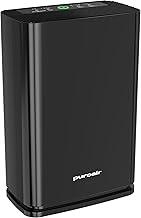
- Match finish to reflectance: White cabinets bounce lamplight and disappear against pale walls. Black absorbs it and reads as a deliberate object, which suits darker paint and warmer schemes but shows dust faster.
- Size the tank to your routine: A large reservoir means one fill before bed instead of a 3 a.m. refill. Check tank volume against runtime at the speed you will actually use, not the lowest setting.
- Listen at the lowest setting: Evaporative coolers are fans, so noise is airflow. A unit that is pleasant at speed one and roaring at speed three is fine for sleep and poor for a hot afternoon.
The Best Portable Air Conditioners Without Window Access (2026) Reviewed
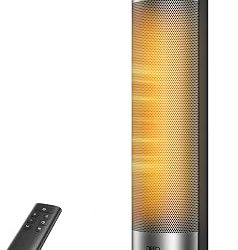
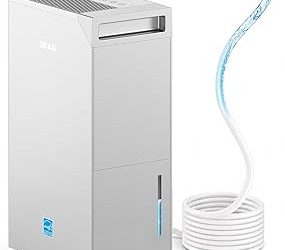
25.3″ Windowless Evaporative Air Cooler, White
The most room-friendly option here: a compact white tower with 90-degree oscillation, four ice packs, and a quiet profile that suits a nightstand-height footprint. Its low, unobtrusive panel and neutral finish let it recede beside a bed frame instead of competing with your lamps.
38.6″ Windowless Evaporative Air Cooler, Black
Taller reach, 120-degree oscillation, a larger tank, and a 12-hour timer make this the better pick for open-plan or awkwardly long rooms where air needs to travel. In black it reads as a slim architectural column, which works well against deep wall colors and moody, layered lighting.
Serantzon 4-in-1 Evaporative Air Cooler
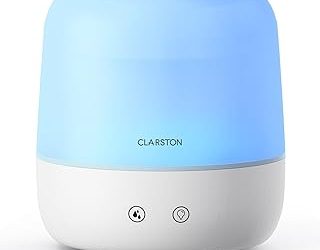
A desktop-scale personal cooler with seven LED colors, three modes, and a 1200ml tank, best understood as an accent piece as much as an appliance. Set the LEDs to a warm tone and it doubles as low-level ambient light for a desk or bedside; leave them off and it is simply a quiet, close-range cooler.
Shinco 12,000 BTU Portable Air Conditioner
If you have any venting route at all — a door transom, wall vent, or sliding panel — this is genuine compressor cooling for rooms up to 450 square feet, with dehumidifier and fan modes. Plan the hose path first and run it along a baseboard rather than across a sightline.
12,000 BTU 3-in-1 Portable AC, 550 Sq. Ft.
Self-evaporating operation means far fewer drain interruptions, and the 550-square-foot rating covers most large bedrooms and home offices. Included window kit and remote make it a straightforward pick when true refrigerant cooling matters more than a hose-free room.
Frequently Asked Questions
Can a portable AC work with no window at all?
An evaporative cooler can, because it has no exhaust. A compressor-based portable AC cannot run unvented indoors without adding heat back into the room, so it needs some opening to work with.
Do evaporative coolers work in humid climates?
Less effectively. They perform best in dry or moderately humid air. In a humid room, expect airflow and mild relief rather than a measurable temperature drop.
Will the LED lights or display keep me awake?
Possibly, if left at full brightness. Use sleep or timer modes to dim the panel, and angle the unit so its display faces away from the bed.
Where should I place a windowless cooler?
Near a doorway or a source of cooler air, with clear intake behind it, and aimed across the bed rather than directly at your head for steadier comfort.
Final Thoughts
For most windowless bedrooms, the 25.3″ white evaporative cooler is the cleanest fit visually and acoustically, while the 38.6″ black tower is the better mover of air in larger or open rooms. If you can find any venting path, the Shinco 12,000 BTU unit delivers the real temperature drop that evaporative designs cannot.