Key takeaways
- Follow the moisture source, not the square footage label: Every home advertises a “basement” and a “bedroom,” but where water actually enters — near a crawlspace vent, behind a north-facing wall, around a laundry hookup — determines your ideal unit position. Walk the house with a hygrometer on a rainy day before committing.
- Account for the stairwell chimney effect: Warm, humid air rises through vertical openings the same way heat escapes a chimney. Placing your dehumidifier at the base of the staircase lets it intercept that upward flow before it reaches upper bedrooms and closets where mold quietly colonizes.
- Match capacity to the enclosed zone, not total home area: A 3,400-square-foot two-story home doesn’t need one massive unit running everywhere. Two properly sized 34-pint units — one per floor — will outperform a single oversized unit dragged between rooms. Zone-specific placement keeps relative humidity below 50 percent consistently.
- Respect condenser heat output: Dehumidifiers exhaust warm air from their rear grille. In a small, poorly ventilated laundry closet or tight pantry alcove, that heat can push temperatures up and reduce the machine’s own efficiency. Leave at least 18 inches of clearance on all exhaust sides and aim the discharge toward a doorway or vent.
- Prioritize near-floor placement for compressor models: Cold air sinks, and so does the densest moisture-laden air. Set your unit on the floor rather than on a shelf or raised platform. The intake grille on most compressor dehumidifiers pulls from the front-bottom, so elevation works against the machine’s own engineering.
What's inside
Most two-story homeowners buy a dehumidifier, place it in the obvious spot — the basement — and then wonder why the upstairs bedrooms still feel clammy by Tuesday. The real issue isn’t the machine; it’s the placement. In a split-level home, humidity migrates upward through stairwells and HVAC returns, meaning a single-unit strategy only works if you think about airflow paths the way you’d think about directing light through a room.
This guide breaks down exactly where a dehumidifier earns its keep in a two-story house, from ground-level moisture sources to upper-floor condensation traps. We tested and compared six compressor models ranging from budget-friendly to energy-star certified, then mapped their real-world performance against the unique airflow dynamics of multi-level homes. Below you’ll find our curated picks followed by a placement framework you can adapt to your own floor plan.
As an Amazon Associate we earn from qualifying purchases.




🛒 Best Price Today on Amazon
Prime members get fast, free shipping on everything above, plus member-only deals. New members get a 30-day free trial — cancel anytime.
How to Choose a Place To Put Dehumidifier In a 2 Story House (2026)
- Follow the moisture source, not the square footage label: Every home advertises a “basement” and a “bedroom,” but where water actually enters — near a crawlspace vent, behind a north-facing wall, around a laundry hookup — determines your ideal unit position. Walk the house with a hygrometer on a rainy day before committing.
- Account for the stairwell chimney effect: Warm, humid air rises through vertical openings the same way heat escapes a chimney. Placing your dehumidifier at the base of the staircase lets it intercept that upward flow before it reaches upper bedrooms and closets where mold quietly colonizes.
- Match capacity to the enclosed zone, not total home area: A 3,400-square-foot two-story home doesn’t need one massive unit running everywhere. Two properly sized 34-pint units — one per floor — will outperform a single oversized unit dragged between rooms. Zone-specific placement keeps relative humidity below 50 percent consistently.
- Respect condenser heat output: Dehumidifiers exhaust warm air from their rear grille. In a small, poorly ventilated laundry closet or tight pantry alcove, that heat can push temperatures up and reduce the machine’s own efficiency. Leave at least 18 inches of clearance on all exhaust sides and aim the discharge toward a doorway or vent.
- Prioritize near-floor placement for compressor models: Cold air sinks, and so does the densest moisture-laden air. Set your unit on the floor rather than on a shelf or raised platform. The intake grille on most compressor dehumidifiers pulls from the front-bottom, so elevation works against the machine’s own engineering.
The Best Place To Put Dehumidifier In a 2 Story House (2026) Reviewed
4500 Sq.Ft Dehumidifier by Quilt Compressor
This high-capacity compressor unit shines when stationed in a large basement or open ground-level area where moisture enters most aggressively. Its intelligent humidity control adjusts fan speed dynamically, making it ideal for a single-floor anchor point that feeds dry air upward through the home’s central return. If your basement doubles as a living space, this is the one to run continuously.
KNKA 34-Pint Dehumidifier
The KNKA hits a sweet spot for upstairs bedrooms and bathrooms where noise matters. Its three operating modes let you switch between aggressive drying and a whisper-quiet overnight cycle, and the 24-hour timer means you can run it on a schedule that matches your household rhythm. Place it near the bathroom door or bedroom closet — exactly where condensation collects unseen.
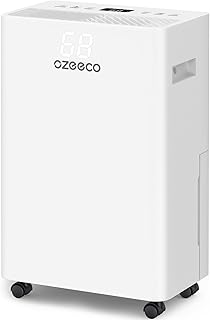
Ozeeco 34-Pint Dehumidifier with Ionizer
Where this unit separates itself is the built-in ionizer and child lock, making it a smart choice for a nursery or kids’ bedroom on the second floor. The ultra-quiet compressor won’t disrupt sleep, and the ionizer helps pull fine particulates from the air alongside moisture. It’s a dual-purpose solution for families who want cleaner air without adding another gadget.
Waykar 34-Pint Energy Star Dehumidifier
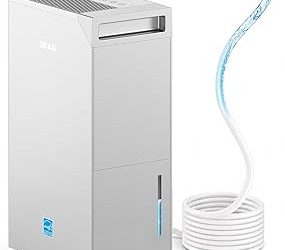
Energy Star certification matters when a unit runs 10 or more hours a day, and the Waykar’s automatic defrost feature keeps it performing through cooler basement temperatures where lesser compressors cycle off. Its generous 0.66-gallon tank also means fewer drain hose installations — set it near a floor drain in the basement and forget it for days.
34-Pint 2500 Sq.Ft Compressor Dehumidifier
This straightforward, no-frills compressor model excels in garages, workshops, and unfinished lower levels where you need reliable moisture extraction without paying for features you won’t use. Its simple drain hose hookup makes permanent installation easy in utility spaces. Position it near the garage entry or workshop bench where temperature swings cause the most condensation.
Frequently Asked Questions
Should I put my dehumidifier upstairs or downstairs?
Start downstairs, near the primary moisture source. In most two-story homes, that means the basement or crawl space. Dry air naturally rises through stairwells and HVAC ducts, giving your ground-floor unit a head start on reducing humidity across both levels. If upper floors still read above 50 percent relative humidity after 48 hours, add a second smaller unit upstairs.
Can one dehumidifier handle a whole two-story house?
It depends on the unit’s pint rating and your home’s square footage, but realistically, a single dehumidifier struggles to cover more than about 2,000 to 2,500 square feet of conditioned space. Two-story homes with 1,500-plus square feet on each floor almost always benefit from two strategically placed units rather than one oversized machine running at maximum capacity.
Where exactly in the basement should I place it?
Position the unit close to the moisture source — near a known leaky wall, the sump pump, or a floor drain — and ensure the exhaust air points toward an open doorway or stairwell. Keep it at least 12 inches from walls on the intake side and avoid tucking it behind stored boxes or furniture that block airflow.
Do I need to empty the water tank if I use a drain hose?
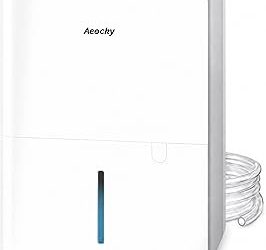
No. When connected to a continuous drain hose that routes to a floor drain or exterior outlet, the tank becomes a backup reservoir that only fills if the hose kinks or the drain backs up. Most of the models listed above include the hose in the box — just verify the fitting size matches your drain point before installation.
Final Thoughts
For most two-story homes, the Waykar Energy Star model offers the best balance of efficiency and low-maintenance operation in a basement anchor role, while the KNKA or Ozeeco handles upper-floor duty where quiet performance and scheduled cycling matter most. Pair those two and you’ll cover the full vertical footprint of your home without overworking a single unit. Start with a hygrometer reading on each floor, place deliberately, and let the machines do what they were built for.