Key takeaways
- Light transmission: Aim for a canopy that passes roughly a third of midday sun. Fine-leaved and twining vines hover in that range naturally; broad-leaved self-clingers like ivy trend toward full blackout, so plan on training them over half the rafters rather than all of them.
- Shadow character: Leaf size dictates shadow edge. Small, divided foliage throws a soft, restless lace across a tabletop, while large simple leaves cast hard-edged dark blocks. Decide which you want on your dining surface before you buy, because you cannot retrofit it.
- Bloom color under lamplight: Warm 2200K bulbs drain blues and lavenders toward grey and push reds and oranges forward. If you want blue or purple flowers to register after dark, budget for 3000K sources or a cool moonlighting downlight in the beam above them.
- Fixture access as it fills in: Fast, heavy growers swallow junction boxes and make lamp changes a pruning job. Mount fixtures on the outer face of posts and beams, and leave one bay deliberately open as your service corridor.
- Seasonal swing: Deciduous vines hand back winter sun and expose the structure’s silhouette, which is a gift if you have grazing uplights. Evergreens hold their screen year-round but keep the space dim in the months you need brightness most.
What's inside
Most pergola vine advice stops at flowers and hardiness zones, which leaves out the thing you actually live with every day: light. A vine is a light filter you grow. Choose one that knits into a solid mat and your pergola becomes a dim cave by three in the afternoon, with every fixture you carefully aimed now buried in leaf litter. Choose one too thin and open and you get glare at four o’clock, hot seats, and string lights that read as bare bulbs against a blank sky instead of glowing points held inside a canopy.
This guide reads pergola vines the way a lighting designer reads a diffusion sample: how much daylight passes through, what shape the shadows take on the table, how bloom color behaves under warm lamps at night, and how the canopy changes between June and January. Below are six climbers worth planting in 2026, plus the selection criteria I use before anything goes in the ground.
As an Amazon Associate we earn from qualifying purchases.




🛒 Best Price Today on Amazon
Prime members get fast, free shipping on everything above, plus member-only deals. New members get a 30-day free trial — cancel anytime.
How to Choose a Pergola Vines (2026)
- Light transmission: Aim for a canopy that passes roughly a third of midday sun. Fine-leaved and twining vines hover in that range naturally; broad-leaved self-clingers like ivy trend toward full blackout, so plan on training them over half the rafters rather than all of them.
- Shadow character: Leaf size dictates shadow edge. Small, divided foliage throws a soft, restless lace across a tabletop, while large simple leaves cast hard-edged dark blocks. Decide which you want on your dining surface before you buy, because you cannot retrofit it.
- Bloom color under lamplight: Warm 2200K bulbs drain blues and lavenders toward grey and push reds and oranges forward. If you want blue or purple flowers to register after dark, budget for 3000K sources or a cool moonlighting downlight in the beam above them.
- Fixture access as it fills in: Fast, heavy growers swallow junction boxes and make lamp changes a pruning job. Mount fixtures on the outer face of posts and beams, and leave one bay deliberately open as your service corridor.
- Seasonal swing: Deciduous vines hand back winter sun and expose the structure’s silhouette, which is a gift if you have grazing uplights. Evergreens hold their screen year-round but keep the space dim in the months you need brightness most.
The Best Pergola Vines (2026)s Reviewed
Thunbergia Grandiflora Blue Trumpet Vine, Pack of 2
Sky Vine climbs fast and layers into a medium-density screen that softens afternoon sun without killing it, and the trumpet blooms hang below the foliage where light can actually reach them. Skip amber bulbs here; a neutral 3000K wash keeps that cornflower blue from going ashen at night.
Boston Ivy Vine Seeds, 50 Seeds
This is your blackout drape, not your diffusion: the overlapping palmate leaves stack into near-total shade and cling directly to masonry and posts. Run it up piers and along one edge of the roof rather than the whole span, and save a pair of uplights for the autumn color, which reads spectacularly against warm light.
2 Purple Wisteria Trees, Amethyst, 2.5″ Pot
Nothing else gives you pendant racemes hanging through the rafters like a naturally grown chandelier, and the effect doubles when you backlight or uplight them so the petals glow rather than sit in shadow. Give it serious structure, because a mature wisteria is a load, not a decoration.
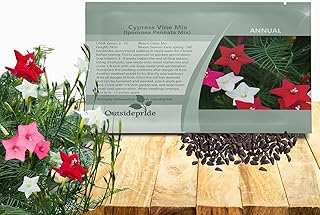
Outsidepride Mixed Cypress Vine Seeds, 100 Seeds
The finest dappling on this list, thanks to threadlike foliage that breaks sun into a shifting lace instead of solid shade. It stays translucent enough that string lights remain visible as distinct points inside the canopy, which is exactly the effect most people are chasing.
Wisteria Seeds, 20 Heirloom Non-GMO Seeds
The economical route to a wisteria canopy, with the honest caveat that seed-grown plants often take several years longer to flower than rooted stock. Worth it if you are designing the pergola’s mature state for the early 2030s rather than next summer.
Frequently Asked Questions
Will a vine ruin the lighting I already installed?
Only if it grows over the fixtures. Foliage above your light sources actually helps by giving the beams something to graze and catch; the failure mode is planting a dense climber directly across a downlight.
What bulb color temperature works best under a green canopy?
2700K to 3000K. Anything warmer turns green leaves a muddy olive and erases cool-toned blooms entirely.
How long before I get real shade and a real night effect?
Annual seed vines like cypress vine deliver in a single season. Woody perennials such as wisteria and Boston ivy typically need two to four years for meaningful coverage.
Can I safely run string lights through the vine itself?
Attach cabling to the timber, never to the plant. Growth and wind will chafe the insulation, and you will want the wiring reachable when you prune.
Final Thoughts
For most pergolas, the Thunbergia Sky Vine hits the sweet spot between shade and light transmission, and the Outsidepride Cypress Vine is the one I reach for when dappled shadow and visible string lights are the goal. If you want that overhead chandelier effect and can build for the weight, the Amethyst Wisteria trees are worth the wait.