Key takeaways
- Recline range, honestly assessed: 90–115° is a lean; 90–135° is a genuine second posture. Anything past about 125° puts your eyes well off the monitor axis, so plan for a headrest and a lamp you can re-aim, or treat deep recline as reading-and-thinking mode rather than screen time.
- Infinite lock over fixed stops: Preset detents rarely land where your spine wants to be. An infinite or multi-gear lock lets you park at the exact angle where the ceiling fixture stays out of your upper field of view — usually a few degrees shy of where you’d guess.
- Headrest that moves in two planes: Height alone isn’t enough. Tilt matters more when reclined, because it sets whether your chin drops and your eyes look down through your lashes at a bright screen. Look for adjustable pitch, not just a padded block.
- Surface finish and reflectance: Glossy PU throws a specular highlight straight back at you when a window sits behind your shoulder. Matte leather, velvet, and open mesh scatter light instead, which keeps contrast in the room gentler and your pupils steadier.
- Footrest and armrest geometry: A footrest changes weight distribution enough to make deep recline sustainable. Flip-up or lay-flat arms matter if you cross your legs or share the seat with a cat — and they let you pull closer to a task lamp without the arms fouling the desk edge.
What's inside
Anyone who designs light for a living learns the same lesson twice: a room only works when the body in it can settle. Most home offices are lit for one posture — upright, eyes level with a monitor, lamp over the left shoulder. The moment you lean back to think, that carefully aimed pool of light lands on your collarbone, the ceiling fixture drops into your peripheral vision, and the screen becomes a bright rectangle floating in a dim field. So you sit forward again, shoulders creeping up, and blame the chair for being uncomfortable when the real problem is that reclining broke the lighting.
A reclining chair is a lighting decision as much as an ergonomic one. Change your seat back angle and you change your sightlines, your glare geometry, and how much of the room’s ambient wash reaches your work surface. This guide looks at reclining office chairs through that lens — recline range and how far it takes your eyes off-axis, headrest travel that keeps your gaze aligned in a laid-back position, upholstery sheen and how it handles a window at four in the afternoon, and whether a lock lets you hold a second posture long enough to actually use it. Below are the models worth your attention this year, plus what to check before you commit.
As an Amazon Associate we earn from qualifying purchases.


How to Choose an Office Chair That Reclines (2026)
- Recline range, honestly assessed: 90–115° is a lean; 90–135° is a genuine second posture. Anything past about 125° puts your eyes well off the monitor axis, so plan for a headrest and a lamp you can re-aim, or treat deep recline as reading-and-thinking mode rather than screen time.
- Infinite lock over fixed stops: Preset detents rarely land where your spine wants to be. An infinite or multi-gear lock lets you park at the exact angle where the ceiling fixture stays out of your upper field of view — usually a few degrees shy of where you’d guess.
- Headrest that moves in two planes: Height alone isn’t enough. Tilt matters more when reclined, because it sets whether your chin drops and your eyes look down through your lashes at a bright screen. Look for adjustable pitch, not just a padded block.
- Surface finish and reflectance: Glossy PU throws a specular highlight straight back at you when a window sits behind your shoulder. Matte leather, velvet, and open mesh scatter light instead, which keeps contrast in the room gentler and your pupils steadier.
- Footrest and armrest geometry: A footrest changes weight distribution enough to make deep recline sustainable. Flip-up or lay-flat arms matter if you cross your legs or share the seat with a cat — and they let you pull closer to a task lamp without the arms fouling the desk edge.
The Best Office Chairs That Recline (2026) Reviewed
CYKOV Ergonomic Office Chair
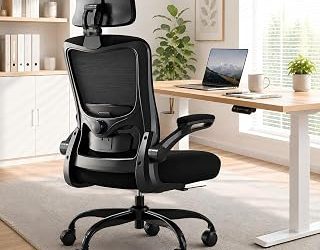
The most adjustable option here, and the one that solves the sightline problem properly: a 4-way headrest with 4.72 inches of travel and 60° of tilt means you can hold your gaze level at 130° of recline instead of craning. Breathable mesh scatters ambient light rather than bouncing it, which makes it the easiest choice for a room with an unavoidable window.
amseatec Big and Tall Office Chair with Footrest
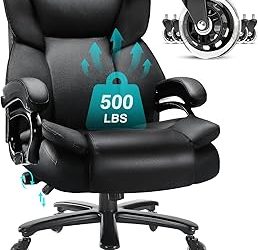
The infinite lock across 90–135° is the standout feature — you can dial in one angle for focused screen work and another for reading, then return to either without hunting. Twenty spring packs and a 300 lb capacity make it feel substantial, and the matte black leather stays visually quiet under warm evening light.
LukkDys Executive Office Chair
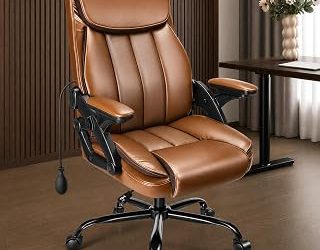
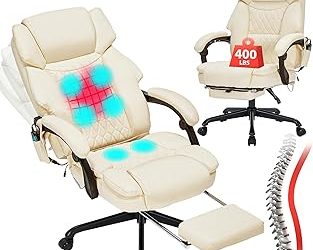
Built for larger frames at 400 lb capacity, with 5-gear lay-flat armrests that swing all the way to 180° for cross-legged sitting. Recline is a conservative 90–115°, so your eyes stay near the monitor axis throughout — a sensible pick if you’d rather not rethink your lamp placement at all.
Big and Tall Flip-Armrest Chair in Crystal Velvet
The velvet is the reason to choose this one: it absorbs and diffuses light in a way leather simply can’t, softening the whole visual field around your desk. Flip armrests and a wide seat accommodate pets and folded legs, and the integrated footrest supports longer reclined stretches.
Ylzyxal Office Desk Chair
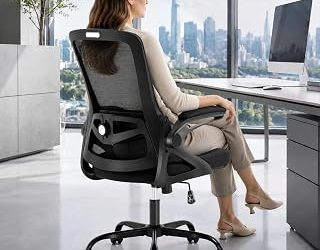
A lean, sensibly priced option with padded flip-up arms, adjustable lumbar support, and a tilt lock that holds a modest recline securely. Best suited to smaller rooms where a lower-profile back keeps the chair from casting a shadow across the wall behind it.
Frequently Asked Questions
How much recline do I actually need?
For screen work, 110–120° covers most people. Reserve 130–135° for reading or thinking, and pair it with a headrest and a repositionable lamp — otherwise your overhead fixture ends up shining directly into your eyes.
Does a footrest really matter?
Yes, once you pass roughly 120°. Without one your legs slide forward and your lower back takes the load, so you unconsciously sit up again within minutes.
Mesh or upholstery for a bright room?
Mesh, generally. It stays cooler and its open weave diffuses light instead of producing hotspots. Velvet is the next-best diffuser; glossy PU is the most reflective.
Will a tall headrest block my lighting?
It can cast a shadow if your primary light source sits directly behind the chair. Move the lamp to a 45° front-side position and the problem disappears — the mesh-backed Ergonomic High Back model with headrest and 90–120° tilt lock is a good compromise if you’re short on wall space.
Final Thoughts
If you want the widest range of adjustment and the best behaviour in a bright room, the CYKOV is the one to beat. The amseatec earns its place on the strength of that infinite lock, which is genuinely the most useful feature on any chair here, and the LukkDys is the obvious answer for larger frames who want lay-flat arms without rearranging their lighting.