Key takeaways
- Surface sheen: Run your hand-held phone flashlight across a sample photo if you can. A matte or lightly textured face diffuses light into a soft wash; high-gloss PVC produces a mirror hotspot that will find your eyes eventually. Matte is almost always the safer choice near a window.
- Tone and value: Dark mats absorb light and read as a grounding anchor, which suits bright rooms with pale floors. Clear mats let the existing floor tone come through, preserving whatever warmth the wood already gives you. Mid-grey is the diplomatic middle.
- Coverage geometry: Measure your chair’s full roll radius, not just the desk footprint. A mat that stops short creates a hard edge line across the floor, and hard edges catch raking light in a way that draws the eye downward.
- Grip and lay-flat behavior: Curled corners are a lighting problem as much as a trip hazard — a lifted edge catches light differently from the flat field and reads as a defect. Look for mats that ship flat or relax quickly, with a genuinely non-slip backing.
- Cleanability: Dust and scuff haze scatter light unpredictably and dull a floor’s finish. A wipeable, waterproof face keeps the reflectance consistent over months, which matters more than the day-one appearance.
What's inside
Most people shop for a chair mat the way they shop for a furnace filter — functional, invisible, done. Then it arrives, unrolls, and suddenly there’s a bright rectangle of reflected window sitting under the desk like a puddle. As someone who spends their working life managing how surfaces receive and return light, I can tell you that the floor is the most underestimated reflector in any room. A four-foot slab of glossy PVC positioned directly beneath the brightest zone of a workspace will bounce daylight up into your eyeline, throw a second highlight onto your monitor bezel, and flatten the shadow gradients that make a room feel settled rather than clinical.
This guide looks at chair mats through that lens. Protection from caster wear is the baseline — every option here handles that. What separates them is sheen, tone, translucency, and how each one behaves under a north window at 9am versus a warm 2700K desk lamp at 9pm. I’ve grouped the picks by the visual job they do, so you can match a mat to your light rather than fighting it afterward.
As an Amazon Associate we earn from qualifying purchases.


🛒 Best Price Today on Amazon
Prime members get fast, free shipping on everything above, plus member-only deals. New members get a 30-day free trial — cancel anytime.
How to Choose an Office Chair Floor Mat (2026)
- Surface sheen: Run your hand-held phone flashlight across a sample photo if you can. A matte or lightly textured face diffuses light into a soft wash; high-gloss PVC produces a mirror hotspot that will find your eyes eventually. Matte is almost always the safer choice near a window.
- Tone and value: Dark mats absorb light and read as a grounding anchor, which suits bright rooms with pale floors. Clear mats let the existing floor tone come through, preserving whatever warmth the wood already gives you. Mid-grey is the diplomatic middle.
- Coverage geometry: Measure your chair’s full roll radius, not just the desk footprint. A mat that stops short creates a hard edge line across the floor, and hard edges catch raking light in a way that draws the eye downward.
- Grip and lay-flat behavior: Curled corners are a lighting problem as much as a trip hazard — a lifted edge catches light differently from the flat field and reads as a defect. Look for mats that ship flat or relax quickly, with a genuinely non-slip backing.
- Cleanability: Dust and scuff haze scatter light unpredictably and dull a floor’s finish. A wipeable, waterproof face keeps the reflectance consistent over months, which matters more than the day-one appearance.
The Best Office Chair Floor Mats (2026) Reviewed
Baroyal Hard Floor Protector 36″ x 48″ (Espresso)
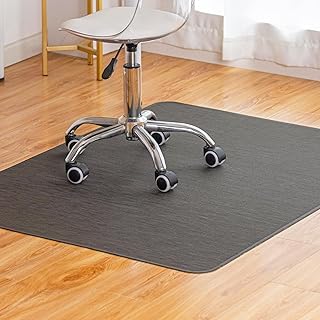
The espresso tone does something clever: it reads as a deliberate dark rug rather than a plastic overlay, absorbing stray daylight instead of returning it upward. Heavy-duty PVC with a low-sheen face makes this my default recommendation for rooms with pale oak or light tile, where a clear mat would only amplify an already bright floor.
Hardwood Floor Chair Mat, Black 36″ x 48″
Black is the most forgiving value in a workspace because it kills reflection outright and lets your lamp pools define the room’s shape. The non-pilling face holds its matte character rather than developing a shiny wear path where the casters travel most, which is the usual failure point on budget mats.
Blvornl Rattan Woven Pattern Mat, 36″ x 48″ (Dark Grey)
The woven texture is the standout feature here — micro-relief breaks up incoming light into a soft, even diffusion instead of a single specular sheet. In a room with a warm overhead fixture, that texture picks up gentle shadow detail and reads far more like a natural fiber rug than PVC has any right to.
Blvornl Ultra Large Chair Mat, 47.2″ x 60″ (Black)
If your chair actually roams, this is the coverage to buy, and the larger field lets the dark surface function as a proper visual base for the whole desk zone. The scale change matters: a big matte rectangle grounds a workspace, whereas a small one just looks like a patch.
Kuyal Clear Chair Mat, 36″ x 48″
The right pick when the floor itself is the feature — walnut, wide-plank, anything with grain worth seeing. Just be honest about placement, because transparent PVC under direct daylight will produce a bright reflected panel; set it back from the window or pair it with a diffusing shade and it disappears completely.
Frequently Asked Questions
Will a clear mat make my floor look shiny?
It can. Transparent PVC adds its own specular layer on top of whatever finish is underneath, so a satin floor may suddenly read as semi-gloss. In dimmer rooms this is negligible; in a sun-facing office it’s noticeable.
Do dark mats make a small office feel smaller?
Not if your lighting is layered. A dark floor plane with a warm task lamp and one wall-washing source creates depth. Problems arise only when a dark mat sits in a room lit by a single ceiling fixture, which flattens everything.
Are studs or spikes needed for hard floors?
No — spiked backings are designed to grip carpet pile and can mark or scratch wood and tile. Every mat here uses a smooth non-slip backing appropriate for hard surfaces.
How do I flatten a mat that arrives curled?
Unroll it face-up in a warm, well-lit room for a day and weight the corners with books. Warmth relaxes PVC faster than pressure alone, and a flat mat holds an even reflectance across its whole surface.
Final Thoughts
For most rooms, the Blvornl rattan-pattern mat is the best balance of protection and visual restraint — that texture solves glare before it starts. Choose the Baroyal espresso if your floor is light and you want a grounding anchor, or the Blvornl Ultra Large in black when coverage and a calm, non-reflective base matter more than blending in.