Key takeaways
- Surface reflectance: Think in light reflectance value. White laminate returns roughly 75–85% of what hits it, which brightens a dark room but also throws uplight onto your face and screen. Mid-tone woods like maple sit near 45–55%, the most forgiving range for mixed daylight and lamp light.
- Sheen, not just color: Matte and low-sheen finishes diffuse a fixture into a soft bloom; semi-gloss and glass reflect it as a discrete bright shape. If you have a bare bulb, an exposed LED panel, or a large window in the desk’s line of sight, choose matte and save yourself the daily repositioning.
- Undertone versus your bulbs: Warm-brown and vintage finishes sing under 2700K–3000K and go muddy under cool white. Maple, grey, and white are undertone-neutral and hold their character from 2700K all the way to 5000K, making them the safer pick if your ceiling light isn’t negotiable.
- Frame color as a drawn line: At standing height the legs are lit from above and read as vertical strokes. Black frames create high-contrast shadow lines that sharpen a room; white frames dissolve into pale walls and make the desktop appear to float. Match the frame to your wall, not to your desktop.
- Room for layered light: Look for a clean underside, grommets or a cable tray, and enough desktop depth (28 inches or more) to place a bias light behind your monitor. A desk that hides its own wiring lets you add the low, warm accent layer that makes an office look designed rather than merely equipped.
What's inside
Most standing desks are bought from a photograph taken in a studio: even diffusion, no windows, no ceiling fixture throwing a hotspot across the surface. Then the desk arrives, you set it under a single overhead lamp beside a west-facing window, and the finish you fell for behaves like a different material entirely. Gloss turns into a mirror at 4 p.m. A white top bounces so much light it washes out your monitor’s shadow detail. Walnut that read rich and warm online goes flat and grey under 4000K bulbs. The desk didn’t change — the light did.
This guide ranks the best-looking standing desks of 2026 the way a lighting designer would evaluate them: by how the surface handles reflectance, how the finish scatters or specularly reflects your fixtures, how the tone reacts to warm versus neutral bulbs, and how the frame reads as a shadow line in the room. Below you’ll find the picks, a selection framework built around light behavior rather than trend colors, and answers to the questions that actually determine whether a desk looks good in your space at night.
As an Amazon Associate we earn from qualifying purchases.


How to Choose a Good-Looking Standing Desk in 2026
- Surface reflectance: Think in light reflectance value. White laminate returns roughly 75–85% of what hits it, which brightens a dark room but also throws uplight onto your face and screen. Mid-tone woods like maple sit near 45–55%, the most forgiving range for mixed daylight and lamp light.
- Sheen, not just color: Matte and low-sheen finishes diffuse a fixture into a soft bloom; semi-gloss and glass reflect it as a discrete bright shape. If you have a bare bulb, an exposed LED panel, or a large window in the desk’s line of sight, choose matte and save yourself the daily repositioning.
- Undertone versus your bulbs: Warm-brown and vintage finishes sing under 2700K–3000K and go muddy under cool white. Maple, grey, and white are undertone-neutral and hold their character from 2700K all the way to 5000K, making them the safer pick if your ceiling light isn’t negotiable.
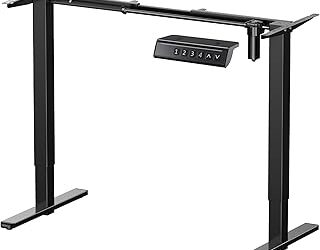
- Frame color as a drawn line: At standing height the legs are lit from above and read as vertical strokes. Black frames create high-contrast shadow lines that sharpen a room; white frames dissolve into pale walls and make the desktop appear to float. Match the frame to your wall, not to your desktop.
- Room for layered light: Look for a clean underside, grommets or a cable tray, and enough desktop depth (28 inches or more) to place a bias light behind your monitor. A desk that hides its own wiring lets you add the low, warm accent layer that makes an office look designed rather than merely equipped.
The Best Looking Standing Desks Reviewed (2026)
Vari Classic Electric — 72×30, Walnut/Slate
The walnut top has genuine depth of tone, absorbing warm light in a way that reads expensive under 2700K lamps, and the slate frame gives you a crisp shadow line against light walls. At 72 by 30 inches it’s the pick if you want the desk to anchor the room’s lighting composition rather than sit inside it.
Marsail Glass Standing Desk with Drawer
Glass is the most sophisticated surface here and the most demanding: it reflects fixtures specularly, so it looks stunning with indirect or cove lighting and unruly under a bare overhead. The integrated drawer and USB ports keep clutter off the top, which matters twice as much on a surface that mirrors everything you leave on it.
ErGear 55×28 Electric — Vintage Brown
The vintage brown finish is low-sheen and slightly textured, so it scatters lamp light into a soft glow with almost no glare, and the 28-inch depth leaves room for a bias light behind a monitor. Best-value choice for a warm, evening-friendly office.
FEZIBO 48×24 Electric — Maple
Maple is the most color-neutral top in this roundup, holding its tone from warm to daylight bulbs without shifting green or grey — useful if you photograph, edit, or take calls at this desk. The compact 48 by 24 footprint suits smaller rooms where a dark top would visually shrink the space.
Veken 55 Inch Large Electric Standing Desk — White
High reflectance makes this the desk for windowless or north-facing rooms, effectively acting as a second bounce surface for your existing lamps. Pair it with a dimmable task light rather than a bright overhead, since white laminate under strong downlight can wash out screen contrast.
Frequently Asked Questions
What desktop color looks best in a dim room?
A light, matte surface — white or maple. High reflectance recycles the little light you have, raising perceived brightness without adding a fixture. Reserve dark walnut for rooms with good daylight or layered lamps.
Do glass desktops cause glare on video calls?
They can. Glass reflects light sources as sharp shapes, which may appear as a bright band under your chin on camera. Position your key light slightly above and to the side, never directly overhead, and the reflection drops out of frame.
Warm or neutral bulbs over a wood desk?
Warm brown and walnut finishes look richest at 2700K–3000K with a CRI of 90 or above, which preserves the grain’s red undertones. Neutral 4000K light flattens warm woods and tends to grey them out.
Does a white desk make a small office look bigger?
Yes, mainly by reducing contrast between the desk and pale walls, so the eye reads fewer visual edges. Pair it with a white frame to strengthen the effect.
Final Thoughts
If you want a desk that photographs and lives beautifully, the Vari Classic in walnut and slate is the strongest overall composition under warm light. The Marsail glass model is the design statement for rooms with indirect or cove lighting, while the ErGear in vintage brown delivers the same glare-free warmth for considerably less.