Key takeaways
- Fence quality over motor spec: Nearly every saw here draws 15 amps, so power is not the differentiator. A rack-and-pinion fence that locks parallel every single time is what lets you rip six identical valance rails; a stamped fence that racks under hand pressure will cost you material on every setup.
- Rip capacity you will actually use: If you plan to break down full sheets for diffuser boxes or wall panels, look for 30 inches or more to the right of the blade. If your work is trim, lamp bases, and narrow stock, a 24-inch capacity saves space and money without limiting you.
- Depth of cut at 45 degrees: Mitered light boxes and beveled reveals need the blade to still bite through stock when tilted. Check the 45-degree figure, not just the 90-degree one, since it typically drops by nearly an inch.
- Stand, mobility, and setup time: A rolling or folding stand is the difference between a saw you use and a saw you leave buried under drop cloths. If the machine has to be lifted onto a bench each session, you will reach for a circular saw instead.
- Dust behavior around finished work: Fine sawdust settles on lenses, diffusers, and freshly finished surfaces, and it dulls light output fast. A shrouded blade and a functional 2.5-inch port keep airborne dust out of the parts you have already built.
What's inside
Lighting work lives or dies on millimeters. A cove valance that sits a quarter inch proud of the wall throws a hard scallop instead of a soft wash. A diffuser panel cut with a wandering edge lets a hot line of LED bleed through the seam. When I build light — plywood coves, poplar sconce backers, walnut lamp plinths, birch baffles for a linear fixture — the saw doing the ripping determines whether the finished glow reads as intentional or as a mistake someone tried to caulk over. Most people arriving at a first table saw purchase are not chasing cabinet-shop tolerances. They want a machine that will rip a straight, repeatable edge in sheet goods and hardwood without eating a month of budget.
That is a harder ask than it sounds. Under a thousand dollars, the compromises show up in the fence, the trunnions, and the sheet-metal flex you feel the first time you push a full sheet of 3/4 ply across the table. This guide walks through what actually matters at this price, then reviews five saws I would trust to cut fixture parts, trim stock, and furniture components in a garage or a shared basement shop.
As an Amazon Associate we earn from qualifying purchases.



🛒 Best Price Today on Amazon
Prime members get fast, free shipping on everything above, plus member-only deals. New members get a 30-day free trial — cancel anytime.
How to Choose a/an Inexpensive Table Saw (2026)
- Fence quality over motor spec: Nearly every saw here draws 15 amps, so power is not the differentiator. A rack-and-pinion fence that locks parallel every single time is what lets you rip six identical valance rails; a stamped fence that racks under hand pressure will cost you material on every setup.
- Rip capacity you will actually use: If you plan to break down full sheets for diffuser boxes or wall panels, look for 30 inches or more to the right of the blade. If your work is trim, lamp bases, and narrow stock, a 24-inch capacity saves space and money without limiting you.
- Depth of cut at 45 degrees: Mitered light boxes and beveled reveals need the blade to still bite through stock when tilted. Check the 45-degree figure, not just the 90-degree one, since it typically drops by nearly an inch.
- Stand, mobility, and setup time: A rolling or folding stand is the difference between a saw you use and a saw you leave buried under drop cloths. If the machine has to be lifted onto a bench each session, you will reach for a circular saw instead.
- Dust behavior around finished work: Fine sawdust settles on lenses, diffusers, and freshly finished surfaces, and it dulls light output fast. A shrouded blade and a functional 2.5-inch port keep airborne dust out of the parts you have already built.
The Best Inexpensive Table Saw (2026)s Reviewed
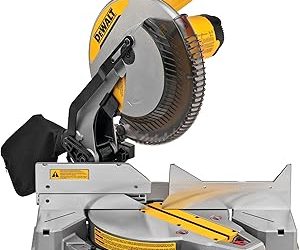
DEWALT DWE7491RS
The rack-and-pinion fence on this one tracks parallel with a consistency I have not found elsewhere near this price, which matters enormously when you are cutting a run of matched cove pieces that all have to meet at the same reveal. The 32-1/2-inch rip capacity handles sheet goods for panel and baffle work, and the rolling stand deploys in seconds.
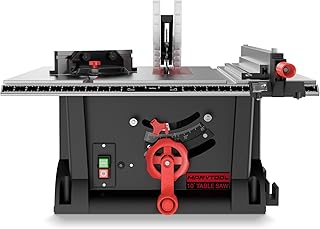
Compact 15A Portable Table Saw with 36T Blade
A sensible benchtop choice if your projects are lamp bodies, small light boxes, and trim rather than full sheets — it crosscuts at 90 degrees and bevels through the 0 to 45 range with enough accuracy for joinery you intend to show. Expect to add a zero-clearance insert and a better blade before you cut anything with veneer.
DOVAMAN DTS10A
The copper motor pulls through hardwood plinth stock without the bogging you sometimes feel in this bracket, and the single-side table extension gives you breathing room when a workpiece starts to overhang. Its 2.48-inch depth at 45 degrees is the number to check against your mitered-box plans.
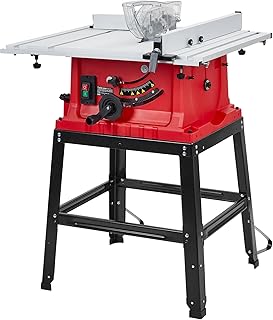
10-Inch Jobsite Table Saw with Stand, 5000 RPM
Straightforward and well equipped for a first saw, with an angle stop and push stick included and depth capacity up to roughly 3-11/32 inches at 90 degrees. It rewards a careful initial alignment session; spend an hour squaring the blade and fence and it holds settings acceptably.
SKIL TS6307-00
SKIL’s folding stand is genuinely quick to set up and stable once locked, and the saw’s ergonomics suit shorter, frequent sessions — exactly how fixture parts tend to get built. Cut quality is clean and predictable in plywood and softwood, which is most of what a lighting build consumes.
Frequently Asked Questions
Can I cut acrylic or polycarbonate diffuser sheet on these saws?
Yes, with a blade intended for plastics and a slow, steady feed. Standard framing blades will chip and melt the edge, which then scatters light unevenly along the seam.
Do I need to replace the included blade?
For visible joinery, yes. A 40- to 60-tooth combination blade dramatically reduces tearout on plywood faces and hardwood edges, and it is the single cheapest upgrade you can make.
Is a portable saw accurate enough for furniture-grade work?
With a tuned fence, a good blade, and shop-made sleds or featherboards, it is. The limitation is capacity and vibration during long rips, not fundamental precision.
How much dust collection do these actually manage?
A shop vacuum on the port captures a meaningful share of the coarse waste, but fine dust escapes above the table. If you finish work in the same room, plan on a separate air filter or work with the door open.
Final Thoughts
If you want one saw to carry you from wall panels to lamp bases without second-guessing your rip width, the DEWALT DWE7491RS is the fence and capacity benchmark at this price. The SKIL TS6307-00 is the smarter buy when space and quick setup matter more than sheet-goods capacity, and the DOVAMAN DTS10A sits neatly between them for hardwood-heavy builds.