
Key takeaways
- Maximum Weight Recommendation: 600 Pounds
- Warranty Type: Push up board
- Assembly Instructions Description: No assembly required
In a small flat, the real currency is not money — it is floor area, and it is not renewable. A folding bench occupies about eight square feet when open and roughly two when stored. An exercise bike occupies its footprint permanently, whether you ride it or not, because nobody folds a bike away twice a week for long. That difference matters more in a 500 square foot apartment than any price tag, because the item you cannot store is the item that has to earn its place in your living room.
So the useful metric is not cost per item but cost in square feet per exercise unlocked. A push-up board that slides under a sofa and covers a dozen movements is extraordinarily efficient by that measure. A weight bench that unlocks another dozen but must live somewhere visible is a bigger decision than its price suggests. Each option below is assessed on stored footprint, working footprint, and how many exercises it buys you for that space.
Our top picks
 MQRW Push Up Board
- Maximum Weight Recommendation: 600 Pounds
- Warranty Type: Push up board
- Assembly Instructions Description: No assembly required
Combines a push-up board, resistance bands, and ab roller in one set
No assembly required, ready to use out of the box
Color-coded zones help target chest, triceps, and shoulders
Push-up board alone is rated to 600 pounds, bands wear faster
Managing many small accessories together can get cluttered
 Pilates Bar Kit with Resistance Bands
- Recommended Uses For Product: At Home Pilates Workout
- Tension Supported: Heavy
- Number of Resistance Levels: 2
360 degree rotating lugs keep resistance bands from tangling
Foam-wrapped bar grip reduces slipping from sweat
Carry bag makes it easy to bring to a gym or park
Included bands rated around 30 pounds limit max resistance
Multiple small pieces can be easy to misplace
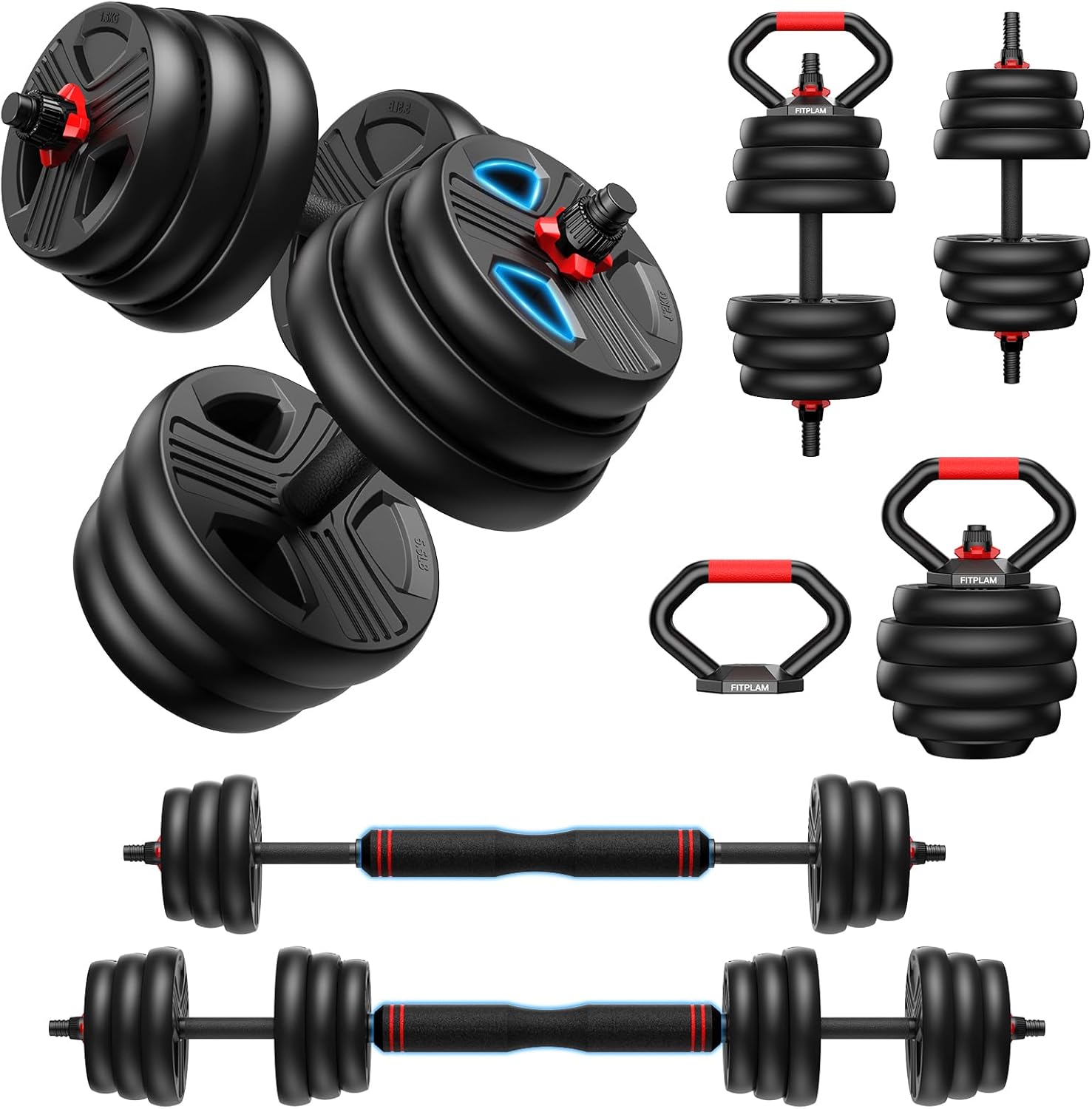 FITPLAM Adjustable dumbbell set
- Material: Alloy Steel, Iron, Polyethylene (PE)
Converts into dumbbells, kettlebells, barbells, and push-up stands
Dual-lock nuts add a second layer of security to plates
Textured ergonomic grips help reduce slipping during sets
Single 45-pound maximum weight limits heavier lifters
Switching between the five modes needs manual reassembly
| Product | Key specs | |
|---|---|---|
| MQRW Push Up Board | Maximum Weight Recommendation: 600 Pounds Warranty Type: Push up board Assembly Instructions Description: No assembly required | Check price |
| Pilates Bar Kit with Resistance Bands | Recommended Uses For Product: At Home Pilates Workout Tension Supported: Heavy Number of Resistance Levels: 2 | Check price |
| FITPLAM Adjustable dumbbell set | Material: Alloy Steel, Iron, Polyethylene (PE) | Check price |
 Ankle Resistance Bands with Cuffs Ankle Resistance Bands with Cuffs | Check price | |
 CURSOR FITNESS Exercise Bike CURSOR FITNESS Exercise Bike | Check price | |
 NICEPEOPLE Adjustable Weight Bench for Home Gym NICEPEOPLE Adjustable Weight Bench for Home Gym | Item Dimensions D x W x H: 46"D x 16.7"W x 17.2"H Material: Superior Alloy Steel | Check price |
 Pedal Resistance Band with Handle Pedal Resistance Band with Handle | Check price | |
 XT Trainer XT Trainer | Check price |
As an Amazon Associate we earn from qualifying purchases at no extra cost to you.
Quick Comparison
| Product | Best For | Standout Feature | Watch Out For |
|---|---|---|---|
| MQRW Push Up Board with Pilates Bar Kit | Zero permanent footprint | Whole kit slides under a bed or sofa | Needs clear floor space while in use |
| Pilates Bar Kit with Resistance Bands | Standing work in a narrow room | Bar length is the only space requirement | Bar needs somewhere to lean when stored |
| Ankle Resistance Bands with Cuffs | The smallest possible storage | Fits in a drawer with room to spare | Lateral walks still need a clear runway |
| FITPLAM Adjustable Dumbbell Set | Replacing a rack in one corner | 20 lb to 90 lb from a single compact set | Loose plates spread if not stored together |
| NICEPEOPLE Adjustable Weight Bench | Foldable strength training | Eight backrests and a 660 lb capacity | Working footprint is larger than it looks |
| CURSOR FITNESS Exercise Bike | Cardio without leaving the flat | Quiet drive suited to shared walls | Occupies its space permanently |
How to Choose
- Stored versus working size: Measure both. Plenty of gear is compact in a cupboard and demands six feet of clearance the moment you use it.
- Vertical storage: Items that stand against a wall or hang on a hook consume no floor area at all, which is the cheapest space you own.
- Setup friction: Anything taking more than two minutes to deploy will be skipped on busy days. In small spaces, quick setup is a usage feature.
- Exercises per square foot: Count the movements each item genuinely unlocks and divide by the space it occupies. The ranking usually surprises people.
- Shared-room tolerance: If the equipment lives in a living room, it has to look acceptable at rest. Gear that offends the room gets moved, then forgotten.
Top Picks Reviewed
Best Space Efficiency: MQRW Push Up Board with Pilates Bar Kit
A board with multiple hand positions, a pilates bar and a set of bands covers pressing, rowing, core and leg work while storing flat enough to slide under most beds. For a small flat that ratio of movements to stored volume is unbeaten, and setup is measured in seconds.
The working footprint is a different number. You still need a clear stretch of floor roughly the length of your body plus room for the bands to travel, which in a cluttered room means moving the coffee table before every session.
Smallest Storage: Ankle Resistance Bands with Cuffs
These disappear into a drawer, weigh almost nothing, and still deliver loaded glute and hip work — kickbacks, standing abduction, lateral walks. If space is the binding constraint, nothing else here comes close on stored volume.
Lateral walks want several feet of clear floor to travel across, which a narrow galley-style room may not offer. Substituting standing abduction against a doorframe covers the same muscles in a fixed spot.
Best Weight Density: FITPLAM Adjustable Dumbbell Set
A single set spanning 20, 35, 45, 55, 70 and 90 lb replaces what would otherwise be a rack occupying a metre of wall. In a small home that consolidation is the entire argument — one corner instead of one wall, with no loss of training range.
Adjustable sets do generate loose parts. Plates and collars scattered across a living room floor undo the tidiness you bought them for, so a box or a small stand should be part of the purchase rather than an afterthought.
Best Foldable Strength Option: NICEPEOPLE Adjustable Weight Bench
Eight backrest angles and a 660 lb rated capacity give you incline pressing, supported rows and a stable platform for split squats, and the folding design means it can be stood against a wall between sessions rather than owning a permanent spot.
Be realistic about the working area. A bench in use needs clearance at both ends and enough width to move dumbbells around it, which is often twice the footprint of the frame itself. Measure the space open, not folded.
Biggest Commitment: CURSOR FITNESS Exercise Bike
For indoor cardio in a flat with shared walls, a quiet brake-pad bike solves a genuine problem: no impact noise, no downstairs complaints, and no weather dependency. Used regularly, it is the most convenient cardio option available at home.
It does not fold away in any meaningful sense. That space is gone for as long as you own it, so the honest question is whether you will ride it often enough to justify a permanent claim on a room you also live in.
Frequently Asked Questions
How much clear floor do I actually need?
Roughly six by three feet covers mat work, push-up board sessions and band training. Anything involving a bench or lateral travel needs more, so measure before assuming a room will work.
What is the best storage for a shared living room?
Vertical and out of sight. Bands on a door hook, a bar leaning in a wardrobe, dumbbells boxed in a cupboard. Equipment left visible in a living space gets tidied away permanently within weeks.
Can I train effectively without any large equipment?
For general fitness, yes. A board, bands and cuffed ankle bands cover full-body training. Large equipment adds load capacity and cardio convenience rather than access to fundamentally new exercises.
Will floor-based training bother downstairs neighbours?
Only if something impacts the floor. Band and bodyweight work is quiet; dropped dumbbells are not. A dense mat and controlled set-downs solve almost all of it.
Final Thoughts
In a small home, buy by footprint before price. The push-up board bundle and cuffed ankle bands deliver the most training per square foot and vanish when you are done, the FITPLAM adjustable dumbbells consolidate an entire rack into one corner, and the folding bench is worth it once you own weight to use on it. Reserve the exercise bike for the case where you are certain the cardio habit will outlast the novelty — that is a permanent piece of your floor.
Write Your Review
No reviews yet. Be the first to share your experience!