Key takeaways
- Reflectance value: Mid-gray surfaces return roughly twice the light of charcoal or black. If you’re working with two or three fixtures, choose a lighter field and you’ll gain usable brightness without adding a watt. Reserve black tile for spaces with generous overhead output or where you want a gallery-like, low-glare mood.
- Texture and specularity: Matte and lightly stippled surfaces scatter light softly. Glossy coatings and slick vinyl create mirror hotspots directly under each fixture, which is exactly the reflected glare that makes you squint while you’re bent over an engine bay.
- Load rating: Anything a car parks on needs a stated compressive capacity — look for figures in the tens of thousands of pounds for rigid polypropylene tile. Undersized tile telegraphs tire flat-spots that catch raking light and look terrible.
- Moisture strategy: Decide whether you want liquid absorbed (fabric containment mats) or drained away (perforated tile). Standing water is a specular nightmare and a slip hazard under low, angled light.
- Installation and seams: Interlocking systems are DIY-friendly and repairable one tile at a time. Grid patterns also create a subtle rhythm that reads well under linear fixtures — align seams with your light runs and the room looks intentional.
What's inside
Most garage upgrades start with a light fixture and end in disappointment. You bolt up a pair of 5,000-lumen shop lights, flip the switch, and the space still reads like a cave with a bright ceiling. The reason is almost always underfoot: bare concrete swallows somewhere between 20 and 30 percent of the light that hits it, and a stained, oil-blotched slab swallows more. In a room where the floor is the single largest continuous surface, that slab is doing more to shape the ambience than any luminaire you own.
This guide looks at garage flooring the way a lighting designer would — as a bounce surface, a glare risk, and a tonal foundation, not just a wear layer. Below you’ll find mats and interlocking tile systems that hold up to a vehicle’s weight while meaningfully changing how the space reads at night, plus a short framework for matching surface value and texture to the fixtures you already have.
As an Amazon Associate we earn from qualifying purchases.



🛒 Best Price Today on Amazon
Prime members get fast, free shipping on everything above, plus member-only deals. New members get a 30-day free trial — cancel anytime.
How to Choose Garage Flooring Ideas (2026)
- Reflectance value: Mid-gray surfaces return roughly twice the light of charcoal or black. If you’re working with two or three fixtures, choose a lighter field and you’ll gain usable brightness without adding a watt. Reserve black tile for spaces with generous overhead output or where you want a gallery-like, low-glare mood.
- Texture and specularity: Matte and lightly stippled surfaces scatter light softly. Glossy coatings and slick vinyl create mirror hotspots directly under each fixture, which is exactly the reflected glare that makes you squint while you’re bent over an engine bay.
- Load rating: Anything a car parks on needs a stated compressive capacity — look for figures in the tens of thousands of pounds for rigid polypropylene tile. Undersized tile telegraphs tire flat-spots that catch raking light and look terrible.
- Moisture strategy: Decide whether you want liquid absorbed (fabric containment mats) or drained away (perforated tile). Standing water is a specular nightmare and a slip hazard under low, angled light.
- Installation and seams: Interlocking systems are DIY-friendly and repairable one tile at a time. Grid patterns also create a subtle rhythm that reads well under linear fixtures — align seams with your light runs and the room looks intentional.
The Best Garage Flooring Ideas (2026) Reviewed
Garage Mats Oversize Parking Mat, 8.8 x 22 Ft
An absorbent, waterproof-backed containment mat in gray, sized to sit under a full-size vehicle and catch snowmelt, brine, and drips. The napped fabric surface is almost perfectly diffuse, which means zero hotspots and no reflected glare when you’re working on the ground under a hanging fixture.
Interlocking Garage Floor Tiles, 12″ x 12″, 48-Pack
Rigid modular plastic tile with a 40,000-pound load rating and oil- and stain-resistant finish, so it stays uniform in tone instead of developing dark patches that read as shadows. The antislip surface texture is fine enough to look clean under wall-washing light but coarse enough to kill specular reflection.
VEVOR Garage Floor Tiles, Red, 50-Pack
A half-inch-thick polypropylene tile with double-sided texture, and the red colorway is the interesting choice here — it warms the ambient bounce noticeably under neutral 4000K shop lighting. Best used as a full field or as a defined parking bay against gray tile for a two-tone layout.
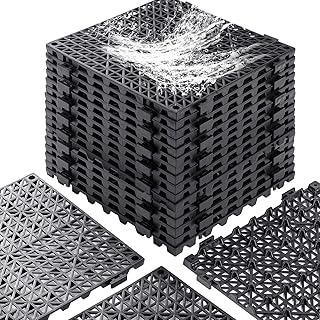
Jocoevol Self-Drainage Interlocking Tile, 60-Pack
Sixty perforated black tiles is enough coverage for a single-bay wash or work zone, and the open grid moves water off the surface before it can pool and glare. The deep matte black absorbs light, so pair it with a lighter perimeter or add fixture output if it’s your primary field.
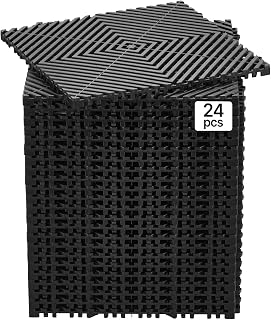
VEVOR Interlocking Drainage Mat, 24-Piece
A cushioned, non-slip drainage tile that suits standing-work areas — a bench zone, a utility sink, a dog wash. The raised profile keeps your feet out of runoff, and the soft surface tames the harsh downlight bounce that hard tile can throw back at task height.
Frequently Asked Questions
Will lighter flooring really brighten my garage?
Yes, measurably. Moving from dark, sealed concrete to a mid-gray surface can raise interior illuminance by a noticeable margin because light bounces off the floor, onto walls, and back into the room. It’s the cheapest lumen you’ll ever buy.
Should I avoid high-gloss epoxy?
Not necessarily, but understand the tradeoff. Gloss looks striking in photos and reflects fixture images sharply, which reads as glare at working height. If you want the polished look, choose diffused or lensed fixtures rather than bare LED strips.
Do drainage tiles work for parking?
Perforated tiles handle foot traffic and wash zones well, but check the stated load rating before parking on them. For full vehicle weight, solid interlocking tile or a containment mat is the safer specification.
Can I mix mats and tile?
Mixing is often the best answer. Use tile for the walking and working field, then drop a containment mat in the parking footprint. The value change also visually zones the space, which helps under a single row of fixtures.
Final Thoughts
For most garages, the 48-pack interlocking tile is the strongest all-round choice — high load rating, stain resistance, and a matte gray field that works with your existing fixtures instead of fighting them. Add the Garage Mats oversize parking mat where the vehicle sits, and if you want warmth or a defined bay, the VEVOR red tile gives you tonal separation without a second lighting circuit.