Key takeaways
- Sleep surface over seat feel: Press the middle third of the mattress, not the edge. Pocket-spring or high-density foam cores hold a hip without hammocking; thin cotton-batting fills compact within months and telegraph every frame slat.
- The fold line: Bifold frames put a seam under the lumbar region. If the futon will host guests more than a few nights a year, favor a boneless or modular build where the sleeping plane is continuous.
- Deck height and your light plan: A 14–17″ sleeping surface reads as a bed and pairs with a nightstand lamp whose shade bottom sits near shoulder height. Floor futons drop the sleeper to roughly 4–9″, which means table lamps will glare straight into the eyeline — plan for a floor lamp, sconce, or shaded lantern instead.
- Fabric and glare: Corduroy’s ribs scatter grazing light and hide the creases that come from being unfolded nightly. Twill and microfiber are cleaner-looking but reflect more, so they show every hot spot from an unshaded bulb.
- Assembly and shadow gaps: No-assembly modular pieces ship compressed and sit flush to the floor, which reads as solid mass. Legged frames leave a shadow gap underneath that makes a room feel taller — genuinely different moods, so choose deliberately.
What's inside
Most futon shopping goes wrong for a reason nobody mentions in the specs: the piece is bought as a couch and slept on as a bed, and those two jobs want opposite things. A sofa wants firm edges and a high seat. A body at 3 a.m. wants pressure relief and a surface that doesn’t fold the spine along a hinge. Add the part I notice first in every room I work in — a futon changes where light lands, because it changes the height of the surface people occupy — and you get the familiar result: a guest room that looks composed at noon and feels like a waiting area after dark.
I design lighting and ambience for a living, which means I spend a lot of time measuring the distance between a lamp’s bottom edge and someone’s eyes while they’re lying down. That habit turns out to be useful for judging futons. Below are the models worth your attention in 2026, evaluated for overnight comfort first, then for how their height, fabric, and silhouette behave under real household light — the reading lamp, the overhead you’d rather not use, the morning window.
As an Amazon Associate we earn from qualifying purchases.


🛒 Best Price Today on Amazon
Prime members get fast, free shipping on everything above, plus member-only deals. New members get a 30-day free trial — cancel anytime.
How to Choose a/an Futon For Sleeping (2026)
- Sleep surface over seat feel: Press the middle third of the mattress, not the edge. Pocket-spring or high-density foam cores hold a hip without hammocking; thin cotton-batting fills compact within months and telegraph every frame slat.
- The fold line: Bifold frames put a seam under the lumbar region. If the futon will host guests more than a few nights a year, favor a boneless or modular build where the sleeping plane is continuous.
- Deck height and your light plan: A 14–17″ sleeping surface reads as a bed and pairs with a nightstand lamp whose shade bottom sits near shoulder height. Floor futons drop the sleeper to roughly 4–9″, which means table lamps will glare straight into the eyeline — plan for a floor lamp, sconce, or shaded lantern instead.
- Fabric and glare: Corduroy’s ribs scatter grazing light and hide the creases that come from being unfolded nightly. Twill and microfiber are cleaner-looking but reflect more, so they show every hot spot from an unshaded bulb.
- Assembly and shadow gaps: No-assembly modular pieces ship compressed and sit flush to the floor, which reads as solid mass. Legged frames leave a shadow gap underneath that makes a room feel taller — genuinely different moods, so choose deliberately.
The Best Futon For Sleeping (2026)s Reviewed
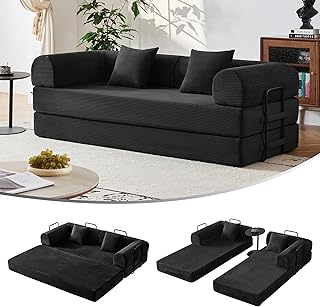
79″ Convertible Sofa Bed, Black Corduroy
Pocket springs inside a boneless build is the combination I keep recommending, because you get sofa support without a hinge across the sleeping surface. The black corduroy is forgiving under warm light — it absorbs rather than bounces, so a single 2700K lamp is enough to make the corner feel finished.
Stanford Futon Set — Full Size
A traditional frame-and-mattress pairing with an 8″ core, which is the minimum thickness I’d accept for adults sleeping multiple nights. The raised frame and open base keep the floor visible, so a low uplight tucked behind it will wash the wall and visually lift the whole room.
79″ 5-in-1 Modular Futon, Olive Green
The modular arrangement earns its keep in small apartments where the same furniture serves as couch, chaise, and guest bed. Olive green is the smarter color choice under mixed daylight and lamplight — it stays neutral where gray often turns muddy or blue after sunset.
78.8″ Convertible Loveseat Sleeper with Storage
Slightly tighter footprint than the 79″ models, with a storage pocket that quietly solves the bedding problem most futon owners never solve. Best for rooms under about 11 feet wide, where a full-length sofa would crowd the window and cut your daylight.
6th Generation Japanese Floor Futon Mattress
Nine layers and high-density foam at 9″ thick make this a legitimate adult sleeping surface, not a camping pad, and it rolls away when the room needs to be a room again. Remember the sightline shift — swap the bedside table lamp for a floor lamp or a low lantern so nothing shines directly into a sleeper’s face.
Frequently Asked Questions
Can a futon be a full-time bed?
Yes, with a pocket-spring or high-density foam core at least 8″ thick and no fold seam under the torso. Thin cotton futons on slatted bifold frames are best kept to occasional use.
Do floor futons cause moisture problems?
They can if left flat permanently. Fold or air the mattress every few days, especially in rooms that get cold at night — condensation collects against the floor where you can’t see it.
What lighting suits a futon that doubles as a bed?
Two layers: a dimmable warm source for evening and something aimed at the wall or ceiling rather than the seat. Avoid overhead downlights directly above the sleeping area, which flatten the space and glare on lighter fabrics.
How firm should the mattress be?
Medium-firm suits most sleepers on a futon, since the support layer beneath is harder than a conventional bed base. Side sleepers should prioritize thickness over firmness.
Final Thoughts
For a genuine dual-purpose piece, the 79″ Convertible Sofa Bed in black corduroy is the most reliable pick — continuous sleeping surface, forgiving under lamplight, no assembly. Choose the Stanford Futon Set if you want a proper frame with a shadow gap that opens up a small room, and the 6th Generation Japanese Floor Futon Mattress if the space needs to disappear during the day.