Key takeaways
- Match value to your light budget: Entryways with no window and one fixture need mid-to-light values (beige, khaki, pale grey) that reflect light upward. Save charcoal and deep brown for spaces with a sidelight, transom, or a second lamp — otherwise the floor becomes a visual hole.
- Watch the pile shadow: Downlight rakes across texture and throws micro-shadows. Low-profile flatweaves and printed surfaces stay calm and legible; deep shag under a single downlight looks perpetually dusty even when it’s clean.
- Test the wet sheen: Rubber and TPR backings are great functionally, but check how the face fiber looks saturated. Absorbent microfiber goes matte and darkens evenly. Slicker synthetics develop a specular glare patch right where the light lands.
- Size to the light pool, not the door: Stand under your fixture and note where the bright circle falls. A rug that stops short of that pool leaves an awkward lit strip of bare floor; extending past it by a few inches makes the whole entry read as one composed zone.
- Choose pattern by shadow tolerance: Vintage-washed and abstract prints hide the dirt that raking light reveals. Solid mid-tones are cleaner-looking in bright entries but show every footprint where the light hits at an angle.
What's inside
Entryways are the most poorly lit rooms in most homes, and almost nobody plans for it. You get one overhead fixture — often a flush mount with a frosted shade — casting light straight down onto the floor from six feet up. That single downward beam is unforgiving: it flattens texture, exaggerates every crumb of tracked-in grit, and turns a rug you loved under showroom fluorescents into a muddy gray smear by 5 p.m. in January. Add a warm 2700K bulb and that “cool greige” you ordered reads distinctly yellow.
This guide approaches entryway rugs the way a lighting designer approaches a floor plane: as a surface that either absorbs your limited light or bounces it back into the room. We look at light reflectance value, how fiber pile catches or kills shadow, sheen behavior under raking downlight, and whether a mat still looks intentional when it’s damp. Below are six washable options that earn their spot in a dim, high-traffic zone — plus how to match one to the light you actually have.
As an Amazon Associate we earn from qualifying purchases.


🛒 Best Price Today on Amazon
Prime members get fast, free shipping on everything above, plus member-only deals. New members get a 30-day free trial — cancel anytime.
How to Choose a Entryway Rug (2026)
- Match value to your light budget: Entryways with no window and one fixture need mid-to-light values (beige, khaki, pale grey) that reflect light upward. Save charcoal and deep brown for spaces with a sidelight, transom, or a second lamp — otherwise the floor becomes a visual hole.
- Watch the pile shadow: Downlight rakes across texture and throws micro-shadows. Low-profile flatweaves and printed surfaces stay calm and legible; deep shag under a single downlight looks perpetually dusty even when it’s clean.
- Test the wet sheen: Rubber and TPR backings are great functionally, but check how the face fiber looks saturated. Absorbent microfiber goes matte and darkens evenly. Slicker synthetics develop a specular glare patch right where the light lands.
- Size to the light pool, not the door: Stand under your fixture and note where the bright circle falls. A rug that stops short of that pool leaves an awkward lit strip of bare floor; extending past it by a few inches makes the whole entry read as one composed zone.
- Choose pattern by shadow tolerance: Vintage-washed and abstract prints hide the dirt that raking light reveals. Solid mid-tones are cleaner-looking in bright entries but show every footprint where the light hits at an angle.
The Best Entryway Rugs (2026) Reviewed
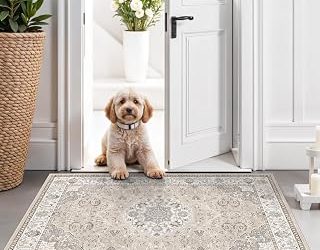
Washable 2×3 Vintage Entryway Rug, Beige
The faded vintage print is quietly brilliant under a single overhead: the built-in tonal variation absorbs shadow noise instead of fighting it, so the rug never looks streaky. Its high reflectance beige also bounces usable light back onto lower walls, which makes a cramped foyer feel less like a tunnel.
PURRUGS Dirt Trapping Indoor Door Mat, 31.5″ x 47″, Charcoal
The most capable dirt-trapper here, and the one that demands the most from your lighting — charcoal drinks light, so reserve it for entries with a glazed door or a wall sconce. The dense low-profile face is a genuine asset: it reads velvety rather than glossy when wet, with no hotspot glare.
ubdyo Front Door Mat, Grey, 23″ x 36″
Mid-grey is the safest value in the lineup, holding its character across warm and cool bulbs without shifting yellow or blue. Fade resistance matters more than people expect on a threshold, where afternoon sun through a storm door will bleach a cheaper mat unevenly within a season.
Non Slip Indoor Door Mat 24″x36″, Khaki
A light, warm neutral that behaves beautifully under 2700K bulbs — it leans soft sand rather than the greenish cast khaki can take on in cool light. The low profile clears a door swing cleanly and stays visually flat, so nothing catches an unflattering edge shadow.
RELEANY Washable 2’x3′ Abstract Rug, Blue Grey
The abstract print gives an entry a focal point, useful when your only light source is unflattering and you’d rather draw the eye to pattern than to a plain expanse. Cool blue-grey needs warm ambient light to avoid reading clinical, so pair it with a lamp on the console.
Frequently Asked Questions
Why does my entryway rug look dirty when it isn’t?
Almost always the light angle. Overhead downlight rakes across the pile and casts shadows into the fiber gaps, which the eye reads as grime. A flatter, lower-profile rug or a second light source at eye level solves it.
Should I match the rug to my flooring or my walls?
Neither exactly. Aim a step or two darker than the floor so the rug defines a zone, but stay above the value where it becomes a shadow. Mid-tones do this best in low light.
Do darker rugs really make an entry feel smaller?
In dim conditions, yes. Dark floors absorb the light you’d otherwise get bouncing back onto walls. If you love a deep tone like the PURRUGS Brown, add a wall or table lamp to compensate.
How often should I wash an entryway rug?
Every two to three weeks in wet seasons. Washing also restores fiber loft, which changes how the surface catches light — a matted mat looks dingy no matter how clean it is.
Final Thoughts
For most single-fixture entryways, the Washable 2×3 Vintage Rug in beige is the smart default: reflective, forgiving, and quietly handsome under warm light. If your entry has real daylight and real mud, the PURRUGS Charcoal 31.5″ x 47″ is the workhorse, while the ubdyo Grey mat is the safest all-around pick for mixed indoor-outdoor light.