Key takeaways
- Finish reflectivity: Matte and lightly satin surfaces diffuse a pendant’s output evenly across the table. Glossy laminates and glass act like mirrors, bouncing the lamp’s filament back at seated eye level. If you love a white top, look for a soft matte texture rather than a lacquered sheen.
- Tone temperature pairing: Walnut and oak read rich and inviting under warm 2700K light; cool white bulbs make the same wood look gray and lifeless. Pale and white tops tolerate a neutral 3000K to 3500K without flattening. Choose the top and the bulb as a pair, not separately.
- Expanded footprint vs. fixture spread: Measure the table at full extension, not folded. A single pendant covers roughly a 30 to 36 inch span well. Anything wider needs a two- or three-light linear run, or a wall sconce and dimmer to fill the shadow at the ends.
- Mobility and cord clearance: Casters are excellent for flexible living, but a table that rolls will not always sit beneath a hardwired fixture. Pair wheeled designs with a plug-in swag pendant on a hook, a floor lamp with an arched arm, or a track head you can aim.
- Shape and shadow behavior: Round and oval tops let light fall off gradually toward the rim, which flatters faces and food. Square and rectangular tops create harder corner shadows and benefit from a wider shade or a slightly higher mounting height.
What's inside
In a small dining area, the table is not just furniture — it is the surface that catches every lumen in the room. I spend my working life positioning pendants, dimming circuits, and choosing color temperatures, and the same problem surfaces again and again in apartments and galley kitchens: the table was chosen for its footprint alone, and the light has nothing kind to land on. A high-gloss white top throws a hot spot straight into everyone’s eyes. A table pushed against a wall leaves half the pool of light falling on nothing. A leaf that extends 12 inches past the fixture above it turns one diner into a silhouette.
This guide looks at small-space dining tables through that lens. Footprint and build quality still matter, and I cover both, but I also weigh how each top handles reflected light, whether the shape suits a single pendant or needs a linear fixture, and how expandable and folding designs change your lit zone when they open. Below are six tables worth considering in 2026, followed by a short buying framework, individual notes, and answers to the questions I hear most from clients mid-renovation.
As an Amazon Associate we earn from qualifying purchases.



🛒 Best Price Today on Amazon
Prime members get fast, free shipping on everything above, plus member-only deals. New members get a 30-day free trial — cancel anytime.
How to Choose a Dining Table For Small Spaces (2026)
- Finish reflectivity: Matte and lightly satin surfaces diffuse a pendant’s output evenly across the table. Glossy laminates and glass act like mirrors, bouncing the lamp’s filament back at seated eye level. If you love a white top, look for a soft matte texture rather than a lacquered sheen.
- Tone temperature pairing: Walnut and oak read rich and inviting under warm 2700K light; cool white bulbs make the same wood look gray and lifeless. Pale and white tops tolerate a neutral 3000K to 3500K without flattening. Choose the top and the bulb as a pair, not separately.
- Expanded footprint vs. fixture spread: Measure the table at full extension, not folded. A single pendant covers roughly a 30 to 36 inch span well. Anything wider needs a two- or three-light linear run, or a wall sconce and dimmer to fill the shadow at the ends.
- Mobility and cord clearance: Casters are excellent for flexible living, but a table that rolls will not always sit beneath a hardwired fixture. Pair wheeled designs with a plug-in swag pendant on a hook, a floor lamp with an arched arm, or a track head you can aim.
- Shape and shadow behavior: Round and oval tops let light fall off gradually toward the rim, which flatters faces and food. Square and rectangular tops create harder corner shadows and benefit from a wider shade or a slightly higher mounting height.
The Best Dining Table For Small Spaces (2026)s Reviewed
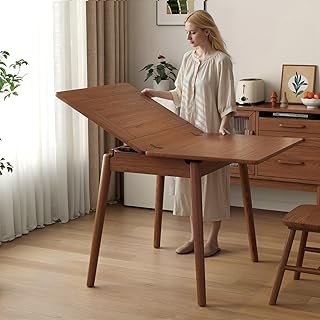
Solid Wood Expandable Kitchen Table, 23.6″–47.2″ (Walnut)
The nearly two-to-one expansion range makes this the most adaptable pick here, and solid walnut under a warm dimmed pendant gives a depth of grain that veneer cannot fake. At full width you will want a two-light fixture or a supplementary sconce to avoid a dim end seat.
AWQM 3-Piece Dining Set for 2
A complete, coherent breakfast nook in one purchase, with a warm brown wood tone that sits comfortably under 2700K without turning muddy. Because the set is compact and fixed, it is the easiest of the group to center precisely beneath a single hardwired pendant.
Extendable Round-to-Oval Dining Table, 35.4″–47.2″ (Oak)
Round-to-oval is the most forgiving geometry for lighting, since the pool of light softens naturally toward the edge instead of stopping at a corner. The hidden storage for the leaf is genuinely useful, and pale oak keeps a low-ceilinged room feeling open under neutral white light.
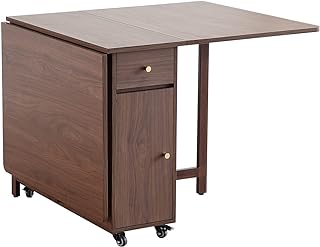
Drop Leaf Folding Table with Storage and Wheels (Walnut)
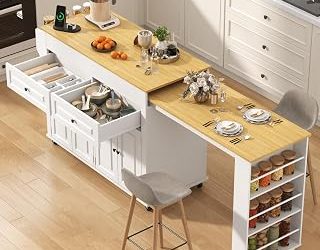
An 18mm plywood build with a 300 lb capacity and locking casters makes this the workhorse of the list — it functions as a console, prep surface, or full table depending on the hour. Plan on a plug-in pendant or aimed track head rather than a fixed ceiling drop, since the table’s position will change.
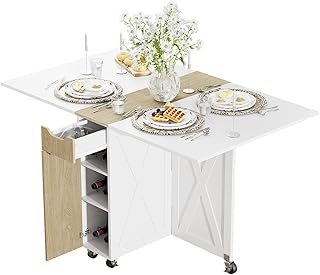
42″–58″ Extendable Round Table with Flip Leaf
The built-in flip leaf means no separate panel to store, and metal legs keep the visual weight low so light travels under and around it. At 58 inches you are firmly into linear-fixture territory; a single pendant will leave the ends noticeably underlit.
Frequently Asked Questions
How high should a pendant hang over a small dining table?
Aim for 30 to 34 inches from the tabletop to the bottom of the shade. In tight rooms, lean toward the higher end so the fixture spreads light more widely and stays out of sightlines.
Are glass or high-gloss tops a bad idea in small spaces?
Not inherently — they bounce light around and can make a room feel larger. The tradeoff is glare and visible fingerprints. Use a fully shaded or diffused fixture rather than an exposed bulb.
Does a folding table work if I have no ceiling fixture?
Yes, and it is often the better combination. A wheeled table like the Folding Dining Table with 6 Wheels pairs well with an arc floor lamp, which travels with the table and needs no electrical work.
What bulb should I use for a wood dining table?
Choose 2700K, 90+ CRI, and put it on a dimmer. High CRI renders wood grain and food color accurately; the dimmer lets one table serve morning coffee and evening dinner.
Final Thoughts
For most small dining areas, the Extendable Round-to-Oval Oak Table is my default recommendation — the shape is the friendliest to a single pendant and the pale finish keeps things bright. If you want warmth and real material presence, the Solid Wood Expandable Walnut Table rewards a good warm dimmer, and for genuinely flexible or multi-use rooms, the Drop Leaf Folding Table with Wheels paired with a plug-in or floor-standing light is the most practical setup you can build.