Key takeaways
- Lift height versus your table: Measure from chair seat to tabletop, then aim for a child’s elbows to sit an inch or two above the surface. Around 3.5 to 4 inches of rise suits standard 29 to 31 inch dining tables; taller counters need a different category of seat entirely.
- Harness and chair anchoring: Two-point straps handle a settled eater; a three-point harness with a crotch strap stops the determined climber from standing mid-meal. Just as important are the rear ties that lash the cushion to the chair back and seat so it can’t creep forward.
- Surface finish under your lights: High-gloss PU throws a bright specular highlight straight back at a downlight or a low pendant, which is distracting at eye level and unflattering in photos. Matte or lightly grained PU diffuses the same beam and hides crumbs better between wipes.
- Grip that respects your chairs: Silicone dots or a rubberised base hold on sealed wood without abrading the finish. On woven or upholstered seats, look for a broad flat underside rather than aggressive nubs that press marks into fabric.
- Cleanup and packing down: Sealed seams and a wipeable skin beat fabric covers you have to unzip and launder. If it travels, check it compresses flat enough for a nappy bag and has no rigid frame to bruise your shins.
What's inside
Most dining rooms are lit for adults. The pendant hangs at 30 to 34 inches above the tabletop, the cone of light lands where a grown-up’s plate sits, and everything below that plane falls into soft shadow. Put a two-year-old on a bare chair and you’ve placed them under the table’s lighting, not in it — chin at the edge, plate in gloom, face unreadable across the room. Add the usual physical problems (sliding, slouching, a fork that can’t reach anything) and mealtime becomes a negotiation rather than a shared hour.
A booster seat is the cheapest way to fix a room’s sightlines. Lift a child four inches and their face enters the same pool of warm light as everyone else’s, their forearms clear the table edge, and the whole seating arrangement reads as one group instead of a table with a small person attached. This guide covers six boosters worth considering in 2026, judged on lift height, harness security, how the upholstery behaves under real dining light, grip on wood and upholstered chairs, and how quickly the thing wipes down when dinner ends badly.
As an Amazon Associate we earn from qualifying purchases.



🛒 Best Price Today on Amazon
Prime members get fast, free shipping on everything above, plus member-only deals. New members get a 30-day free trial — cancel anytime.
How to Choose a Booster Seats For Dining Table (2026)
- Lift height versus your table: Measure from chair seat to tabletop, then aim for a child’s elbows to sit an inch or two above the surface. Around 3.5 to 4 inches of rise suits standard 29 to 31 inch dining tables; taller counters need a different category of seat entirely.
- Harness and chair anchoring: Two-point straps handle a settled eater; a three-point harness with a crotch strap stops the determined climber from standing mid-meal. Just as important are the rear ties that lash the cushion to the chair back and seat so it can’t creep forward.
- Surface finish under your lights: High-gloss PU throws a bright specular highlight straight back at a downlight or a low pendant, which is distracting at eye level and unflattering in photos. Matte or lightly grained PU diffuses the same beam and hides crumbs better between wipes.
- Grip that respects your chairs: Silicone dots or a rubberised base hold on sealed wood without abrading the finish. On woven or upholstered seats, look for a broad flat underside rather than aggressive nubs that press marks into fabric.
- Cleanup and packing down: Sealed seams and a wipeable skin beat fabric covers you have to unzip and launder. If it travels, check it compresses flat enough for a nappy bag and has no rigid frame to bruise your shins.
The Best Booster Seats For Dining Table (2026)s Reviewed
Upseat Boost
Developed with physical therapists, this is the one that actually addresses posture rather than just height, with a contoured base that keeps hips back and shoulders open — which reads visibly better across a lit table than a slumped silhouette. Adjustable height means it stays useful as the child grows, and the wipe-clean shell shrugs off sauce.
3.8″ Booster with Side Pockets
The 3.8-inch lift is the sweet spot for standard dining tables, putting a toddler’s face squarely inside a pendant’s light pool instead of below it. Side pockets swallow the bib and spoon that usually end up on the floor, and the removable cushion pulls out for a proper scrub.
Backrest Booster with 3-Point Harness
The backrest is the differentiator here: it fills the gap behind a small back on a deep kitchen chair, so the child sits forward where the light and the food are. A three-point harness handles the wriggling stage that two-point straps quietly lose.
PU Washable Double-Strap Booster (Grey)
A clean, low-drama grey that disappears against most chair finishes and doesn’t flare under warm bulbs — useful if you’d rather your dining room not look like a nursery. Double safety straps and a non-slip base cover the fundamentals, and the PU skin wipes clean in one pass.
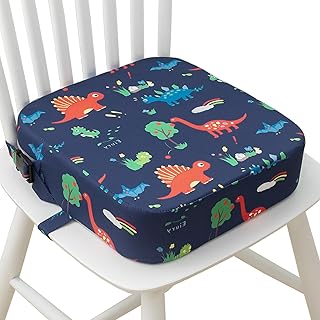
Eiury Blue Dinosaur Booster
The dinosaur print earns genuine cooperation from a child who resists being strapped into anything, and the safety buckles are straightforward enough for a grandparent to work out unassisted. Light, non-slip, and easy to throw in a bag for a restaurant or a holiday let.
Frequently Asked Questions
How much lift does my child actually need?
Sit them on the chair and check their elbows. If they’re below the tabletop, you want roughly 3 to 4 inches. Overshooting is worse than undershooting — a child perched too high loses foot contact and starts to slide.
Will a shiny booster cause glare problems?
Only in specific setups: a low pendant or a directional downlight aimed near the chair will bounce off gloss PU. Nudging the pendant up a few inches or swapping to a matte-finish cushion resolves it.
Are these safe on any kitchen chair?
They need a flat seat and a solid back to tie against. Skip stools, benches without backs, and chairs with steeply sloped or heavily curved seats where the cushion can’t sit level.
When does a child outgrow one?
Usually between four and five, when they can reach the table comfortably from the chair itself and get on and off without help. Weight limits are typically the earlier constraint on cushion-style boosters.
Final Thoughts
If posture matters most, the Upseat Boost is the considered choice and grows with the child. For everyday dining where you want the right lift, tidy storage, and a surface that behaves under warm light, the 3.8″ Booster with Side Pockets is the practical pick, while the Eiury Dinosaur Booster is the one to keep in the car for travel and eating out.