Key takeaways
- Seated eye level: Aim for a boost that brings your child’s chin roughly level with the tabletop plus a hand’s width. Too low and their face sits below the pendant’s spill; too high and a low-hung fixture starts casting shadows across their tray.
- Surface finish over surface color: Matte and lightly textured PU reads as fabric under warm light and hides crumb dust. Glossy vinyl throws a hard highlight straight back at the fixture and turns into a bright distraction in photos.
- Harness and grip together: A three-point harness holds the child; a genuinely tacky non-slip base holds the cushion. You need both, and the base is what most brands skimp on.
- Chair compatibility: Measure your seat pan depth and check whether your chairs have a curved back or a horizontal rail. Straps designed for a flat spindle back will not cinch cleanly onto a solid slab.
- How it looks empty: Boosters live on chairs full-time. Choose a neutral or a tone drawn from your existing textiles so the seat disappears when the room is lit for adults.
What's inside
A dining table is usually the most deliberately lit surface in a home. There is a pendant hung at a specific height, a dimmer set to a specific warmth, and a pool of light sized to the tabletop. Then a toddler arrives, and the whole composition gets solved with a stack of throw pillows and a folded blanket. The child sits too low to catch the light, shadows fall across the plate instead of the face, and every wobble pulls the eye away from the table. From where I sit — designing ambience for rooms that people actually eat in — a booster seat is not just childcare hardware. It sets your smallest diner’s eye level, and eye level is what decides whether they are inside the light or underneath it.
This guide looks at the current crop of dining-table boosters through that lens alongside the usual concerns: harness security, non-slip grip on wood and rattan seats, and how quickly a surface returns to clean after a bolognese incident. Warm 2700K light is flattering to a room and merciless on smeared PU, so wipeability matters more than most buyers expect. Below are six models worth your time, followed by the criteria I use before anything gets a permanent place at my table.
As an Amazon Associate we earn from qualifying purchases.



🛒 Best Price Today on Amazon
Prime members get fast, free shipping on everything above, plus member-only deals. New members get a 30-day free trial — cancel anytime.
How to Choose a Booster Seat For Dining Table (2026)
- Seated eye level: Aim for a boost that brings your child’s chin roughly level with the tabletop plus a hand’s width. Too low and their face sits below the pendant’s spill; too high and a low-hung fixture starts casting shadows across their tray.
- Surface finish over surface color: Matte and lightly textured PU reads as fabric under warm light and hides crumb dust. Glossy vinyl throws a hard highlight straight back at the fixture and turns into a bright distraction in photos.
- Harness and grip together: A three-point harness holds the child; a genuinely tacky non-slip base holds the cushion. You need both, and the base is what most brands skimp on.
- Chair compatibility: Measure your seat pan depth and check whether your chairs have a curved back or a horizontal rail. Straps designed for a flat spindle back will not cinch cleanly onto a solid slab.
- How it looks empty: Boosters live on chairs full-time. Choose a neutral or a tone drawn from your existing textiles so the seat disappears when the room is lit for adults.
The Best Booster Seats For Dining Table (2026) Reviewed
Upseat Boost Ergonomic Toddler Booster
Developed with input from physical therapists, the Boost is the only seat here built around pelvic positioning rather than simple elevation, which keeps a child upright and forward instead of slumping into the chair back. The adjustable height is the real win for lighting: you can dial in the exact seated level your pendant wants, then raise it as your child grows.
Ingenuity SmartClean Toddler Booster (Slate)
The slate finish is the most design-neutral option in this group and stays quiet against oak, walnut, or painted chairs. Genuinely light to carry, sensibly shaped for one-handed wipe-downs, and secured with a three-point harness — a reliable default if you want something that stops announcing itself the moment the dimmer comes down.
Backrest Booster Cushion with 3-Point Harness
The added backrest gives smaller toddlers lateral support that flat cushions cannot, which matters at a long dinner when a child starts to tire and lean. The PU wipes clean quickly and the non-slip underside holds well on smooth wooden seat pans.
PU Washable Booster Seat with Double Safety Straps (Grey)
Two independent strap systems anchor it to the chair while the harness holds the child, and the grey PU sits comfortably in almost any palette. The best value pick here for a second seat at grandparents’ house or a travel bag.
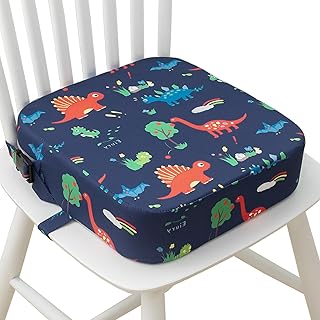
Eiury Portable Booster Cushion (Blue Dinosaur)
The dinosaur print is unapologetically for the child rather than the room, which is exactly right for some families and worth thinking about if your dining area doubles as an entertaining space. Safety buckles and a grippy base make it a sound choice for the seat your child chooses themselves.
Frequently Asked Questions
What age is a dining-table booster for?
Most suit children from around 18 months, once they can sit unaided, through to roughly five years. Follow the manufacturer’s stated weight limit rather than age, since it varies by model.
Will a booster fit my dining chairs?
Check seat pan width and depth first, then look at the chair back. Boosters strap most securely to chairs with an open or slatted back; solid upholstered backs and heavily curved shells are the common problem cases.
Booster seat or high chair?
A booster brings your child to the existing table, which keeps the room’s sightlines and lighting intact. A high chair is more supportive for younger babies but occupies floor space and often blocks a pendant’s light pattern.
Does the PU finish fade in sunlight?
Direct afternoon sun will dull any vinyl over time. If your table sits by a south-facing window, store the seat off the chair between meals or choose a mid-tone grey, which shows fading far less than saturated colors.
Final Thoughts
For most dining rooms the Upseat Boost is the strongest overall choice, thanks to genuine postural design and adjustable height that lets you tune your child’s seated level to the light you already have. The Ingenuity SmartClean in Slate is the most visually restrained pick and the easiest to clean quickly, while the backrest booster with three-point harness gives younger toddlers the extra support they need to make it through a full meal at the table.