Our Top Picks
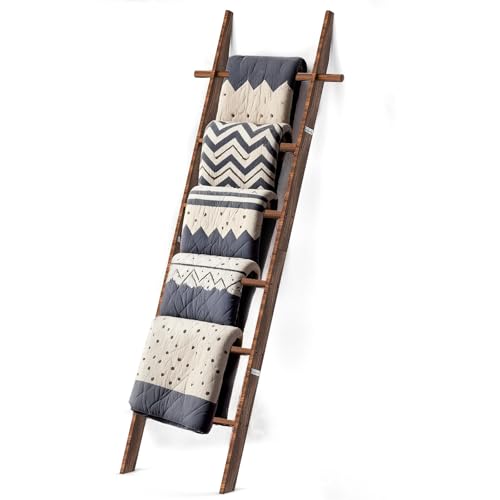 Farmhouse Wooden Blanket Ladder with Removable Hooks BrownLarge2.5 x 17.32 x 66 inchesCheck on Amazon


Short answer: the best blanket ladders are stable, smooth, and sized to the wall and the blankets you actually own. A leaning ladder is the simplest and most flexible choice, but it needs non-slip feet, a sensible lean angle and a household where nobody will climb it. A wall-mounted ladder takes up no floor space and is the safer option for homes with small children, provided it is anchored into studs or rated anchors. Solid wood suits most rooms, metal gives a slimmer modern look, and wider rungs hold thick throws without letting them slide. Choose the height from the wall, the width from the blankets, and the finish from the room.
What is in this guide
- Types of blanket ladders
- Materials and finishes compared
- Features that matter
- How to choose for your room
- Sizing and rung spacing
- Setting up and mounting
- Styling and folding blankets
- Safety and stability
- Care and cleaning
- Common mistakes
- Who should choose what
- Buying checklist
- Frequently asked questions
Types of blanket ladders
A blanket ladder is a decorative ladder used to store and display throws, quilts and towels. It is one of the more forgiving pieces of decor because there is not much that can go wrong with the idea, but the different formats suit quite different homes.
Leaning ladders
This is the classic format. Two rails and several rungs lean against the wall at an angle, with the feet on the floor. It needs no tools, moves easily, and works well in a rental. The weight of the blankets pushes the ladder against the wall, but it relies on friction at the base and contact at the top, so the floor surface, the feet and the angle all matter.
Wall-mounted ladders
These attach to the wall with brackets, screws or French cleats, so they sit flat or at a slight angle without touching the floor. They suit narrow spaces, nurseries and homes where a leaning ladder might be knocked over. They require drilling and correct anchors, and they are less easy to move.
Freestanding ladder racks
Some ladders are built as an A-frame or with a separate base, so they stand without leaning on the wall. They use more floor space but protect the wall and can be positioned in the middle of a room or behind a sofa. They must have a base wide enough to resist tipping when loaded on one side.
Ladder shelves
These combine rungs with small shelves or hooks so that you can also place a basket, books or plants. They are a nice multi-purpose option, but the shelves add weight and stress, so make sure the product states what each shelf can support.
Folding and collapsible designs
Some ladders fold flat for storage. They are convenient if you move often or store seasonal blankets. Check the hinges, which are the usual weak point, and consider whether the folded design is sturdy enough when open.
| Format | Floor space | Setup | Stability depends on | Best for |
|---|---|---|---|---|
| Leaning | Small footprint | None | Feet, angle, floor, wall contact | Adult households, rentals |
| Wall-mounted | None | Drill and anchors | Anchors, studs, brackets | Nurseries, narrow rooms |
| Freestanding | Larger | Assembly | Base width and balance | Open floor plans |
| Ladder shelf | Moderate | Assembly or leaning | Shelf and rail strength | Multi-purpose display |
| Folding | Flexible | Unfold | Hinges and locks | Movers, seasonal storage |
Materials and finishes compared
The frame material influences strength, look, weight and how well the ladder handles the surface of your wall and floor. Many ladders combine materials, such as a wooden frame with metal fittings.
Solid wood
Hardwood and quality softwood ladders are sturdy and warm, and can handle thick blankets without bowing. Heavier wood stays put better when leaning, although it is harder to move. Wood can be stained, painted or left raw. A smooth finish on the rungs prevents snagging, and sanded edges protect knitted throws.
Bamboo
Bamboo is lightweight, quick-growing and has a clean, natural look. It is strong along the pole but can split at the ends if poorly finished, so check the joints and the ends of the rungs. It suits airy rooms and lighter blankets.
Engineered wood and composites
These are cheaper and can be uniform in shape and color. They may sag under heavy loads over time and can swell if moisture reaches the core. They are a sensible choice for light display use in dry rooms.
Metal
Steel or iron ladders offer a slim profile, with thin rails that take up little visual space. They are strong for their size, but bare edges and welds can be rough, so a powder-coated or painted finish is preferable. Metal can be slippery on smooth floors, so rubber feet are important.
| Material | Strength | Weight | Look | Watch for |
|---|---|---|---|---|
| Solid wood | High | Medium to heavy | Warm, classic | Rough finish, splinters |
| Bamboo | Moderate | Light | Natural, airy | Splitting ends |
| Engineered wood | Low to moderate | Medium | Uniform finish | Sagging, moisture |
| Metal | High | Medium | Slim, modern | Slippery feet, rough welds |
| Rope or woven mix | Low | Light | Boho, soft | Snags, limited load |
Features that matter
Rung count and spacing
More rungs mean more places to hang, but too many close together prevent thick blankets from draping. Four to six rungs is common for living room ladders. Spacing of roughly a hand’s width and a half between rungs allows a folded throw to hang with room to spare.
Rung shape
Round rungs are common and gentle on fabric. Flat rungs hold slippery blankets better because there is more surface for friction. Wide, slightly squared rungs are good for bulky quilts. Avoid sharp edges.
Feet
Look for rubber or felt-tipped feet that grip the floor without scratching it. On hardwood, tile or laminate, a rubber foot or a thin non-slip pad gives the best friction. On thick carpet, a wider base is more stable than narrow feet that sink in.
Top rails
Smooth, rounded tops are friendlier to paint than sharp edges. Some ladders have a slight angle cut at the top so the rail sits flat against the wall. Felt pads at the top contact points prevent marks.
Stated load
A reliable listing should say how much weight the ladder supports. If it does not, treat it as a light display piece. Blankets are heavier than they look, particularly when wool or several are stacked together.
How to choose for your room
Living room. This is where most blanket ladders live, beside a sofa or in a corner near a reading chair. A leaning ladder in solid wood is the usual choice. Keep it out of the main walkway, and give it a clear spot where it will not be bumped by a door or a vacuum cleaner.
Bedroom. A ladder at the foot of the bed or beside a dresser can hold the extra layers you use in winter. Choose a quieter finish and a lighter look, and consider wall mounting if the space is tight.
Nursery and kids’ rooms. This is where a wall-mounted ladder makes the most sense. A leaning ladder looks like something to climb, and it is not designed for that. If you choose a leaning model in a home with young children, expect that it may be treated as a climbing frame at some point, so think carefully.
Bathroom. A ladder for towels can work, but damp towels and humidity are hard on raw wood and on unprotected metal. Choose sealed wood or coated metal and make sure towels are dry enough that they do not stain the finish.
Rentals. Leaning ladders cause no wall damage if you add soft pads, which makes them an obvious fit. If you choose a wall-mounted ladder in a rental, check your lease before drilling.
Sizing and rung spacing
Measure the blankets, then the wall. Most people choose a ladder that is a bit shorter than the ceiling and substantially lower than the full wall height, since a ladder that reaches nearly to the ceiling looks overwhelming and can feel unsteady.
- Height: a ladder in the range of roughly five to six feet suits many living rooms. Smaller ladders suit corners and compact rooms. Taller ones suit high ceilings but are more prone to wobble.
- Width: the rungs should be at least a bit wider than a blanket folded in half lengthways. A rung about as wide as a standard throw lets the blanket hang without bunching.
- Depth of the base: the further the feet are from the wall, the lower the lean angle and the more stable the ladder, but the more floor space it takes. A steep, nearly vertical lean is less stable and more likely to slide.
- Weight capacity: consider the heaviest set of blankets you might hang, not the average one.
Setting up and mounting
Leaning ladders
- Choose a wall with a firm surface and a floor that gives good grip. Avoid polished stone and waxed floors without a non-slip pad.
- Set the base a comfortable distance from the wall so the ladder leans at a moderate angle, not almost upright and not flat.
- Add small felt or rubber pads at the top contact points to protect paint and prevent slipping.
- Start with the heaviest blankets on the lower rungs and lighter ones on top, to keep the center of gravity low.
- Give it a gentle push before relying on it. If it slides, increase the grip at the feet or reduce the load.
Wall-mounted ladders
- Locate wall studs with a stud finder and mount the brackets into studs where possible.
- If studs do not align, use anchors rated for the load. Drywall anchors vary greatly, and the package states the intended weight.
- Mark the positions with a level so the ladder hangs straight. Predrill pilot holes in wood-framed walls.
- Attach the ladder, check that every bracket is firm, and test by pulling down on the rungs with moderate force before hanging blankets.
- Reinspect the screws after a few weeks, since weight and use can loosen them.
In both cases, follow the maker’s instructions, and use the hardware that comes with the ladder only if the instructions say it suits your wall type. Plaster, brick and concrete need different fasteners from drywall.
Styling and folding blankets
Draping is what makes a blanket ladder look good. Alternate the hanging patterns: drape one blanket over a rung in a long fold, fold another in thirds and lay it across, and let one corner tumble down. Mix textures, such as a chunky knit with a smooth woven throw and a quilt with a clear pattern, but keep a tight color palette, usually two or three tones that appear elsewhere in the room.
Do not hang too many blankets. Three or four make a good display, and more add weight and compromise stability. Let the ladder breathe. Use the top rung for the lightest piece, which keeps the load low. If you want to include other items, such as a dried-flower bundle or a small hanging planter, use a hook rated for the weight, and keep the total load modest.
Safety and stability
- A blanket ladder is not a climbing ladder. It is not designed to hold a person’s weight. Do not climb it, and do not let children treat it as a jungle gym. Rungs can snap.
- Leaning ladders can slip. The combination of a smooth floor and a steep angle is a classic cause of sliding. Use non-slip feet, a moderate lean and pads at the contact points.
- Weight matters. Overloading, particularly on one side, can cause the ladder to tip or slide. Keep heavy blankets low and balanced.
- Consider a wall-mounted design in homes with toddlers or active pets. The risk of a freestanding ladder being pulled over is lower when it is fixed to the wall.
- Anchor properly. For wall mounting, use studs or anchors rated for the load. Do not use adhesive strips for a loaded ladder.
- Keep paths clear. Position the ladder away from doors, tight corners and walkways to avoid trips.
- Keep ladders away from heat. Do not place them close to a heater, fireplace or stove, where hanging fabric can overheat or catch fire.
- Check for rough edges and loose joints. Splinters and wobble are both signs of poor construction.
Care and cleaning
Dust a wooden ladder with a dry or slightly damp cloth and dry it straight away. Avoid soaking, and use a wood-safe cleaner only if the finish allows it. Oiled or waxed ladders may need occasional reconditioning, and painted ones can be touched up. For metal, wipe with a damp cloth and dry it, and touch up chips in the coating before rust sets in.
Tighten screws and bolts every few months, particularly on assembled ladders. Check the feet for wear and replace pads that have flattened or slipped. If the ladder stands on a wood floor, lift it rather than dragging it, since grit under the feet can scratch.
Common mistakes
- Using it as a climbing aid or a shelf for heavy items. It is a display piece.
- Ignoring the floor. Smooth floors without grip are the main cause of sliding.
- Buying too tall. A tall ladder is less stable and harder to place.
- Loading the top. Heavy items high up shift the center of gravity.
- Using weak anchors. Wall-mounted ladders need hardware that suits the wall and load.
- Hanging too many blankets. The result is bulky and unstable.
Who should choose what
| If you are… | Consider | Why |
|---|---|---|
| Renting | Leaning wood ladder with felt pads | No drilling and easy to move |
| Parenting toddlers | Wall-mounted ladder anchored to studs | Reduces tipping and climbing risk |
| Decorating a modern room | Slim metal ladder with a coated finish | Light profile, strong frame |
| Storing thick quilts | Solid wood ladder with wide rungs | Handles weight and bulk |
| Short on space | Compact wall-mounted or folding ladder | Small or no floor footprint |
| Wanting multi-purpose display | Ladder shelf with stated shelf capacity | Blankets plus baskets or books |
If you would like to compare options online, a selection of blanket ladders shows rung count, dimensions and stated load. Non-slip rubber furniture pads are an inexpensive way to improve grip, and a stud finder helps with wall mounting.
Buying checklist
- Measure the wall, the ceiling height and the width of your largest blanket.
- Choose leaning, wall-mounted or freestanding based on floor space and children.
- Look for a stated load capacity and keep your load well below it.
- Check that the rungs are smooth and the joints are tight.
- Choose rubber or felt feet suited to your floor type.
- Add pads to the top contact points to protect paint.
- Locate studs or buy rated anchors before mounting.
- Keep the ladder out of walkways and away from heat.
- Hang heavy blankets low and balance the load.
Frequently asked questions
How tall should a blanket ladder be?
Many living rooms suit a ladder in the range of five to six feet. Pick a height that looks in proportion with nearby furniture and is clearly below the ceiling.
How many blankets can I hang?
Three or four medium throws are common. The real limit is the stated load and the balance: keep weight low and even.
Will a leaning ladder damage my wall?
It can mark paint if the top rubs. Felt or rubber pads at the contact points prevent most marks.
Is a wall-mounted ladder safer?
It is more resistant to tipping and sliding, provided it is anchored properly. It is a better fit for homes with toddlers.
Can I use a blanket ladder in a bathroom?
Yes, with a sealed wood or coated metal ladder, and with dry towels. Raw wood and humidity do not mix well.
How do I stop a leaning ladder from sliding?
Use non-slip feet, lean it at a moderate angle, place it on a grippy surface and keep the heaviest blankets on the lower rungs.
Can children climb a blanket ladder?
No. It is a decorative storage piece, not a climbing ladder, and it is not designed to hold a person.
What is the best way to fold blankets for a ladder?
Fold lengthways in half or thirds and drape over the rung, varying the folds. Keep bulky quilts on lower rungs.
Conclusion
A blanket ladder should keep throws handy, look good and stay put. Match the format to your home: leaning for flexibility, wall-mounted for homes with children, and a modest height that suits the room. Pay attention to the feet, the angle and the anchors, keep the load balanced, and the ladder will be a reliable, attractive part of the room for years.
Disclosure: As an Amazon Associate, we earn from qualifying purchases. Links marked as sponsored may earn a commission at no extra cost to you.
More from Amazon
Programs that pair well with the guide above. Offers and eligibility are set by Amazon and may change.
Collect the home and kitchen items you want in one registry that guests can shop from.
Create a wedding registrySet up recurring deliveries of everyday items on eligible products. Terms and savings are set by Amazon.
Explore Subscribe & SaveFree shipping on eligible items, Prime Video and more. Eligible new members can start with a free trial.
Start a Prime free trialAudiobooks and podcasts to listen to on the go. Eligible new members can start with a free trial.
Try Audible freeAs an Amazon Associate we earn from qualifying purchases.