Key takeaways
- Match TPI to wall thickness: Keep three teeth in the cut at all times. Thin-wall brass tube and sheet brackets want 18 TPI or a 12/14 variable pitch; solid bar and thick flat stock are happier at 10/14. Too few teeth and you get the ribbed, light-catching wash you’ll spend an hour sanding out.
- Bimetal for metal, carbon for wood: M42 bimetal blades hold an edge in steel and brass long enough to stay sharp through a full fixture run. Hardened carbon blades cut wood cooler and cheaper, and they resaw diffuser-thin stock without the tension a bimetal band demands.
- Confirm blade length before anything else: Portable saws split into roughly 32-7/8″, 44-7/8″, and 30-9/16″ compact families, while 14″ bench saws typically run 93″ to 93-1/2″. A blade that’s a half-inch off simply will not tension.
- Width sets your curve radius: A 3/4″ band tracks dead straight for resawing lamp bases and long rip cuts. Drop to 1/2″ or narrower when you’re scrolling shade rings, curved backplates, or organic bracket profiles.
- Look for variable pitch and positive rake: Varied tooth spacing kills the harmonic hum that puts ripple in a cut face, and a positive rake angle pulls chips clear instead of packing them — the difference between a shear-cut surface and a smeared one.
What's inside
In a lighting build, the cut edge is rarely hidden. A blackened steel sconce arm, a brass pendant stem, the mitered lip of a walnut lamp plinth — these land within inches of a bare filament or a grazing LED strip, and raking light is merciless. Tooth chatter that looks invisible on the bench reads as a fine ribbed shadow once the lamp is lit, and a barrel-cut tube face leaves a seam gap that glows where it shouldn’t. Most of that comes down to a $12 consumable rather than the saw itself.
This guide looks at band saw blades through that lens: which blades leave a face clean enough to sit under directional light with minimal dressing, which survive brass, aluminum, and mild steel tube without dulling into a burnisher, and which resaw thin veneers and diffuser stock for shades and lensed shelves. Below are six blades worth stocking, plus the specs that actually change your finish work.
As an Amazon Associate we earn from qualifying purchases.



🛒 Best Price Today on Amazon
Prime members get fast, free shipping on everything above, plus member-only deals. New members get a 30-day free trial — cancel anytime.
How to Choose a/an Band Saw Blade (2026)
- Match TPI to wall thickness: Keep three teeth in the cut at all times. Thin-wall brass tube and sheet brackets want 18 TPI or a 12/14 variable pitch; solid bar and thick flat stock are happier at 10/14. Too few teeth and you get the ribbed, light-catching wash you’ll spend an hour sanding out.
- Bimetal for metal, carbon for wood: M42 bimetal blades hold an edge in steel and brass long enough to stay sharp through a full fixture run. Hardened carbon blades cut wood cooler and cheaper, and they resaw diffuser-thin stock without the tension a bimetal band demands.
- Confirm blade length before anything else: Portable saws split into roughly 32-7/8″, 44-7/8″, and 30-9/16″ compact families, while 14″ bench saws typically run 93″ to 93-1/2″. A blade that’s a half-inch off simply will not tension.
- Width sets your curve radius: A 3/4″ band tracks dead straight for resawing lamp bases and long rip cuts. Drop to 1/2″ or narrower when you’re scrolling shade rings, curved backplates, or organic bracket profiles.
- Look for variable pitch and positive rake: Varied tooth spacing kills the harmonic hum that puts ripple in a cut face, and a positive rake angle pulls chips clear instead of packing them — the difference between a shear-cut surface and a smeared one.
The Best Band Saw Blade (2026)s Reviewed
Timber Wolf 1/2″ x 93-1/2″, 4 TPI
The silicon-steel band that resaws hardwood at low tension, which means less drift and a face flat enough to glue up a lamp plinth or a lensed shelf without a trip to the jointer. At 4 TPI it clears chips aggressively, so use it for thickness work and switch blades for detail curves.
LENOX 44-7/8″ 14 TPI, 5-Pack
The workhorse for full-size portable saws cutting conduit, threaded rod, and steel tube for pendant canopies. The 14 TPI count is the sweet spot for general shop metal, and buying in fives means you retire blades on schedule instead of nursing a dull one and burnishing your stock.
Lenox Classic Tuff Tooth 93″ x 3/4″, 18 TPI
A bimetal band with wavy set and positive rake that’s genuinely quiet in thin brass and aluminum — exactly what you want for shade frames and mitered tube joints where the cut face becomes a visible seam. The 3/4″ width tracks straight enough for long, repeatable cuts on a bench saw.
DEWALT DW3983C 32-7/8″, 18 TPI, 3-Pack
Sized for the common compact portable saws, with a high tooth count that behaves well on unistrut, small angle, and light tube. It leaves a fine enough face that a quick file and scuff is all you need before blackening or lacquer.
Imachinist S933414 M42 93″ x 3/4″, 10/14 TPI
Real M42 bimetal at a price that lets you keep a dedicated metal blade mounted, and the 10/14 variable pitch handles solid bar and heavier flat stock that would strip an 18 TPI band. This is the blade for weighted bases and structural brackets rather than thin decorative tube.
Frequently Asked Questions
Which blade should I use for thin brass lamp tube?
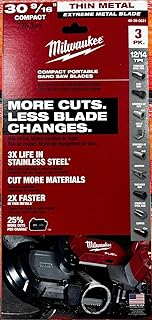
Go fine: 18 TPI or a 12/14 variable pitch, and let the saw’s own weight feed the cut. On sub-compact saws, the Milwaukee 48-39-0631 30-9/16″ 12/14 TPI blade is the right size and pitch combination for tight in-place cuts near an assembled fixture.
Why does my blade cut in a curve instead of straight?
Usually one dull side of the set, often from cutting hardened material or forcing the feed. Check tension and guide adjustment first, but if the blade consistently pulls one direction under light pressure, replace it — a wandering band will never give you a face that reads clean under a lamp.
Can one blade handle both wood and metal?
Technically yes, practically no. Metal cutting glazes the gullets and cutting wood afterward drops surface quality noticeably. Keep two blades and swap them; the four minutes cost less than the sanding.
How do I know when to change a blade?
Listen and look. A rising pitch, more sparks or dust than chips, and a cut face that shines rather than shears all mean the edge is gone. Blades die gradually, and finish quality drops long before the cut speed does.
Final Thoughts
For a lighting-focused shop, two blades cover most of the work: the Timber Wolf 1/2″ 4 TPI for resawing bases, plinths, and thin diffuser stock, and the Lenox Classic Tuff Tooth 18 TPI for brass and aluminum where the cut edge stays visible. Add the Imachinist M42 10/14 TPI when you move into solid bar and heavier brackets, and keep the LENOX 14 TPI five-pack on the shelf so a dull blade is never the reason you settle for a rough face.