Key takeaways
- Sustained CFM, not peak: An HVLP or LVLP gun draws continuously. Match the rating at 90 PSI to your gun’s requirement with roughly 30% headroom, or the compressor will cycle mid-panel and leave a visible seam under angled light.
- Tank volume as a buffer: Larger tanks smooth pressure between motor cycles. Eight gallons handles panels and touch-ups; 13 to 20 gallons lets you lay a full base coat without chasing the gauge.
- Oil-free versus lubricated: Oil-free pumps remove the biggest contamination risk for paint work. Whichever you pick, budget for a water separator and desiccant filter — humid air is the most common cause of blush and fisheye.
- Noise level and shop ambience: A 70 dB machine sits under conversation. A 90 dB one dominates a garage attached to a house and makes you rush. Quiet compressors also run cooler and typically last longer.
- Mobility and drainage: Wheels matter if the compressor has to leave the corner. An automatic drain valve matters more, because forgotten condensate rusts tanks and eventually finds its way into your air line.
What's inside
Every finish is really a lighting problem. I spend my working hours aiming fixtures at surfaces and deciding what a material will confess under a hard beam, and nothing confesses faster than automotive paint. Orange peel, dry spray, mottled metallic, a faint tiger-stripe in the clear — none of it shows under flat overhead fluorescents, and all of it shows the moment a car rolls into daylight or under a showroom’s raking wash. The culprit is almost never the gun. It’s air that arrives unevenly, at the wrong pressure, carrying moisture or oil the spray pattern then prints into the panel.
This guide looks at compressors the way I look at a light source: for stability, duty cycle, and how much of the room they take over. Below are the machines worth considering in 2026 for spraying cars in a home garage or a small detail bay, with notes on the CFM you actually need, why tank volume matters more than horsepower claims, and how noise quietly determines whether you enjoy the work at all.
As an Amazon Associate we earn from qualifying purchases.



🛒 Best Price Today on Amazon
Prime members get fast, free shipping on everything above, plus member-only deals. New members get a 30-day free trial — cancel anytime.
How to Choose a/an Air Compressor For Painting Cars (2026)
- Sustained CFM, not peak: An HVLP or LVLP gun draws continuously. Match the rating at 90 PSI to your gun’s requirement with roughly 30% headroom, or the compressor will cycle mid-panel and leave a visible seam under angled light.
- Tank volume as a buffer: Larger tanks smooth pressure between motor cycles. Eight gallons handles panels and touch-ups; 13 to 20 gallons lets you lay a full base coat without chasing the gauge.
- Oil-free versus lubricated: Oil-free pumps remove the biggest contamination risk for paint work. Whichever you pick, budget for a water separator and desiccant filter — humid air is the most common cause of blush and fisheye.
- Noise level and shop ambience: A 70 dB machine sits under conversation. A 90 dB one dominates a garage attached to a house and makes you rush. Quiet compressors also run cooler and typically last longer.
- Mobility and drainage: Wheels matter if the compressor has to leave the corner. An automatic drain valve matters more, because forgotten condensate rusts tanks and eventually finds its way into your air line.
The Best Air Compressor For Painting Cars (2026)s Reviewed
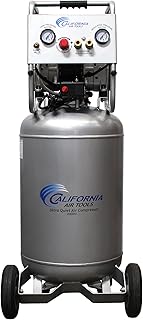
California Air Tools 20020AD
The most complete choice here for real bodywork: 2.0 HP, a 20-gallon tank, and a 70 dB noise floor that makes long sessions genuinely pleasant. The automatic drain valve is the unsung feature — it quietly protects your paint from the moisture that ruins gloss.
VEVOR 13-Gallon Air Compressor
At 4.6 SCFM at 90 PSI with a 13-gallon reserve and 125 PSI ceiling, this covers most HVLP guns with room to spare, and 66 dB is remarkably restrained for the output. The thickened steel body and wheels suit a garage that doubles as storage.
California Air Tools CAT-4610AC
The aluminum twin-tank build keeps it light enough to carry, and the oil-free pump is clean out of the box. Think of it as a spot-repair and panel tool rather than a full-respray machine — 4.6 gallons is a small buffer for continuous spraying.
8 Gallon Ultra Quiet Air Compressor
A 4.52 CFM rating from a 1.5 HP motor at 70 dB is a strong efficiency story, and 115 PSI is plenty for gun work. Best suited to bumpers, doors, and wheels where you can pause between passes.
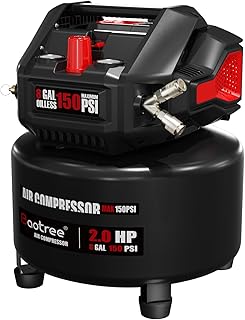
Baotree 8 Gallon Portable Air Compressor
Max 150 PSI gives useful headroom for filters and regulators that eat pressure, and 2.8 SCFM at 90 PSI handles LVLP guns and nailers well. A sensible dual-purpose pick if painting is one of several jobs in your shop.
Frequently Asked Questions
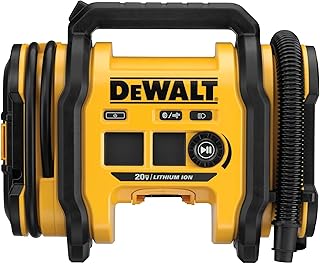
Can I paint a car with the DEWALT DCC020IB?
No. The DEWALT 20V MAX inflator is excellent for tires, with automatic shut-off and an LED light, but it produces no meaningful CFM for a spray gun. Keep it as a companion tool.
How much CFM do I actually need?
Most HVLP guns want 9 to 13 CFM at 30 to 40 PSI inlet; LVLP guns often run on 3 to 5. Check your gun’s spec sheet before the compressor’s.
Does a quiet compressor spray differently?
Not directly, but it changes how you work. Lower noise means slower, more deliberate passes, and deliberate passes are what produce a clean reflection.
What filtration should I add?
At minimum a water separator at the tank, a coalescing filter mid-line, and a desiccant dryer at the gun. Air quality is inseparable from finish quality.
Final Thoughts
For anyone spraying whole panels or full cars, the California Air Tools 20020AD is the machine I’d build a bay around — quiet, high-capacity, and self-draining. The VEVOR 13-Gallon is the value alternative with nearly the same working comfort, and the CAT-4610AC earns its place for portable touch-up work where every reflection still has to read clean.