Key takeaways
- Surface finish over surface color: Matte and lightly textured tops scatter light; high-gloss laminates return it straight into your face. If you work under overhead fixtures, a low-sheen finish does more for comfort than any monitor setting.
- Clamp clearance at the rear edge: Check the top’s thickness and whether the frame’s crossbar sits far enough forward to leave the back lip free. Most quality task lamps and monitor lights need 1–2 inches of unobstructed edge to bite onto.
- Height range against your light sources: Measure the bottom of your window frame and any pendant fixtures before buying. A desk whose maximum height pushes your monitor above the window sill turns daylight into permanent backlight glare.
- Depth for screen distance: Deeper tops let you push displays back, which softens the brightness differential between screen and wall behind it. Thirty inches gives you real latitude; twenty-four is workable but tight with dual monitors.
- Cable management that survives travel: Every raise and lower tugs your lamp cords. Trays and clips that keep power runs slack prevent the slow disconnection creep that plagues motorized desks.
What's inside
Most desk shopping advice ignores the thing that actually determines how a workspace feels: the way light lands on it. A desk that rises and falls changes its relationship to every lamp and window in the room, and buyers rarely account for that. Raise a surface twelve inches and a warm task lamp that used to pool nicely across your keyboard is now glaring into your eyes at temple height. A glossy top that looked rich in the showroom becomes a mirror for your ceiling fixture the moment you’re standing over it. The complaints that follow — eye fatigue, headaches by 3pm, screens that seem washed out — usually get blamed on the monitor.
This guide evaluates six adjustable desks with surface finish, glare behavior, and lamp compatibility treated as primary criteria rather than afterthoughts. I’ve considered how each top material handles reflected light, whether the frame geometry leaves room for clamp-mounted fixtures, and how the footprint interacts with typical window placement. Load capacity, motor noise, and memory presets are covered too, since those determine whether you’ll actually use the height range you paid for.
As an Amazon Associate we earn from qualifying purchases.


How to Choose a/an Adjustable Desk (2026)
- Surface finish over surface color: Matte and lightly textured tops scatter light; high-gloss laminates return it straight into your face. If you work under overhead fixtures, a low-sheen finish does more for comfort than any monitor setting.
- Clamp clearance at the rear edge: Check the top’s thickness and whether the frame’s crossbar sits far enough forward to leave the back lip free. Most quality task lamps and monitor lights need 1–2 inches of unobstructed edge to bite onto.
- Height range against your light sources: Measure the bottom of your window frame and any pendant fixtures before buying. A desk whose maximum height pushes your monitor above the window sill turns daylight into permanent backlight glare.
- Depth for screen distance: Deeper tops let you push displays back, which softens the brightness differential between screen and wall behind it. Thirty inches gives you real latitude; twenty-four is workable but tight with dual monitors.
- Cable management that survives travel: Every raise and lower tugs your lamp cords. Trays and clips that keep power runs slack prevent the slow disconnection creep that plagues motorized desks.
The Best Adjustable Desk (2026)s Reviewed
FEZIBO 48 × 24 Electric Standing Desk, Maple
The maple laminate is the standout here from a lighting perspective: warm-toned, low-sheen, and forgiving under both daylight and 2700K task lamps, where darker tops tend to read as flat voids. Three memory presets and a compact 48 × 24 footprint make it a sensible pick for a bedroom corner or a room where the desk shares wall space with a window.
ErGear 48 × 24 Electric Standing Desk, Black
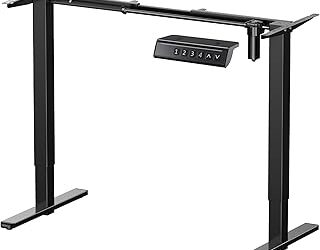
Black tops absorb rather than reflect, which eliminates ceiling-fixture glare entirely but demands more from your task lighting — plan on a dedicated lamp with a directional shade rather than relying on ambient room light. The steel frame is genuinely stable at height and the four presets and one-touch control make transitions frictionless enough that you’ll actually use them.
VIVO 60 × 30 Standing Desk (DESK-KIT-1B6-P3B)
Sixty inches wide by thirty deep is the sweet spot for anyone running dual displays and a separate lighting setup, since you can position a bar light or two clamp lamps without crowding your working area. The included cable tray handles the cord slack that motorized height changes create, and the 220 lb capacity means heavy monitor arms and fixtures won’t strain it.
Veken 47 × 28 Electric Standing Desk with Drawers, Brown
The brown finish reads warm under incandescent and LED alike, and the built-in drawers keep clutter off a surface where shadows from stacked objects would otherwise fragment your lighting. Quiet lift and three presets round out a desk that suits smaller rooms needing storage and a calm visual field.
VIVO 60 × 30 Extra Deep Standing Desk (DESK-KIT-1B6B-30)
The extra depth is the real feature: it lets you push monitors well back from your eyes, reducing the contrast gap between bright screen and dim wall that causes most end-of-day eye strain. Same 220 lb rating and memory presets as its sibling, with a frame that stays planted at full extension.
Frequently Asked Questions
Does desk color really affect eye comfort?
It affects reflected glare, which is a real contributor to fatigue. Light matte tops bounce diffuse fill light upward and reduce screen-to-surround contrast; dark tops eliminate specular reflections but require better task lighting to avoid a harsh bright-screen-in-dark-field setup.
Where should a lamp go on a sit-stand desk?
Mount it so the shade stays above your seated eye line and below your standing eye line, or choose a monitor-mounted light bar that travels with the screen. Fixed desk lamps that work perfectly seated often glare when you stand.
Will a clamp lamp fit any of these desks?
Most standard clamps handle tops up to about 1.5 inches and need a clear rear edge. Desks with rear crossbars or full-width cable trays can interfere, so measure before ordering a fixture.
Is a wider desk better for lighting?
Generally yes. Extra width gives you somewhere to place fixtures that isn’t your working area, letting you light the surface from an angle rather than directly overhead where it casts hand shadows onto your keyboard.
Final Thoughts
For most setups the VIVO 60 × 30 extra-deep model is the strongest all-round choice, since depth buys you screen distance and gentler contrast. If you want a surface that stays visually warm under any lamp, the FEZIBO in maple is the pick, and the Veken 47 × 28 handles smaller rooms where storage and a clean, shadow-free top matter most.