Key takeaways
- Tooth Count & Geometry: Higher tooth counts (80–100) shear wood fibers more gently, leaving a surface that catches light evenly instead of scattering it across micro-tears. ATB (Alternating Top Bevel) grinds excel at crosscutting, while TCT (Tungsten Carbide Tipped) tips hold an edge longer under abrasive loads.
- Kerf Thickness: Thin-kerf blades remove less material per pass, reducing tear-out on delicate moldings and trimming motor strain. Full-kerf options offer more rigidity for dense hardwoods where blade deflection would show as visible washboarding.
- Carbide Grade & Tip Count: Industrial-grade carbide stays sharp through hundreds of cuts, preserving that factory-fresh edge that distinguishes a showpiece joint from one that needs filler. More tips generally mean more re-sharpenings before replacement.
- Arbor Size & Compatibility: The standard 1-inch arbor fits most 12-inch sliding and compound miter saws, but always verify your saw’s bore before ordering. Adapter rings exist but introduce a potential vibration point that undermines cut quality.
- Intended Material: A blade tuned for clean crosscuts in pine will behave differently in melamine or MDF. Multi-purpose blades offer convenience; dedicated finish blades deliver superior results when your project demands visible joinery under gallery-level lighting.
What's inside
Anyone who has watched afternoon light rake across a freshly finished tabletop knows the truth: precision cuts aren’t just structural — they’re visual. A miter saw blade that leaves tear-out, burn marks, or fuzzy grain turns every joint into a shadow trap and every chamfer into a missed opportunity for clean, luminous lines. The problem isn’t finding a 12-inch blade; it’s filtering through hundreds of listings that all claim “ultra fine finish” without explaining what actually delivers one.
This guide narrows the field to six serious contenders and separates the blades that genuinely produce glass-smooth crosscuts from the ones that merely market themselves well. We evaluated each blade on cut quality under real shop lighting, noise profile, carbide longevity, and how well it plays across hardwoods, softwoods, and engineered sheet goods — so you can pick one that makes every piece you build look intentional, not merely assembled.
As an Amazon Associate we earn from qualifying purchases.


🛒 Best Price Today on Amazon
Prime members get fast, free shipping on everything above, plus member-only deals. New members get a 30-day free trial — cancel anytime.
How to Choose a 12-Inch Miter Saw Blade (2026)
- Tooth Count & Geometry: Higher tooth counts (80–100) shear wood fibers more gently, leaving a surface that catches light evenly instead of scattering it across micro-tears. ATB (Alternating Top Bevel) grinds excel at crosscutting, while TCT (Tungsten Carbide Tipped) tips hold an edge longer under abrasive loads.
- Kerf Thickness: Thin-kerf blades remove less material per pass, reducing tear-out on delicate moldings and trimming motor strain. Full-kerf options offer more rigidity for dense hardwoods where blade deflection would show as visible washboarding.
- Carbide Grade & Tip Count: Industrial-grade carbide stays sharp through hundreds of cuts, preserving that factory-fresh edge that distinguishes a showpiece joint from one that needs filler. More tips generally mean more re-sharpenings before replacement.
- Arbor Size & Compatibility: The standard 1-inch arbor fits most 12-inch sliding and compound miter saws, but always verify your saw’s bore before ordering. Adapter rings exist but introduce a potential vibration point that undermines cut quality.
- Intended Material: A blade tuned for clean crosscuts in pine will behave differently in melamine or MDF. Multi-purpose blades offer convenience; dedicated finish blades deliver superior results when your project demands visible joinery under gallery-level lighting.
The Best 12-Inch Miter Saw Blades (2026) Reviewed
DEWALT DWA112100 12-Inch 100-Tooth Fine Finish
DEWALT’s 100-tooth ultra-sharp carbide blade sets a high bar for shop-floor consistency. The fine pitch produces burn-free crosscuts in cherry and maple that need virtually no sanding — exactly the kind of surface where directional light reveals nothing but clean grain. Its full-kerf body resists deflection on compound angles, and the carbide tips maintain edge integrity well past the point where cheaper blades start leaving fuzzy lines.
Diablo D1280X 12-Inch 80-Tooth Fine Finish
Diablo’s Hi-Density carbide formulation gives this 80-tooth blade a distinct edge in value-to-performance ratio. At twenty fewer teeth than the DEWALT, it trades a marginal amount of surface refinement for noticeably faster feed rates — a worthwhile exchange when you’re cutting crown molding in volume. The laser-cut anti-vibration slots keep noise down and prevent the harmonic ringing that can mask binding issues during long sessions.
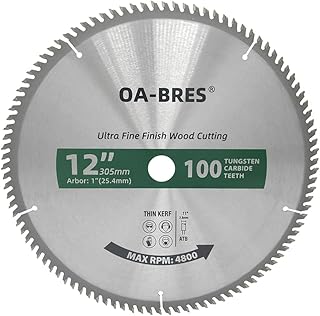
100-Tooth ATB TCT Ultra Fine Finish Circular Saw Blade
This unbranded 100-tooth ATB/TCT blade punches above its price class, delivering a polished finish that holds up under close inspection. The alternating top bevel grind clears chips efficiently, reducing heat buildup that causes discoloration on light-colored species like poplar and maple. For hobbyists building furniture on a budget, it offers finish quality that rivals premium-name alternatives without the premium invoice.
DEWALT DWA112CMB Combo Pack (40 & 60 Tooth)
The combo pack approach makes practical sense for woodworkers who split time between rough dimensioning and finish work. The 40-tooth blade handles rapid stock removal with surprising smoothness, while the 60-tooth blade steps in when joinery quality matters. Having both blades dialed in and ready on a shelf eliminates the false economy of pushing one blade past its comfort zone.
FOXBC 100-Tooth Ultimate Polished Finish
FOXBC targets the finish-craft niche directly with this 100-tooth blade, and the result is a surface so smooth it practically glows under shop lights. The thin-kerf design reduces material waste — a real consideration when you’re working with figured exotics at forty dollars per board foot. Edge life is respectable, though not quite matching DEWALT’s longevity under sustained daily use.
Frequently Asked Questions
How many teeth should a 12-inch miter saw blade have for furniture work?
For visible furniture joints and finish cuts, aim for 80 to 100 teeth. The higher tooth count produces a smoother surface that reflects light uniformly, eliminating the micro-shadows that telegraph tear-out in stained or finished pieces. Lower tooth counts (40–60) work well for dimensioning and rough cuts where surface quality is irrelevant.
Are thin-kerf blades better than full-kerf for miter saws?
Thin-kerf blades generate less waste and require less motor power, which matters for compound cuts in dense hardwoods. Full-kerf blades offer greater lateral stability, reducing blade wander on thick stock. Choose based on your saw’s motor capacity and the thickness of material you cut most often.
Can I use a Diablo blade on a DEWALT miter saw?
Yes — both brands use the standard 1-inch arbor bore that fits most 12-inch miter saws. Always confirm your specific saw model’s arbor size in the owner’s manual before purchasing, though the 1-inch standard is nearly universal in this class.
When should I replace my miter saw blade instead of sharpening it?
Replace when carbide tips show visible chipping, when cuts require noticeably more force, or when burn marks appear despite proper technique and sharp blade alignment. Most quality carbide blades can be professionally sharpened two to three times before the tips are too short for safe, effective cutting.
Final Thoughts
For most furniture-focused woodworkers, the DEWALT DWA112100 delivers the best combination of cut quality and durability — it’s the blade that makes you stop sanding and start admiring. The Diablo D1280X earns the value pick, offering 90% of that performance at a friendlier price point. And if your budget is tight but your standards aren’t, the 100-Tooth ATB TCT blade proves that excellent finish cuts don’t require a brand-name premium. Pick the one that matches your workflow, let the blade do the finishing work, and watch your projects catch the light the way fine furniture should.