Key takeaways
- Map your travel range first: Measure from floor to desk surface, subtract 10 to 12 inches, and confirm the chair’s cylinder covers that number with room to spare. A 22″–30″ range suits most 40″ to 46″ desks; anything shorter leaves you reaching upward with raised shoulders.
- Read the surface, not the swatch: Faux leather returns a tight specular highlight that will mirror a ceiling fixture straight back at anyone across the room. Mesh diffuses that same light into nothing. Choose leather for warm, lamp-lit studios and mesh for spaces with bright overheads or skylights.
- Treat the footrest ring as structural: A ring with independent height adjustment lets you set thigh angle after you set seat height, which keeps your pelvis neutral. A welded, fixed ring only works if your inseam happens to match the designer’s assumption.
- Insist on flip-up arms: Standing desks live close to walls and under shelving. Arms that fold flush let the chair tuck fully out of the lighting path when you stand, so it stops casting a shadow bar across your work surface.
- Check the backrest height against your sightlines: Mid-back shells keep the room visually open and won’t block a sconce or a wall wash. Tall executive backs offer more support but read as a solid mass in small rooms, so reserve them for spaces with depth behind the desk.
What's inside
Raise a desk to standing height and you change more than your posture. You change your eye line, and with it the entire lighting geometry of the room. A pendant that hung politely above your head now sits in your peripheral vision. The window that used to backlight your monitor is suddenly level with it. Most people notice the ache before they notice the glare, so they buy the first tall stool they find, perch on a flat pad with no footrest, and wonder why the space feels harsher than it did before.
I specify seating for rooms where light is the primary material, and drafting chairs are one of the few pieces that move a person through two or three distinct lighting zones in a single workday. This guide looks at the tall chairs worth owning in 2026 through that lens: how their travel range lines up with fixture heights, how their surfaces behave under downlights and screens, and where the ergonomics actually hold up over a long afternoon.
As an Amazon Associate we earn from qualifying purchases.


How to Choose a Drafting Chair For Standing Desk (2026)
- Map your travel range first: Measure from floor to desk surface, subtract 10 to 12 inches, and confirm the chair’s cylinder covers that number with room to spare. A 22″–30″ range suits most 40″ to 46″ desks; anything shorter leaves you reaching upward with raised shoulders.
- Read the surface, not the swatch: Faux leather returns a tight specular highlight that will mirror a ceiling fixture straight back at anyone across the room. Mesh diffuses that same light into nothing. Choose leather for warm, lamp-lit studios and mesh for spaces with bright overheads or skylights.
- Treat the footrest ring as structural: A ring with independent height adjustment lets you set thigh angle after you set seat height, which keeps your pelvis neutral. A welded, fixed ring only works if your inseam happens to match the designer’s assumption.
- Insist on flip-up arms: Standing desks live close to walls and under shelving. Arms that fold flush let the chair tuck fully out of the lighting path when you stand, so it stops casting a shadow bar across your work surface.
- Check the backrest height against your sightlines: Mid-back shells keep the room visually open and won’t block a sconce or a wall wash. Tall executive backs offer more support but read as a solid mass in small rooms, so reserve them for spaces with depth behind the desk.
The Best Drafting Chair For Standing Desk (2026)s Reviewed
22″–30″ Mesh Drafting Chair with 7″ Lift Footrest Ring
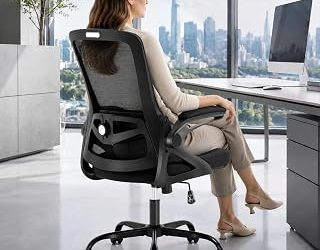
The widest usable adjustment range here, and the 7-inch footrest lift is the detail that separates it from cheaper mesh stools. The breathable back scatters overhead light rather than bouncing it, making this the most forgiving choice for rooms with strong ceiling fixtures or an unshaded window behind you.
Flip-Up Armrest Drafting Chair with Adjustable Footrest Ring
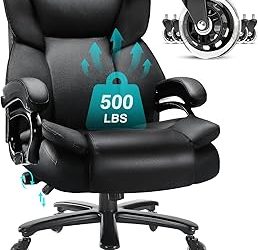
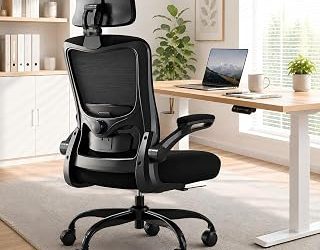
A quietly competent all-rounder: firm lumbar curve, genuinely adjustable ring, and arms that fold clear so the chair disappears under the desk when you switch to standing. The matte black finish holds no highlights, which is why it works in nearly any lighting scheme without drawing attention to itself.
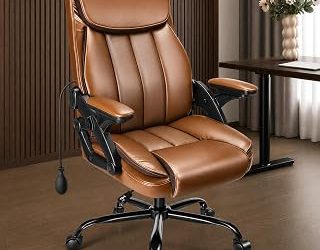
Misolant Leather Drafting Chair with Flip-Up Armrest
Better suited to studios lit by lamps and warm sources, where the leather picks up soft gradients instead of hard glare. Cushioning is denser than the mesh options, so it rewards long seated stretches at counter-height desks more than constant sit-stand switching.
Premium Faux Leather Drafting Chair with Multi-Function Arms
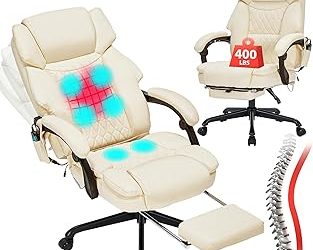
The multi-function arms are the standout, letting you set height and angle independently so your forearms stay level with a raised keyboard. Its mid-back shell keeps the visual mass low, which preserves wall washes and shelf lighting behind the desk.
Misolant Leather High Executive Drafting Chair
The most formal option, with a taller shell and a presence that suits a dedicated office over a shared living space. Worth noting that the high back will interrupt any light source directly behind it, so give it room or plan your fixtures around it.
Frequently Asked Questions
What seat height do I need for a standing desk?
Subtract 10 to 12 inches from your desk height. For a 42-inch surface, target roughly 30 to 32 inches of seat height, then use the footrest ring to support your feet at that elevation.
Is mesh or leather better for a drafting chair?
Mesh stays cooler and keeps glare down, which matters near windows and bright overheads. Leather feels more substantial and photographs well in warm, low light, but it shows fingerprints and reflects fixtures.
Do I really need an adjustable footrest ring?
Yes. Without foot support at that height your legs dangle, circulation suffers, and you slide forward off the seat within twenty minutes. Fixed rings work only if the height happens to fit you.
Will a drafting chair work at a normal desk too?
Most drop low enough to be usable, though the tall cylinder and ring make them clumsy at a 29-inch desk. If your setup rarely goes up, a standard task chair is the better buy.
Final Thoughts
For most rooms, the 22″–30″ Mesh Drafting Chair with 7″ Lift Footrest Ring is the safest specification: the broadest range, the best footrest travel, and a surface that never fights your lighting. The Premium Faux Leather model with multi-function arms is the pick if precise arm positioning matters more than breathability, while the Misolant Leather Drafting Chair suits warmly lit studios where the chair should read as furniture rather than equipment.