Key takeaways
- Go dense, not deep: Over existing carpet you already have cushion underfoot. Adding a thick, soft layer lets the rug flex and roll. A firm 1/4″ pad stabilizes the field; save the half-inch plush for bare floors.
- Understand grip over pile: Natural rubber bonds beautifully to sealed wood and tile, but on carpet it works by friction against fiber tips rather than suction. Needle-punched felt with a textured face often holds better on low-pile, while dual-surface pads split the difference if you also move rugs between rooms.
- Watch your clearance lines: Add carpet height, pad height, and rug height together before you commit. Interior doors, closet sweeps, and floor-length curtains all have a hard limit, and a curtain hem that suddenly bunches will read as sloppy under wall washing.
- Trim to a shadow gap: Cut the pad about an inch shy of the rug on all sides. That small inset lets the rug edge taper to the floor instead of ending on a cliff, which softens the shadow your lamps cast along the perimeter.
- Check the material honesty: Recycled felt and natural rubber breathe and stay put. Adhesive-tacky plastic films can transfer residue into carpet fibers and discolor over time, especially in sunlit zones.
What's inside
Rug-on-carpet is the layering trick that makes a room feel composed, and it’s also the one that betrays a cheap pad the fastest. I spend my days aiming light at floors, and nothing announces a problem quicker than a low-angled beam from a floor lamp skimming across a rug that has started to travel. Every ripple throws a hard shadow line. Corners lift and catch a highlight on their underside. What should read as one calm plane of color turns into a topographic map the moment the sun drops and your lamps take over.
The fix is a pad chosen for carpet specifically, not a general-purpose one borrowed from a hardwood install. Below are the pads I keep specifying for layered installs, plus the selection logic I use on site: how thickness interacts with clearance and shadow, why grip behaves differently over pile than over wood, and which construction keeps a rug flat enough that raking light finds nothing to grab onto.
As an Amazon Associate we earn from qualifying purchases.


How to Choose a Rug Pad For Carpeted Floors (2026)
- Go dense, not deep: Over existing carpet you already have cushion underfoot. Adding a thick, soft layer lets the rug flex and roll. A firm 1/4″ pad stabilizes the field; save the half-inch plush for bare floors.
- Understand grip over pile: Natural rubber bonds beautifully to sealed wood and tile, but on carpet it works by friction against fiber tips rather than suction. Needle-punched felt with a textured face often holds better on low-pile, while dual-surface pads split the difference if you also move rugs between rooms.
- Watch your clearance lines: Add carpet height, pad height, and rug height together before you commit. Interior doors, closet sweeps, and floor-length curtains all have a hard limit, and a curtain hem that suddenly bunches will read as sloppy under wall washing.
- Trim to a shadow gap: Cut the pad about an inch shy of the rug on all sides. That small inset lets the rug edge taper to the floor instead of ending on a cliff, which softens the shadow your lamps cast along the perimeter.
- Check the material honesty: Recycled felt and natural rubber breathe and stay put. Adhesive-tacky plastic films can transfer residue into carpet fibers and discolor over time, especially in sunlit zones.
The Best Rug Pad For Carpeted Floors (2026)s Reviewed
RUGPADUSA Dual Surface 1/4″
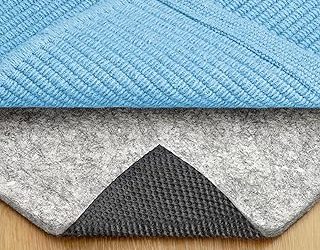
The most versatile pick here: a felt body bonded to natural rubber, firm enough to keep an 8’x10′ from creeping across low-pile carpet while still giving a little softness. It’s my default when a client may relocate the rug later, since it performs equally well on bare floors without leaving anything behind.
RUGPADUSA Basics 1/4″
All-felt, no rubber, and genuinely the right answer for many carpet installs where you want stabilization and body rather than tack. It adds enough loft to make a flatweave read richer under a warm lamp, and the dense construction resists the rolling that creates those ugly shadow ridges.
Jorvila Non-Slip Rug Pad Gripper 8×10
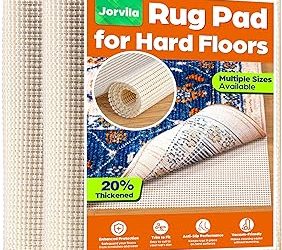
A budget-friendly cushioned option that punches above its price for renters and guest rooms. Grip is best on low-pile carpet and firm surfaces; on deep plush you’ll want to pair it with rug corner anchors in high-traffic paths.
RUGPADUSA Eco-Plush 1/2″
The luxury choice, and the one to reserve for thin flatweaves over very low-pile or commercial-grade carpet where the extra half-inch won’t cause buckling. Under directional light, that added loft deepens the pile shadow and makes color read noticeably fuller.
RUGPADUSA Eco-Plush, Thinner Cut
Because Eco-Plush comes in three thicknesses, you can order the same recycled felt in a lower profile when door clearance is tight. This is the workaround I use most often in hallways and bedrooms where the full half-inch simply won’t fit.
Frequently Asked Questions
Do I really need a pad if there’s already carpet underneath?
Yes, for movement control more than cushion. Without a pad, a rug slides and wrinkles against pile, and those wrinkles become permanent creases that catch light for years.
Will a rubber-backed pad damage my carpet?
Natural rubber is safe on wall-to-wall carpet. The materials to avoid are PVC and adhesive-coated plastics, which can leave residue or discoloration.
How thick should the pad be over carpet?
1/4″ is the reliable range. Thicker pads work on hardwood but tend to amplify buckling when stacked on existing cushion.
Can I cut a pad to fit an odd rug size?
Felt pads cut cleanly with a utility knife or heavy shears. Measure the rug, subtract an inch per side, and cut on the floor rather than folded.
Final Thoughts
For most layered installs, the RUGPADUSA Dual Surface 1/4″ is the safest specification, with the all-felt Basics 1/4″ a close second when you want stability without tack. If your base carpet is genuinely low-pile and clearance allows, the Eco-Plush adds a depth of shadow and color that photographs beautifully under warm evening light.