Key takeaways
- Length and coverage: Aim to fill roughly two thirds to three quarters of each cabinet’s width, then link segments across a run. A 36-inch bar under a 42-inch cabinet gives a continuous wash; two short bars with a gap between them produces visible hot spots and dark valleys.
- Color rendering: This is the spec that separates a designer install from a builder-grade one. Look for CRI above 90 and, ideally, a published R9 value above 80, since R9 governs deep reds — raw meat, peppers, wine, your own hands.
- Selectable color temperature: Multi-CCT fixtures let you match existing pendants and recessed cans after installation rather than guessing from a product page. 2700K reads warm and residential, 3000K is the most forgiving all-purpose choice, and 4000K and up suits pantries, closets, and workshops.
- Dimming compatibility: Confirm the driver works with the dimmer you already own. Low-voltage LED drivers can flicker or buzz on older incandescent-era dimmers, and a fixture that only dims to 20 percent won’t give you the low late-night glow that makes a kitchen feel calm.
- Lens and profile: A frosted diffuser and a low-profile housing keep the LED dots out of your sightline and off a polished countertop. Mount toward the front edge of the cabinet bottom so light falls on the work surface instead of glaring off the backsplash tile.
What's inside
Most kitchens are lit from a single point overhead, which means the person standing at the counter is casting a shadow directly onto the work they’re trying to see. It’s the most common lighting mistake in a home, and it’s the reason a beautifully renovated kitchen can still feel flat at seven in the evening. Under cabinet lighting solves it by placing the source where the task actually happens: low, forward, and aimed at the countertop rather than the top of your head.
Hardwired fixtures are the version worth installing. No cord snaking down the backsplash, no wall wart eating an outlet, and control from a wall switch or dimmer instead of an inline toggle you have to reach behind the toaster to find. This guide covers the hardwired under cabinet lights I’d specify for a residential kitchen in 2026, what separates a fixture that renders food accurately from one that makes tomatoes look grey, and how to size a run so the counter reads evenly instead of scalloped.
As an Amazon Associate we earn from qualifying purchases at no extra cost to you. Product prices and availability are accurate as of the date shown and are subject to change.


🛒 Best Price Today on Amazon
Prime members get fast, free shipping on everything above, plus member-only deals. New members get a 30-day free trial — cancel anytime.
How to Choose a Led Under Cabinet Lighting Hardwired (2026)
- Length and coverage: Aim to fill roughly two thirds to three quarters of each cabinet’s width, then link segments across a run. A 36-inch bar under a 42-inch cabinet gives a continuous wash; two short bars with a gap between them produces visible hot spots and dark valleys.
- Color rendering: This is the spec that separates a designer install from a builder-grade one. Look for CRI above 90 and, ideally, a published R9 value above 80, since R9 governs deep reds — raw meat, peppers, wine, your own hands.
- Selectable color temperature: Multi-CCT fixtures let you match existing pendants and recessed cans after installation rather than guessing from a product page. 2700K reads warm and residential, 3000K is the most forgiving all-purpose choice, and 4000K and up suits pantries, closets, and workshops.
- Dimming compatibility: Confirm the driver works with the dimmer you already own. Low-voltage LED drivers can flicker or buzz on older incandescent-era dimmers, and a fixture that only dims to 20 percent won’t give you the low late-night glow that makes a kitchen feel calm.
- Lens and profile: A frosted diffuser and a low-profile housing keep the LED dots out of your sightline and off a polished countertop. Mount toward the front edge of the cabinet bottom so light falls on the work surface instead of glaring off the backsplash tile.
The Best Led Under Cabinet Lighting Hardwired (2026)s Reviewed
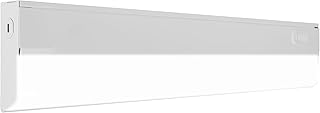
36-Inch 22W Hardwired Under Cabinet Light, CRI>92
The strongest color performance in this group: CRI above 92 with R9 above 90, which is territory usually reserved for architectural tape light. At 1426 lumens across 36 inches it’s genuinely bright, so pair it with a dimmer and treat full output as prep lighting rather than evening ambience.
24-Inch 12W Linkable 5-CCT Under Cabinet Light
A well-balanced workhorse with five color temperatures from 2700K to 5000K and a diffused, eye-care lens that keeps individual diodes from reflecting off quartz. Linkability plus an ETL listing makes it easy to run three or four segments along a full galley wall from a single feed.
UltraPro 24-Inch Hardwired Under Cabinet Light
A dependable pick if you want fewer decisions: 908 lumens, three color temperatures spanning soft to cool white, and clean linkable connections. Output is moderate rather than aggressive, which suits kitchens with light-colored counters that already bounce plenty of light.
NICOR UCB Series 18-Inch Direct Wire Under Cabinet Light
NICOR builds to a spec-grade standard, and the UCB series shows it in the housing quality and consistent selectable CCT from 2700K to 5000K. At 9W and roughly 630 lumens it’s the right proportion for an 18 to 24-inch cabinet section or a butler’s pantry.
12-Inch Low-Profile 3CCT Linkable Fixture
The short-run problem solver, useful above a sink cabinet, a narrow spice section, or an open shelf where longer bars overhang. The Hi/Low brightness switch is a smart touch if the fixture ends up on a non-dimming circuit.
Frequently Asked Questions
Do I need an electrician to install hardwired under cabinet lighting?
If you’re tapping into a junction box or adding a switch leg, yes — and in many jurisdictions permits require it. Several of these fixtures offer a plug-in option, which is a reasonable interim step while you plan the hardwired version.
What color temperature is best for a kitchen?
3000K flatters wood, warm metals, and skin tones while still reading clean on white counters. Go 2700K if your kitchen leans traditional and your pendants are warm; reserve 4000K for utility spaces.
How bright should the run be?
Plan for roughly 300 to 400 lumens per linear foot of counter for comfortable task light. Dimming down is always easier than wishing you’d bought more output.
Can I mix different fixtures on the same circuit?
You can, but don’t. Different drivers dim at different rates and slight CCT variance between brands is obvious once the lights are side by side on one wall.
Final Thoughts
For a kitchen where you actually cook, the 36-inch CRI>92 fixture is the one I’d specify first — accurate color at the counter changes how the whole room feels. The 24-inch 12W linkable 5-CCT bar is the better value for long multi-cabinet runs, and the NICOR UCB series is the choice when you want spec-grade build quality in a shorter length.