Key takeaways
- Recline range, mapped to your ceiling: A 90–145° chair lays you back far enough that a bare overhead bulb will sit squarely in your field of view. If your only light source is central and undiffused, either choose a chair that stops nearer 135°, or plan to shade that fixture before the chair arrives.
- Headrest travel: Height-adjustable 3D and 4D headrests double as glare shields. Raised an inch or two past where your skull naturally rests, they intercept the hot spot from a lamp positioned behind and above you, which is exactly where most people put their floor lamps.
- Footrest extension and your task light: Measure how far the footrest pushes your hips back from the desk edge. Anything beyond about eight inches typically takes your hands out of a standard desk lamp’s usable pool, so favour clamp lamps with long arms or a second light source.
- Backrest translucency: Open mesh backs let window light and lamp light pass through instead of casting a hard slab of shadow across the floor behind you. It’s a subtle thing that keeps a small room feeling open rather than blocked.
- Finish, base, and floor noise: Matte black frames swallow specular highlights that polished chrome scatters. Steel and alloy bases with PU-coated wheels also roll quieter, and ambience is as much about what you don’t hear as what you see.
What's inside
Most people shop for an office chair with a footrest thinking about their legs. Then the chair arrives, they tip it back for the first time, and discover the real change: reclining moves your entire relationship to the light in the room. Your eyeline leaves the desk and lands on the ceiling fixture. Your monitor, angled for someone sitting upright, now throws a sheet of reflected window light straight back at you. The desk lamp that was pooling neatly over your keyboard is suddenly behind your shoulder, rimming the edge of your head and leaving your work in shadow. A reclining chair is a lighting decision disguised as a furniture purchase.
This guide looks at the current crop of footrest chairs the way I’d assess any seating position in a room I’m lighting: where your eyes point at each recline angle, what the backrest does to light passing through it, how far the footrest pushes you out of your task-light zone, and whether the finish quietly absorbs highlights or bounces them around. Specs matter too, and I cover them, but the picks below are judged on how livable they are in an actual lit room rather than on feature counts alone.
As an Amazon Associate we earn from qualifying purchases.


How to Choose an Office Chair With Footrest (2026)
- Recline range, mapped to your ceiling: A 90–145° chair lays you back far enough that a bare overhead bulb will sit squarely in your field of view. If your only light source is central and undiffused, either choose a chair that stops nearer 135°, or plan to shade that fixture before the chair arrives.
- Headrest travel: Height-adjustable 3D and 4D headrests double as glare shields. Raised an inch or two past where your skull naturally rests, they intercept the hot spot from a lamp positioned behind and above you, which is exactly where most people put their floor lamps.
- Footrest extension and your task light: Measure how far the footrest pushes your hips back from the desk edge. Anything beyond about eight inches typically takes your hands out of a standard desk lamp’s usable pool, so favour clamp lamps with long arms or a second light source.
- Backrest translucency: Open mesh backs let window light and lamp light pass through instead of casting a hard slab of shadow across the floor behind you. It’s a subtle thing that keeps a small room feeling open rather than blocked.
- Finish, base, and floor noise: Matte black frames swallow specular highlights that polished chrome scatters. Steel and alloy bases with PU-coated wheels also roll quieter, and ambience is as much about what you don’t hear as what you see.
The Best Office Chairs With Footrest (2026) Reviewed
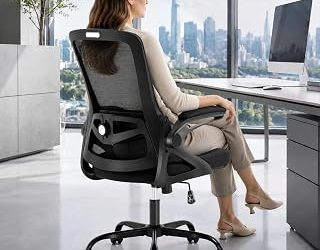
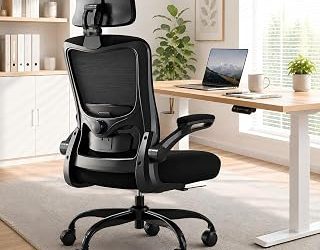
MALOL 400lbs High Back Mesh Chair
The most complete chair here: 6D armrests, a 3D headrest, seat depth adjustment and a genuine metal base that keeps the whole thing planted. The matte mesh and dark frame read as almost invisible under warm lamplight, which makes it the easiest pick for a room you actually want to spend evenings in.
Ergonomic Chair with Footrest, 90–145° Recline
The widest recline in this group and the closest thing to a nap chair, with adjustable lumbar support, a headrest and a 350lb capacity frame. Just be honest about your overhead lighting first, because at 145° you are looking directly at your ceiling for as long as you stay there.
X100 Big and Tall Mesh Chair (First Light)
Built for larger frames, with 5D flip-up arms and 3D lumbar support that lets you tune the curve rather than accept it. The lighter First Light colourway is the one worth considering in a dim room, since it picks up ambient bounce instead of turning into a dark mass in the corner.
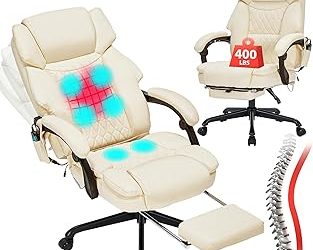
Ergonomic Chair with 4D Armrest, 400lbs Cushion
A high mesh back paired with a thickened seat cushion, which is the right combination for long reclined stretches where a thin sling starts to bite. The 135° stop keeps your sightline below most ceiling fittings, so glare stays manageable without extra shading.
Ergonomic Chair with Footrest, 135° and Large Steel Base
The oversized steel base is the story here, adding stability that cheaper nylon spiders can’t match once you extend the footrest and shift your weight rearward. A sensible 300lb, 3D-armrest package for anyone who wants recline without drama.
Frequently Asked Questions
Can I actually sleep in one of these?
Short naps, yes, particularly in the 145° models. For anything longer, the footrest gap and lack of side support will wake you before the recline angle does.
Will the footrest fit under my desk?
Retracted, almost always. Deployed, it needs clear floor space in front of the chair, so check for crossbars, cable trays and power strips before you commit to a position.
Mesh or padded for long sessions?
Mesh backs win on airflow and keep a room visually lighter; padded seats win on pressure relief. The chairs pairing a mesh back with a thickened cushion give you both.
Does a 400lb rating matter if I’m well under it?
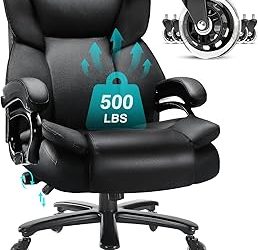
Yes, indirectly. Higher ratings usually mean thicker gas lifts and metal bases, which translates into less flex and less creak when you recline repeatedly.
Final Thoughts
For most rooms, the MALOL 400lbs mesh chair is the balanced choice, combining serious adjustability with a finish that stays discreet under lamplight. Choose the X100 First Light if you need big-and-tall support or want a chair that lifts a darker corner, and the 90–145° model if deep recline matters more to you than keeping your ceiling fixture out of frame.