Key takeaways
- Rated capacity with headroom: Choose a chair rated well above your weight, not just at it. Load ratings are tested under static conditions; daily sitting involves dropping, leaning, and twisting. A 500 lb or 600 lb rating for a 320 lb user means the frame never operates near its limit, which is where creaks and cylinder failures begin.
- Seat width and cushion depth: Look for seats around 21–24 inches wide with genuinely thick padding. Pocket-spring cushions hold their loft far longer than single-density foam, and that consistency matters — a seat that sinks two inches over a year silently changes your eye height relative to your monitor and task lamp.
- Base and caster construction: Steel or heavy nylon bases with five arms, paired with rubber-coated wheels. Rubber runs quieter than hard plastic on wood and doesn’t chatter on tile — a small thing that makes a real difference in a room you’re trying to keep peaceful.
- Adjustable lumbar, not decorative lumbar: A fixed bulge in the backrest helps almost nobody. You want lumbar support that moves vertically and in depth, so it meets your actual lower spine rather than a mannequin’s.
- Backrest material and finish: Breathable mesh keeps you cooler through long sessions; darker upholstery reads as a soft mass in the room and absorbs glare rather than throwing it back at you. Both are valid — just choose deliberately based on how much natural light your desk gets.
What's inside
I spend my working life thinking about how a room feels at 4pm in November — where the lamp sits, how much bounce comes off a desk surface, whether a corner reads as calm or clinical. And the single object that most often wrecks a carefully built workspace isn’t the fixture. It’s the chair. If a seat is too low, your eye line drops beneath the monitor and you spend the afternoon looking up into a backlit screen. If it groans every time you shift weight, no amount of warm 2700K glow will make that corner feel restful. For larger and heavier bodies, this gets sharper still: an underbuilt chair sags, tilts, and quietly relocates you a few inches away from every ergonomic reference point the room was designed around.
This guide looks at office chairs built for heavier users — 330 lb through 750 lb ratings — with an eye on the things a spec sheet tends to skip. Frame integrity under real load. Whether the cushion holds its height after six months, because a compressed seat changes your relationship to the desk and the light above it. Wheel noise. Backrest surfaces that either absorb or scatter what’s coming from the window. Below are the models worth your attention, plus a short framework for choosing well.
As an Amazon Associate we earn from qualifying purchases.




How to Choose an Office Chair For Obese Person (2026)
- Rated capacity with headroom: Choose a chair rated well above your weight, not just at it. Load ratings are tested under static conditions; daily sitting involves dropping, leaning, and twisting. A 500 lb or 600 lb rating for a 320 lb user means the frame never operates near its limit, which is where creaks and cylinder failures begin.
- Seat width and cushion depth: Look for seats around 21–24 inches wide with genuinely thick padding. Pocket-spring cushions hold their loft far longer than single-density foam, and that consistency matters — a seat that sinks two inches over a year silently changes your eye height relative to your monitor and task lamp.
- Base and caster construction: Steel or heavy nylon bases with five arms, paired with rubber-coated wheels. Rubber runs quieter than hard plastic on wood and doesn’t chatter on tile — a small thing that makes a real difference in a room you’re trying to keep peaceful.
- Adjustable lumbar, not decorative lumbar: A fixed bulge in the backrest helps almost nobody. You want lumbar support that moves vertically and in depth, so it meets your actual lower spine rather than a mannequin’s.
- Backrest material and finish: Breathable mesh keeps you cooler through long sessions; darker upholstery reads as a soft mass in the room and absorbs glare rather than throwing it back at you. Both are valid — just choose deliberately based on how much natural light your desk gets.
The Best Office Chair For Obese Person (2026)s Reviewed
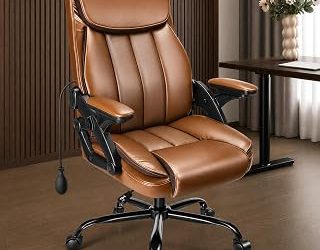
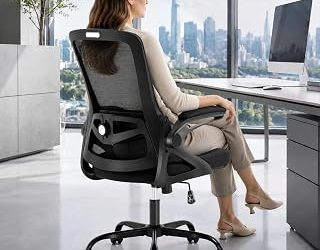
600LBS Large Heavy Duty Executive Office Chair with 5D Flip Arms
This is the most confident frame in the group — a 600 lb rating, pocket-spring seat, and dual rubber wheels that stay quiet on hard flooring. The high back and 5D flip-up arms let you tuck it fully under a desk when you want the room visually clear, which matters more than people expect in small home offices.
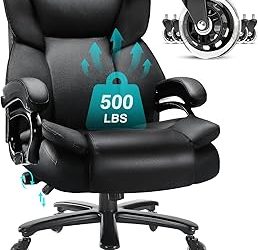
500lbs Big and Tall High Back Executive Desk Chair
A slightly more compact take on the same idea: heavy-duty build, pocket-spring cushion, adjustable lumbar, and quiet rubber casters. Good choice if you want serious capacity without a chair that dominates the corner it sits in.
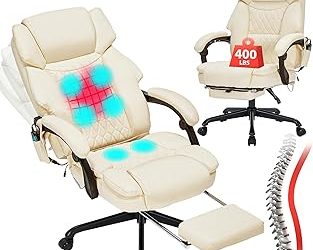
X100 Ergonomic Mesh Office Chair with Footrest
The mesh back and 3D lumbar make this the coolest-running option here, and the retractable footrest is genuinely useful for reading or evening work when you want to recline out of your task-light zone. The 5D flip-up arms are well executed.
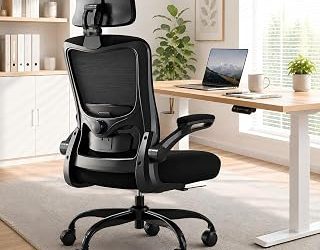
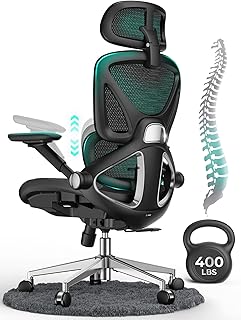
Ergonomic Mesh Office Chair 400lbs with 4D Arms and 3D Headrest
A strong middle-weight pick: 400 lb capacity, three-position tilt lock, and an adjustable headrest that actually reaches the base of the skull. Worth noting the headrest can cast a shadow if your lamp sits high and behind you — angle accordingly.
330LBS High Back Mesh Office Chair with Flip-Up Armrests
The most affordable entry, best suited to users comfortably under its 330 lb rating. Adjustable lumbar, breathable mesh, and a light visual footprint make it a reasonable secondary or guest-desk chair.
Frequently Asked Questions
Does chair height really affect screen glare?
Yes. Your seated eye height determines the angle at which you view the monitor, and that angle changes how much window or lamp reflection lands in your sightline. A chair with a stable, non-sagging cushion keeps that geometry consistent day to day.
Mesh or padded upholstery for a heavier user?
Padded seats with pocket springs generally distribute weight better and last longer under load. Mesh backs, however, are excellent for temperature — many of the best chairs here combine a cushioned seat with a mesh back.
How much capacity headroom should I allow?
Aim for at least 25–30% above your weight. It’s the cheapest insurance against gas cylinder failure, the most common complaint among heavier users.
Are 750 lb chairs overkill?
Not if you’re above 350 lb or share the chair. The 750lbs Big and Tall model with its wide thick seat cushion is the safest option in this lineup for sustained eight-hour use.
Final Thoughts
For most heavier users, the 600LBS Heavy Duty Executive Chair is the best all-round buy — quiet, generously rated, and built around a cushion that holds its height. If you run warm or work late, the X100 Mesh Chair with Footrest is the more comfortable companion for long evening sessions, and the 750lbs Big and Tall model remains the one to choose when maximum capacity is the priority.