Key takeaways
- Lowest seat position, not the range: Manufacturers advertise the span, but only the bottom number counts. Aim for a minimum seat height where your heels rest flat and your thighs stay roughly parallel to the floor. That posture holds your eye level steady, which keeps your task lamp aimed where you set it instead of drifting into your peripheral vision.
- Seat depth under 19 inches: A pan that’s too deep presses the back of your knees and quietly encourages you to slouch forward out of the lumbar curve. Shallower cushions on compact models solve this without needing a sliding mechanism.
- Backrest height and sightlines: Mid-back designs stop below shoulder blade level, leaving windows, sconces, and shelving visible behind the desk. Tall executive backs on a small frame create a solid rectangle that swallows light and makes modest rooms read as cramped.
- Upholstery sheen versus your light sources: Glossy PU throws specular highlights under downlights and can create a bright band in your lower field of view. Matte or lightly grained finishes diffuse the same light. Warm browns settle nicely under 2700K bulbs; greys and blacks hold their character better under cooler 4000K task lighting.
- Armrest clearance and flip-up geometry: Shorter sitters usually raise the seat to reach the desk, which means fixed arms collide with the desk apron. Flip-up or height-adjustable arms let you tuck in fully and keep your forearms in the lit zone rather than hovering in shadow.
What's inside
Most chair problems that land on my desk don’t arrive labeled as chair problems. Someone tells me the room feels harsh, or that they get a headache by mid-afternoon, and when I visit I find a person under 5’4″ perched on a seat pan built for someone six inches taller. Their feet dangle, so they slide forward. Sliding forward drops their eye level and pushes their head toward the monitor, which means the desk lamp that was aimed perfectly now rakes across their line of sight instead of the page. The lighting was never wrong. The seat height was.
This guide looks at compact office chairs from a slightly unusual vantage point: how they sit inside a room’s visual and physical atmosphere. Seat height sets your eye level, and eye level determines what you see — glare, window brightness, the ceiling fixture, the top edge of your screen. Upholstery finish decides whether a chair absorbs lamplight quietly or bounces a hot spot back at you. Backrest height decides whether the chair reads as furniture or as a wall. Below are six chairs designed with shorter frames in mind, plus the specifications that actually matter once you factor light into the equation.
As an Amazon Associate we earn from qualifying purchases.




How to Choose a/an Office Chair For Short People (2026)
- Lowest seat position, not the range: Manufacturers advertise the span, but only the bottom number counts. Aim for a minimum seat height where your heels rest flat and your thighs stay roughly parallel to the floor. That posture holds your eye level steady, which keeps your task lamp aimed where you set it instead of drifting into your peripheral vision.
- Seat depth under 19 inches: A pan that’s too deep presses the back of your knees and quietly encourages you to slouch forward out of the lumbar curve. Shallower cushions on compact models solve this without needing a sliding mechanism.
- Backrest height and sightlines: Mid-back designs stop below shoulder blade level, leaving windows, sconces, and shelving visible behind the desk. Tall executive backs on a small frame create a solid rectangle that swallows light and makes modest rooms read as cramped.
- Upholstery sheen versus your light sources: Glossy PU throws specular highlights under downlights and can create a bright band in your lower field of view. Matte or lightly grained finishes diffuse the same light. Warm browns settle nicely under 2700K bulbs; greys and blacks hold their character better under cooler 4000K task lighting.
- Armrest clearance and flip-up geometry: Shorter sitters usually raise the seat to reach the desk, which means fixed arms collide with the desk apron. Flip-up or height-adjustable arms let you tuck in fully and keep your forearms in the lit zone rather than hovering in shadow.
The Best Office Chair For Short People (2026)s Reviewed
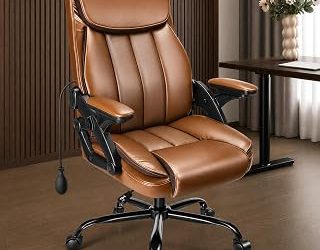
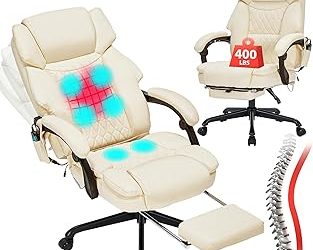
Leather Swivel Chair with Lumbar Support (Brown)
The brown PU carries a soft, low-gloss quality that behaves beautifully under warm incandescent or 2700K LED lamps, absorbing rather than reflecting. Padded arms and a genuinely low seat drop make this the pick for a home study where the chair needs to look like furniture, not equipment.
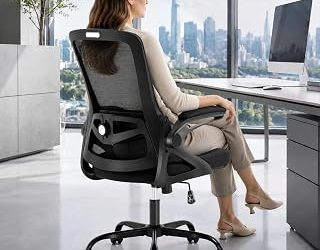
PU Home Computer Desk Chair with Ergonomic Back Support
A compact, honest performer with a tight footprint and adjustable armrests that clear most standard desk aprons. The scaled-down backrest keeps the space behind your desk visually open, which matters if a window or wall lamp sits in that plane.
Upgraded PU Chair with Double-Layer Cushion and Neckrest
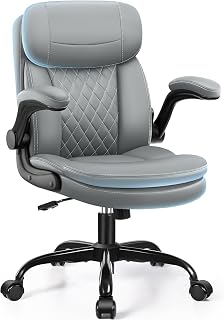
The dual-layer cushion resists the flattening that pushes shorter sitters into a forward slump by month three, and the grey finish holds its tone under cooler daylight-balanced bulbs. The neckrest is the one element to check against your own proportions before committing.
Executive Chair with Lumbar Support and Flip-up Armrest
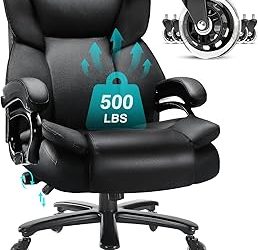
Flip-up arms are the quiet hero here, letting you raise the seat to a proper eye level and still slide fully under the desk. Black PU is the most forgiving surface for rooms with bright overhead fixtures, since it simply refuses to create a hot spot.
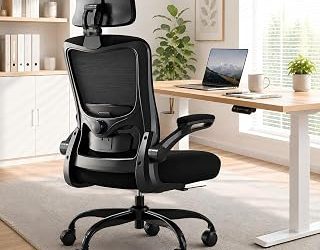
Ylzyxal Ergonomic Office Desk Chair
Tilt lock plus adjustable lumbar support means you can dial in a working angle and keep it, which stabilises your head position relative to your monitor and lamp. The padded flip-up arms make it a strong fit for shared desks where two people of different heights trade off.
Frequently Asked Questions
What seat height should I look for if I’m 5’0″?
Roughly 15 to 16.5 inches from floor to seat top, measured at the chair’s lowest setting. Sit down and check that your heels contact the floor without your toes pointing — that’s the position that keeps your eye level predictable throughout the day.
Is a footrest a reasonable substitute for a low seat?
It helps circulation, but it doesn’t fix eye level or seat depth. If your torso still sits high relative to the desk, your neck angle and your relationship to every light source in the room stay compromised.
Does upholstery colour really affect eye strain?
Indirectly, and more than people expect. A glossy pale seat within your lower visual field reflects overhead light back at you, adding brightness contrast your eyes have to work around. Matte and mid-to-dark finishes reduce that competing signal.
Mid-back or high-back for a small room?
Mid-back, in almost every case. A tall backrest on a compact frame blocks light paths and creates a heavy silhouette against the wall, particularly noticeable in evening lamplight when shadows lengthen.
Final Thoughts
If you want one chair that solves the height problem while staying visually quiet, the Brown Leather Swivel Chair with Lumbar Support is the most room-friendly of the group, with a finish that flatters warm lighting. For desks with tight aprons and bright overhead fixtures, the Executive Chair with Flip-up Armrest gives you clearance and a glare-resistant surface in one package. And if long sessions are the reality, the Double-Layer Cushion model holds its shape and your eye level the longest.