As an Amazon Associate we earn from qualifying purchases.
A recessed can is only as good as the bulb screwed into it. The housing and trim decide where the light goes, but the bulb decides how bright the room feels, how true colors look, and whether the dimmer produces a smooth fade or an annoying flicker. For most 5-inch and 6-inch cans, the standard replacement is a BR30 LED flood bulb: a wide, soft beam, a medium E26 screw base, and a shape that sits neatly inside the trim.
This guide compares five LED bulbs built for recessed fixtures, from a value 10-pack that can relight a whole kitchen to a high-output bulb for tall ceilings. Every pick is a screw-in bulb, not a retrofit trim kit, so each one drops into an existing can with no rewiring. The comparison sticks to figures published on the product pages: light output, color temperature, color rendering, dimming behavior, and rated life.
Disclosure: This article contains affiliate links, and we may earn a commission when you buy through links on this page.
How to Choose Light Bulbs for Recessed Lighting
Match the bulb shape to the can size. The bulb code describes its diameter in eighths of an inch, so a BR30 is 30/8, or about 3.75 inches across. BR20 and R20 bulbs fit 4-inch cans, BR30 is the standard for 5-inch and 6-inch cans, and BR40 suits larger 6-inch housings where a wider face fills the trim better. Too small a bulb leaves a visible gap and a harsh shadow line; too large and it will not seat fully.
Buy lumens, not watts. With LED bulbs, wattage only describes energy draw; brightness is measured in lumens. A 650 to 850 lumen bulb per can works for most kitchens, hallways, and living rooms spaced four to six feet apart. Ceilings above nine feet, or a single row of cans doing all the work, call for 1,000 lumens or more per position. The Cree pick below reaches 1,400 lumens for that situation.
Pick one color temperature per room. Color temperature, measured in kelvin, runs from warm 2700K light that resembles an old incandescent bulb, through neutral 3000K, up to crisp 5000K daylight. Living rooms and bedrooms usually look best at 2700K to 3000K. Kitchens and bathrooms often suit 3000K to 4000K. Mixing temperatures across one ceiling looks patchy, so order enough of one type to finish the room and keep a spare.
Check the CRI for kitchens and bathrooms. The color rendering index describes how accurately a bulb shows colors compared with natural light. A CRI of 80 is the baseline for general use. A CRI of 90 or higher makes food, wood tones, skin, and artwork look noticeably richer, which is why the high-CRI picks below suit kitchens and vanities.
Confirm dimmer compatibility before ordering a full set. Not every LED dims cleanly on every wall dimmer. Look for bulbs sold as dimmable and check the maker’s dimmer list when one is published. One special case is warm-dim technology: the Philips pick below shifts from 2700K down to 2200K as it dims, copying the way an incandescent warms at low light. Fixed-color bulbs hold the same temperature at every level.
Mind enclosed and damp locations. Cans above a shower or on a covered porch need a bulb listed for damp locations. Enclosed or insulation-covered housings trap heat, which shortens LED life, so check for an enclosed-fixture approval if the trim seals the can.
Sunco’s 10-pack is the practical way to relight a whole ceiling in one order. Each BR30 produces 850 lumens at 3000K, a warm white between the yellow cast of 2700K and the cooler feel of 4000K, so it works in kitchens and living areas alike. The bulbs dim from full output down to 10 percent, and the wide 110-degree flood beam suits typical can spacing, spreading light across the floor rather than pooling it under each fixture.
The 11-watt draw replaces a 65-watt incandescent, and the 25,000-hour rated life means years of daily use before output fades. The pack count is the real draw: ten matching bulbs remove the risk of one odd color temperature in a row of cans, with spares left for the next room. Sunco lists the bulb as UL certified, and the E26 base fits standard 5-inch and 6-inch cans.
2. Philips BR30 LED With Warm Glow Effect (452235)
Runner-Up
2. Philips BR30 LED With Warm Glow Effect (452235)
The Philips Warm Glow BR30 solves the most common complaint about LED recessed lighting: at low dimmer settings, ordinary LEDs keep the same color and can look flat or gray. This bulb imitates an incandescent flood instead. At full brightness it produces 730 lumens at 2700K, and as the dimmer drops, the color temperature slides down to 2200K, so a dining room takes on the amber tone of a dimmed filament bulb. Dimming is smooth down to 10 percent of full output.
Output is lower than the multipack picks here, which is the trade for the warm-dim behavior; 730 lumens per can is still in line with the 65-watt incandescent it replaces. The CRI of 81 is a step above basic bulbs, and the frosted face keeps the beam soft. At 3.7 inches across and 5.1 inches long, it matches the standard BR30 footprint for 5-inch and 6-inch cans. Choose it for rooms where evening ambiance matters more than maximum brightness, on a dimmer to get the full effect.
3. Cree Exceptional Series BR30, 100W Equivalent (TBR30-14030FLFH25-12DE26-1-11)
3. Cree Exceptional Series BR30, 100W Equivalent (TBR30-14030FLFH25-12DE26-1-11)
Most BR30 bulbs top out near 850 lumens. This Cree bulb doubles down with 1,400 lumens, the output of a 100-watt incandescent flood, which makes it the pick for high ceilings, large open-plan rooms, and cans spaced far apart. A single row can light a big kitchen where standard bulbs leave the counters dim. The 3000K bright white color sits in the neutral zone that suits work areas and living spaces alike.
Color quality is the second headline: Cree rates this bulb at 90+ CRI, so reds, wood grain, and skin tones render with a depth that basic 80-CRI bulbs flatten out. It is fully dimmable, which matters at this output level, since 1,400 lumens per can is more than most rooms need after dark. The rated life is 25,000 hours. Sold one bulb at a time, it also works as a targeted upgrade over a kitchen island or reading corner, leaving standard bulbs in the hallway cans.
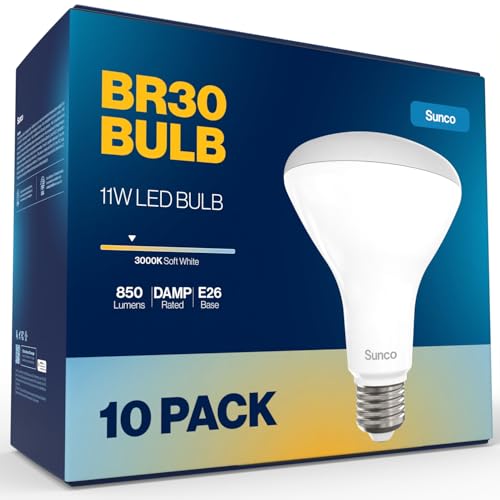
GE’s Reveal line takes a different approach to color. Instead of chasing the highest lumen count, the Reveal HD+ bulb filters out the dull yellow tones that standard LEDs leave in the mix, so whites look cleaner and colors gain contrast. In a kitchen, white cabinets stay white and produce keeps its color; in a bathroom, the mirror gives a more accurate look. Output is 650 lumens at 2700K per bulb, matched to the 65-watt incandescent floods in most existing cans.
The six-pack suits a single room relight, and the bulbs are dimmable on standard LED dimmer circuits. GE rates the bulb life at 25,000 hours, expressed on the packaging as a 22-year life at three hours of use per day. The R30/BR30 face is the standard 3.75-inch diameter for 5-inch and 6-inch cans, on an E26 medium base. Pick the Reveal when the room already has enough cans and the problem is light quality rather than quantity: artwork, painted walls, and detailed finishes benefit most.
5. Amazon Basics BR30 LED Bulbs, 6-Pack (FG-03452)
The Amazon Basics BR30 is the no-frills option: a dimmable 2700K soft white flood that covers the basics at 810 lumens per bulb, a touch brighter than the 65-watt incandescent it replaces. The 11-watt draw and E26 base are standard for the class, and the six-pack covers a small room or a hallway run in one box. For a rental refresh, a basement ceiling, or a first LED conversion, this is the straightforward choice.
The compromise is rated life. At 10,000 hours, these bulbs are rated for less than half the span of the Sunco, Cree, and GE picks above, and there is no high-CRI or warm-dim feature on the spec sheet. In a low-use space such as a guest room or storage area, that shorter lifespan may never matter. In a kitchen that burns lights all evening, the longer-rated picks make more sense. Match the bulb to the duty cycle of the room and the Basics pack does its job without fuss.
Specs
Model: FG-03452
Bulb shape: BR30 flood
Base: E26 medium screw
Wattage: 11 watts (65W equivalent)
Brightness: 810 lumens
Color temperature: 2700K soft white
Dimming: Dimmable
Rated life: 10,000 hours
Pack size: 6 bulbs
Which One Should You Buy?
For a whole-room relight at 3000K, the Sunco 10-pack covers the most cans with matching color and a long rated life. For a living room or dining room on a dimmer, the Philips Warm Glow is the only pick here that warms in color as it dims. For tall ceilings or wide-spaced cans, the Cree Exceptional Series brings 1,400 lumens and 90+ CRI to each position. For color-critical rooms such as kitchens with white finishes or walls of artwork, the GE Reveal HD+ puts color quality first. For utility spaces and light-duty rooms, the Amazon Basics 6-pack keeps the specification simple; rated life is the only real concession.
Frequently Asked Questions
What type of light bulb is best for recessed lighting?
For most 5-inch and 6-inch recessed cans, a BR30 LED flood bulb is the best fit. Its wide, soft beam fills the trim, the E26 base screws into the existing socket, and the 3.75-inch face sits flush instead of protruding. Smaller 4-inch cans take a BR20 or R20, while PAR bulbs suit gimbal trims where a tighter beam is wanted.
How many lumens do I need from recessed light bulbs?
A range of 650 to 850 lumens per can covers most kitchens, hallways, and living rooms with standard eight- or nine-foot ceilings and normal can spacing. Go higher, toward 1,000 to 1,400 lumens per bulb, when ceilings are tall, cans are spaced widely, or one row of fixtures lights a large room. It is easier to dim a bright bulb down than to make up for a dim one.
What color temperature is best for recessed lighting?
Warm 2700K suits bedrooms and living rooms where a relaxed tone is the goal. Neutral 3000K is the most flexible choice and works across kitchens, hallways, and bathrooms. Cooler 4000K to 5000K light fits garages, workshops, and task-heavy spaces. The key rule is consistency: one temperature across every can in a room, so the ceiling light looks even.
What size bulb fits a 6-inch recessed can?
A BR30 is the standard fit for a 6-inch can and also works in most 5-inch cans, giving a full face that matches the trim opening. A BR40 has a wider face, about 5 inches across, and can fill larger 6-inch trims more completely. Avoid A19 household bulbs in cans: their narrower beam and exposed shape leave dark edges and a visible gap.
Conclusion
The best light bulbs for recessed lighting are the ones matched to the can, the ceiling height, and the room’s job. Begin with the shape, BR30 for most 5-inch and 6-inch housings, then choose brightness and color temperature, and finally check CRI and dimming behavior. The five bulbs above cover the main cases: a value multipack from Sunco, warm-dim ambiance from Philips, maximum output and color accuracy from Cree, color-enhancing light from GE Reveal, and a simple budget set from Amazon Basics. Any of them converts an existing can to cooler, longer-lasting LED light in minutes.
H
Home Beautiful Design Editorial Team
We compare specs, materials and verified owner reviews before a product earns a spot. Rankings are never paid.
Affiliate disclosure. As an Amazon Associate we earn from qualifying purchases at no extra cost to you. Prices accurate as of the date shown.
Five desk lamps for miniature painting compared on CRI, daylight temperature and lux, from wide clamp bars for batches to 95+ CRI picks for display work.
Compare five LEGO lighting kits for the Titanic, Hogwarts Castle, Eiffel Tower, Millennium Falcon and Bonsai Tree, with parts, power and install notes.
Five DMX controllers for lighting compared: 384-channel boards with scene banks, chases and MIDI, a hybrid dimmer console and a compact LED color board.
Compact stage lights for small bars, cafés and community stages: low-profile pars, an RGBA wash par and battery uplights with DMX, sized for low ceilings.
Compare the best LED floor lamps for plants, from vertical bars to multi-head tripod grow lights, with full spectrum output, timers and adjustable heights.



 4. GE Reveal HD+ BR30 LED Bulbs, 6-Pack (45170)