5 Best DMX Controllers for Live Shows (November 2026)
Five DMX controllers for lighting compared: 384-channel boards with scene banks, chases and MIDI, a hybrid dimmer console and a compact LED color board.
A live show gives you no pause button. When the band moves from a quiet verse into a full chorus, the lighting has to change at that exact second, and the controller in front of you decides whether that change is one confident button press or a scramble through menus. The real decision is how much of the show you want stored in advance as scenes and chases, and how much you want to play by hand on faders while the music is running.
This guide is for club and bar operators running moving heads every weekend, band lighting volunteers who busk shows with little rehearsal, and small venue crews mixing LED pars with a few conventional dimmers. Every controller below was picked from the names, channel counts and feature lists published on its Amazon product page, and the five picks span full 384-channel boards down to a compact color console built for LED-only rigs.
Quick Picks
As an Amazon Associate we earn from qualifying purchases.
Product
Best for
Key spec from title
Rockville ROCKFORCE 384
Larger live rigs with many movers
384 DMX channels
ADJ DMX Operator 384
Rack rigs that need joystick pan and tilt
384 channels, assignable joystick
Rockville ROCKFORCE 192
First full board for small venues
192 DMX channels
ADJ DMX Operator Pro
Mixed intelligent and dimmer rigs
136 channels across two sections
CHAUVET DJ Obey 6
LED par washes busked by hand
36 channels, 24 preset colors
How to Choose
Count Channels and Fixture Blocks First
Total channel count only tells half the story. Boards divide their channels into fixed fixture blocks, so a 384-channel console that assigns 16 channels per fixture tops out at 24 fixtures, while a board with 32 channels per fixture serves fewer, hungrier units. List every fixture you own, note the channel mode you actually run it in, and add the blocks up. A moving head in an extended mode can swallow a whole block by itself. Leave at least one spare block for the fixture you will inevitably add before next season.
Scene Banks and Chases Decide Your Show Flow
Scenes are the stored looks you recall live, and chases are scenes strung into running sequences. For live work, the useful number is how many scenes sit one button press away: eight scene buttons per bank is the common layout, with bank up and down keys moving between groups. A board holding 30 banks gives you 240 stored looks, enough to dedicate banks to individual songs. Chases matter when you want movement loops running under a chorus while your hands stay free for fader rides and blackout hits.
Faders, Pages and Joysticks for Practical Control
Live control is a physical job. Eight faders that page through channel banks can address 32 channels per fixture, but only eight values sit under your fingers at once, which slows down wide manual looks. Sixteen direct sliders feel faster for busking because more of the fixture answers immediately. A joystick changes moving head work completely: instead of riding separate pan and tilt faders, you point the beam. If your show leans on movers, put joystick control and a manual override that grabs fixtures mid-chase high on the list.
Triggers: Music Mode, MIDI and Blackout
Three trigger tools separate live boards from install controllers. Music mode uses a built-in microphone or a line input so chases step with the beat when nobody can ride the board. MIDI input lets a keyboard player, playback rig or show laptop fire scenes and chases in sync with the set, which is how small productions fake a dedicated operator. The blackout button is the simplest of all: one press kills every output between songs, during speeches, or when a fixture misbehaves, and every board here includes one.
The 5 Best Options
Rockville ROCKFORCE 384
Top Pick
Rockville ROCKFORCE 384
Best for: Club and stage rigs running up to 24 fixtures with programmed songs plus manual overrides.
DMX channels: 384
Fixtures: up to 24 intelligent lights, 16 channels each
Scenes: 30 banks of 8 programmable scenes, 240 total
This is the headroom pick for operators whose rig outgrew a 12-fixture board. Its 384 channels spread across 24 fixture blocks of 16 channels each, so a dozen moving heads plus a row of pars still leave blocks spare for growth. Sixteen direct sliders make manual overrides fast during a live set, the metal housing suits life in and out of a gig rack, and the included gooseneck lamp keeps the surface readable in a dark booth. MIDI control over banks and chases lets a playback rig call looks in time with the music.
Watch out for: DMX output is 3-pin XLR only, so 5-pin fixtures need adapters in the cable run.
ADJ DMX Operator 384
Runner-Up
ADJ DMX Operator 384
Best for: Rack-based live rigs built around a few channel-hungry moving heads.
ADJ aims this rack-mount board at fixtures with deep channel maps. Each of its 12 fixture buttons can address up to 32 channels, reached through eight faders and four channel banks, which suits modern movers running extended modes. The assignable joystick handles pan and tilt positioning far more naturally than paired faders, and a dedicated fog trigger with ready indicators covers atmosphere cues from the same surface. Music triggering can listen through the built-in microphone or an RCA line input, the safer choice in a loud room where a microphone would saturate.
Watch out for: ADJ lists this model as discontinued on its own site, so confirm the seller, stock and warranty terms on the listing before ordering.
Rockville ROCKFORCE 192
Rockville ROCKFORCE 192
Best for: Small venues and mobile rigs stepping up from fixture remotes to a real board.
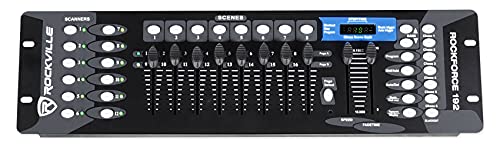
For a first full-size board, this 192-channel console covers the standard small-venue rig: 12 fixtures in fixed 16-channel blocks, 240 scenes across 30 banks, and six chases for song loops. Eight sliders with page switching handle manual control, and the feature list reads like a checklist for live work rather than installs: music triggering from the built-in microphone, MIDI control, a blackout master, manual override for grabbing a fixture mid-chase, and power failure memory that restores your state after an outage instead of leaving the stage dark and unprogrammed.
Watch out for: Fixture blocks are fixed at 16 channels, so a fixture needing more channels than that cannot be controlled in full.
ADJ DMX Operator Pro
ADJ DMX Operator Pro
Best for: Theaters, churches and halls mixing intelligent fixtures with conventional dimmers.
DMX channels: 136 total (128 intelligent, 8 dimmer)
Intelligent fixtures: 8, with 16 channels each
Scenes: 96 programmable per section
Chases: 8 intelligent, 6 dimmer, with fade and speed control
Most boards in this group assume every fixture speaks DMX natively. The Operator Pro is the hybrid: one section runs eight intelligent fixtures with 16 channels each, and a second section drives eight conventional dimmer or on and off channels for older pars and house fixtures. Each section stores its own 96 scenes and its own chases, so a theater or church rig can mix movers and conventionals in one show file. The assignable joystick has fine and fast pan and tilt modes, and show memory backs up to a Compact Flash card.
Watch out for: The intelligent section stops at eight fixtures, and Compact Flash cards are older media you may need to source separately.
CHAUVET DJ Obey 6
CHAUVET DJ Obey 6
Best for: Singers, DJs and small stages washing a room with a handful of LED pars.
DMX channels: 36
Fixtures: up to 6, with up to 6 channels each (RGBAW+UV)
The Obey 6 throws out scene programming entirely and bets on immediacy. It drives up to six LED fixtures with six channels each, laid out as red, green, blue, amber, white and UV, and puts 24 built-in colors on preset buttons for instant washes. Momentary quick color buttons bump accents over a running look, 18 chases and color fade modes add motion, and sound-active playback with adjustable sensitivity follows the music when the operator steps away. At under four pounds and fifteen inches wide, it rides in the same case as the cables.
Watch out for: There is no program memory, so looks exist only during the session and cannot be saved for the next show.
Which One Fits Your Situation
A Club Rig That Runs the Same Show Every Weekend
Pick the Rockville ROCKFORCE 384. A fixed song list rewards deep storage, and its 240 scenes let you dedicate a bank to each track while 24 fixture blocks cover movers, pars and strobes together. Sixteen direct sliders keep manual overrides quick when a vocalist calls an unplanned encore and you need to build a look by hand.
A Band Show You Have to Busk Without Rehearsal
Choose between the ROCKFORCE 192 and the Obey 6 by fixture type. If the rig has moving heads, the ROCKFORCE 192 gives you scenes to grab, a blackout master and manual override for surprises. If the rig is only LED pars, the Obey 6 is faster: preset color buttons and quick color bumps need no programming at all, and sound-active mode covers the songs you do not know.
A Mixed Rig of Movers and Conventional Dimmers
The ADJ DMX Operator Pro is the only board here built for you. Its two sections keep intelligent fixtures and dimmer channels in one console with separate scene storage for each, so the house pars and the moving heads follow the same show. The Compact Flash backup also protects a long programming session in a venue where the board stays installed.
A Rack Rig Built Around a Few Big Moving Heads
Take the ADJ DMX Operator 384. Twelve fixtures with up to 32 channels each match extended mover modes that would overflow a 16-channel block, and the assignable joystick makes positioning beams during a live set far easier than paired faders. The RCA line input also gives its music mode a cleaner signal than a booth microphone in a loud room.
Common Mistakes
Addressing fixtures wherever they happen to land instead of on the fixed block starts the board expects, such as 1, 17 and 33 on 16-channel boards.
Counting total channels but ignoring the per-fixture block limit, then discovering a moving head in extended mode cannot be fully controlled.
Programming every look into chases and saving no plain scenes, leaving nothing simple to grab when the show order changes mid-set.
Skipping the terminator on the last fixture in the chain, which invites flicker and random behavior once the full rig is powered.
Relying on the built-in microphone for music mode while the controller sits far from any speaker, so chases drift off the beat.
Frequently Asked Questions
How many DMX channels does a live band rig actually need?
Count fixtures, not channels in the abstract. Eight LED pars in a six-channel mode plus four moving heads in 16-channel mode already use 112 channels of block space. A 192-channel board covers that rig comfortably, while 384 channels make sense once movers multiply or fixtures run extended modes with fine pan, tilt and extra effect channels.
Can one controller run moving heads and conventional dimmers together?
Yes, if the board is built for it. The ADJ DMX Operator Pro dedicates one section to intelligent fixtures and a second section to eight dimmer or on and off channels, each with its own scenes and chases. Standard boards only speak to DMX fixtures, so conventional dimmers would need a DMX dimmer pack between the console and the lamps.
What is the difference between a scene and a chase?
A scene is one stored look: a fixed set of channel values recalled with a button press. A chase is a sequence of scenes played in order, with speed and fade time shaping how the look moves. Live operators typically store verses and choruses as scenes, then build chases for intros, solos and high-energy passages that should keep moving hands-free.
Do these controllers work with fixtures from any brand?
DMX512 is a shared standard, so any of these boards can drive fixtures from other brands as long as the channel layout fits the board’s fixture blocks. The real checks are practical: 3-pin against 5-pin connectors, the fixture’s channel mode against the block size, and correct start addresses. Proprietary extras, such as a brand-specific fog trigger socket, only work with matching gear.
H
Home Beautiful Design Editorial Team
We compare specs, materials and verified owner reviews before a product earns a spot. Rankings are never paid.
Affiliate disclosure. As an Amazon Associate we earn from qualifying purchases at no extra cost to you. Prices accurate as of the date shown.
Five desk lamps for miniature painting compared on CRI, daylight temperature and lux, from wide clamp bars for batches to 95+ CRI picks for display work.
Compare five LEGO lighting kits for the Titanic, Hogwarts Castle, Eiffel Tower, Millennium Falcon and Bonsai Tree, with parts, power and install notes.
Compact stage lights for small bars, cafés and community stages: low-profile pars, an RGBA wash par and battery uplights with DMX, sized for low ceilings.
Compare the best LED floor lamps for plants, from vertical bars to multi-head tripod grow lights, with full spectrum output, timers and adjustable heights.
Compare the best recessed step lights for stairs, hallways and porches, from 120V gang-box fixtures to low-voltage deck kits, with specs and buying tips.


 ADJ DMX Operator Pro
 CHAUVET DJ Obey 6