Key takeaways
- The “Postage Stamp” Mistake: Buying a fixture that is too small because you are afraid of it overpowering the room. When in doubt, always size up. A slightly larger chandelier looks intentional and dramatic; a too-small chandelier looks like an afterthought.
- Ignoring the View from the Outside: For double-story foyers with large upper windows, the chandelier should be centered in the window so it can be appreciated from the street at night. Measure the window’s height and adjust your chain length so the fixture sits directly in the center of the glass pane.
- Overlooking the Door Swing: Always measure the path of your front door. If your ceiling is low and your door is tall, a wide, low-hanging chandelier can easily block or strike the door when it is opened quickly.
- Forgetting Visual Mass: A solid, dark metal drum-shade chandelier has much more “visual weight” than an open, crystal, or thin-wire cage design of the exact same physical width. If you choose a solid, dense fixture, stay on the smaller side of your calculated range. If you choose an open, airy design, you can safely push to the upper end of the scale.
First impressions begin the moment your guests step through the front door. The foyer sets the stylistic tone for your entire home, and nothing defines this transition space quite like a spectacular light fixture. However, even the most beautiful fixture will look out of place if the scale is wrong. A fixture that is too small gets lost in the volume of the room, while an oversized piece can make your entryway feel cramped and claustrophobic.
Finding the perfect balance requires a mix of simple mathematical formulas, spatial awareness, and design intuition. This comprehensive sizing guide will walk you through exactly how to measure your entry space, select the ideal dimensions, and choose a fixture that scales perfectly with your ceilings and walls.
The Short Answer
To find the ideal width (or diameter) for your foyer chandelier, use the industry-standard sizing rule: **add the width and the length of your entryway in feet, and convert that sum into inches.**
For example, if your foyer measures 10 feet wide by 12 feet long:
10 + 12 = 22. Therefore, your chandelier should be approximately 22 inches wide.
If your entry is a double-story space or has ceilings higher than 10 feet, you can safely scale up the fixture’s width by 10% to 20% to prevent the volume of the empty overhead space from swallowing the fixture. For vertical height, allow 2.5 to 3 inches of fixture height for every foot of overall ceiling height.
Standard Sizes
Because foyer layouts vary from compact apartments to sweeping double-height entryways, manufacturers design fixtures to fit specific spatial tiers. Below is a quick-reference chart mapping common foyer dimensions to their recommended chandelier sizes in both imperial and metric measurements.
| Foyer Dimensions (Feet) | Foyer Dimensions (Meters) | Recommended Width (Inches) | Recommended Width (cm) | Recommended Fixture Height (Inches) |
|---|---|---|---|---|
| 6′ x 8′ (Small/Narrow) | 1.8m x 2.4m | 14″ – 16″ | 35cm – 40cm | 15″ – 20″ |
| 8′ x 10′ (Standard Single-Story) | 2.4m x 3.0m | 18″ – 20″ | 45cm – 50cm | 20″ – 25″ |
| 10′ x 12′ (Medium Foyer) | 3.0m x 3.6m | 22″ – 24″ | 55cm – 60cm | 25″ – 30″ |
| 12′ x 12′ (Large Square Foyer) | 3.6m x 3.6m | 24″ – 28″ | 60cm – 71cm | 30″ – 36″ |
| 14′ x 16′ (Grand/Double-Story) | 4.2m x 4.8m | 30″ – 36″ | 76cm – 91cm | 36″ – 48″+ |
How to Measure Your Space
Determining the correct scale for your entryway lighting requires three key measurements. Follow this step-by-step process to ensure a flawless fit.
- Measure the Room’s Footprint (Length and Width): Use a steel tape measure to find the length and width of the foyer area in feet. If your entryway flows directly into an open-concept living room or hallway without clear walls, measure the immediate “entry zone” where you intend to center the light.
- Calculate the Target Diameter: Add the length and width measurements together. If your entry is 9 feet by 11 feet, the sum is 20. Your target chandelier width is 20 inches.
- Measure the Ceiling Height: Note the distance from the floor to the ceiling. This determines how tall the fixture can be and how much chain or stem suspension you will need. For a standard 8-foot ceiling, you will need a semi-flush mount or a very shallow chandelier. For ceilings 10 feet and higher, you can look at tall, multi-tier fixtures.
- Calculate Vertical Clearance: The bottom of your foyer chandelier must hang at least 7 feet (84 inches) above the finished floor to allow adequate clearance for tall guests and moving furniture. If you have an inswinging front door, measure its height (typically 80 to 96 inches) to ensure the door swing will not collide with a low-hanging fixture.
- Determine Weight Capacity: Standard ceiling junction boxes are rated to support fixtures up to 50 pounds (22.6 kg). If your chosen chandelier exceeds this weight, your electrician must install a heavy-duty, fan-rated junction box or brace the ceiling joists to support the load safely.
By Room or Use Case
As we look ahead to 2026 design trends, entryways are shifting toward highly personalized spaces where lighting acts as functional architectural art. Different architectural layouts demand distinct approaches to fixture scale and style.
Small or Narrow Foyer Entries
If you live in an apartment, townhouse, or ranch-style home with a compact entry, space is at a premium. A massive fixture will overwhelm the area, while a tiny flush mount can look cheap and dated. For entries measuring roughly 6′ x 8′ or narrow hallways, look for fixtures with a width of 14 to 16 inches.
In these spaces, a compact 5-light modern farmhouse or rustic vintage chandelier ($100 to $180 price range) works beautifully. These fixtures provide plenty of ambient light without extending too far down into the walking path. Opt for open-frame, airy designs that let light pass through, making the small entry feel larger and brighter.
Our top picks
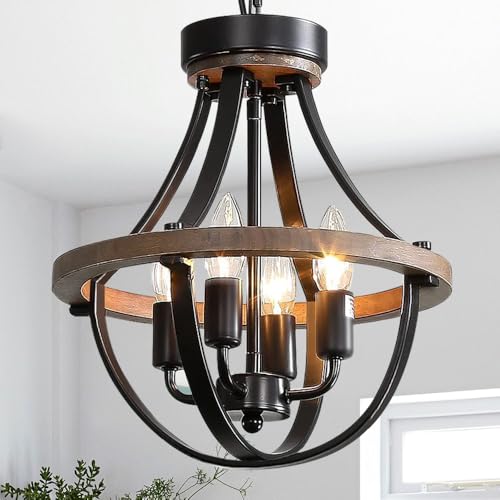

As an Amazon Associate we earn from qualifying purchases at no extra cost to you.
Standard Double-Story Foyers
Double-story entryways present a unique challenge: they have a modest floor footprint but massive vertical volume. If you apply the basic width formula to an 8′ x 10′ two-story foyer, you get an 18-inch recommendation. However, an 18-inch fixture will look like a speck of dust floating in a massive two-story void.
For double-story foyers, you should scale up the width to 24 to 32 inches and focus on vertical presence. A large 12-light farmhouse lantern or an industrial multi-tier pendant ($300 to $500 price range) is ideal here. These taller, cage-like structures fill the vertical volume of the room without blocking natural light from upper-story transom windows.
Grand and Vaulted Entryways
Large estate homes with wide, grand entryways (14′ x 16′ or larger) require statement pieces that command attention. In these expansive zones, look for chandeliers with widths ranging from 36 to 48 inches, featuring multiple tiers of lights.
Vaulted or sloped ceilings require fixtures with adjustable chains or stems to hang straight, along with a canopy designed for sloped installations. Expect statement fixtures in this category to weigh between 40 and 80 pounds, requiring professional installation and reinforced ceiling support. Budgets for these high-end, heavy-duty fixtures typically range from $600 to $1,500+.
Common Sizing Mistakes
Even professional designers occasionally make mistakes when calculating scale. Avoid these frequent pitfalls to ensure your foyer installation goes smoothly:
- The “Postage Stamp” Mistake: Buying a fixture that is too small because you are afraid of it overpowering the room. When in doubt, always size up. A slightly larger chandelier looks intentional and dramatic; a too-small chandelier looks like an afterthought.
- Ignoring the View from the Outside: For double-story foyers with large upper windows, the chandelier should be centered in the window so it can be appreciated from the street at night. Measure the window’s height and adjust your chain length so the fixture sits directly in the center of the glass pane.
- Overlooking the Door Swing: Always measure the path of your front door. If your ceiling is low and your door is tall, a wide, low-hanging chandelier can easily block or strike the door when it is opened quickly.
- Forgetting Visual Mass: A solid, dark metal drum-shade chandelier has much more “visual weight” than an open, crystal, or thin-wire cage design of the exact same physical width. If you choose a solid, dense fixture, stay on the smaller side of your calculated range. If you choose an open, airy design, you can safely push to the upper end of the scale.
FAQ
How low should a chandelier hang in a two-story foyer?
In a two-story foyer, the bottom of the chandelier should hang level with the second-floor landing or slightly below it. This ensures that the fixture is visible from both the ground floor and the upper staircase. Never let the bottom of the fixture drop below 7.5 to 8 feet from the main floor level to maintain a spacious, open pathway.
Can a foyer chandelier be too bright? What wattage is best?
Yes, an overly bright foyer can feel cold and clinical. For entryways, aim for a total light output of 2,000 to 4,000 lumens, which translates to roughly 150 to 300 watts of traditional incandescent light, or 24 to 40 watts of modern LED power. To avoid glare, choose fixtures with frosted glass or dimmable LED bulbs, and always install a dimmer switch so you can adjust the ambiance.
How do I size a chandelier if my foyer opens directly into a hallway?
If your entry transitions immediately into a long hallway, treat the entry zone as its own distinct square or rectangle. Calculate your width using only the dimensions of that initial entry pad. If the hallway itself needs light, coordinate the main foyer chandelier with matching flush mounts or semi-flush mounts spaced 6 to 8 feet apart down the length of the hall.
Does the shape of the chandelier affect how wide it should be?
Absolutely. Round, square, or drum-shaped chandeliers occupy a 3D block of space and feel much heavier. Linear fixtures, rectangular lanterns, and multi-pendant cascades spread their physical mass differently. For rectangular or narrow hallways, a linear or slim lantern style can be slightly longer than the standard calculation without crowding the walls.