The foyer is your home’s first handshake. It sets the tone for your entire interior design narrative, making the choice of entryway lighting incredibly high-stakes. A modern crystal chandelier is the ultimate statement piece for this space, blending the classic, light-refracting romance of crystal with clean, contemporary geometry. However, choosing the wrong fixture is an expensive and frustrating mistake that homeowners make all too often.
The most common pitfalls when sourcing a foyer chandelier include “scale blindness” (buying a fixture that looks like a postage stamp in a double-height entryway), ignoring the brutal reality of multi-hour assembly times, and selecting incorrect color temperatures that turn a welcoming home into a sterile, cold environment. This buying guide for modern crystal chandelier foyer spaces breaks down the exact specifications, physics, and design choices you need to make to ensure your entryway is nothing short of spectacular.
Our top picks
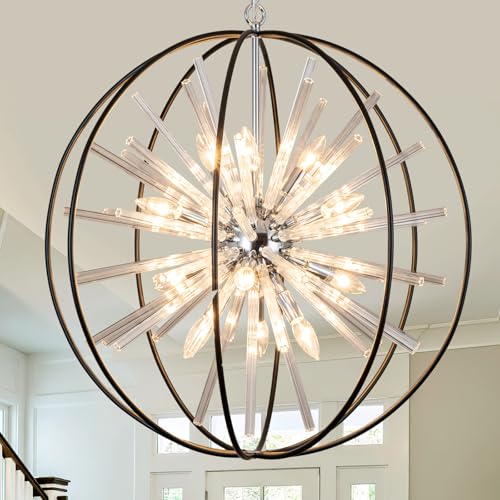
 Vezzio Modern Black Sputnik Globe Crystal Chandeliers
- 1.【Modern Crystal Design Inspiration】The black spherical frame paired…
- 2.【 Black Chandelier Dimension】This 2 story foyer chandelier…
- 3.【 Effortless Installation of Chandelier Lighting】The modern sputnik…

As an Amazon Associate we earn from qualifying purchases at no extra cost to you.
Decide These 3 Things First
Before you fall in love with a specific design online, you must establish three foundational parameters of your foyer. Sourcing a chandelier without these decisions is like buying shoes without knowing your foot size.
- Your Ceiling Height and Clearance: Measure your ceiling height precisely. Standard 8- or 9-foot ceilings require low-profile or flush-mount options, while double-height foyers (12 to 20 feet) demand dramatic, vertically oriented fixtures. The golden rule of foyer lighting is that the bottom of the chandelier must hang at least 7 feet (84 inches) above the floor to prevent tall guests or moving furniture from colliding with it.
- Your Structural Support Capability: Crystal is heavy. While a standard plastic ceiling junction box can support up to 50 pounds, many larger cascading crystal fixtures easily exceed this limit. You must decide if you are willing to hire an electrician to install a heavy-duty, UL-listed metal brace directly to your ceiling joists, or if you need to limit your search to lightweight fixtures under 25 pounds.
- Your Maintenance Tolerance: Be honest with yourself about cleaning. A cascading “raindrop” spiral chandelier looks breathtaking, but it features dozens of individual crystals that collect dust. If you do not want to climb a 12-foot A-frame ladder once a year with a microfiber cloth, you should opt for a self-contained geometric or Sputnik-style crystal fixture where the crystals are easier to reach and dust.
Sizing and Scale: The Golden Math of Foyer Lighting
To avoid a chandelier that looks awkwardly small or overwhelmingly claustrophobic, use these precise design industry formulas:
Calculating Width (Diameter): Add the width and length of your foyer in feet, and convert that sum directly into inches. For example, if your foyer is 12 feet wide by 14 feet long, add 12 and 14 to get 26. Your ideal chandelier should have a diameter of approximately 26 inches. If you have a highly open-concept foyer, use the dimensions of the immediate “entryway zone” rather than the entire open space.
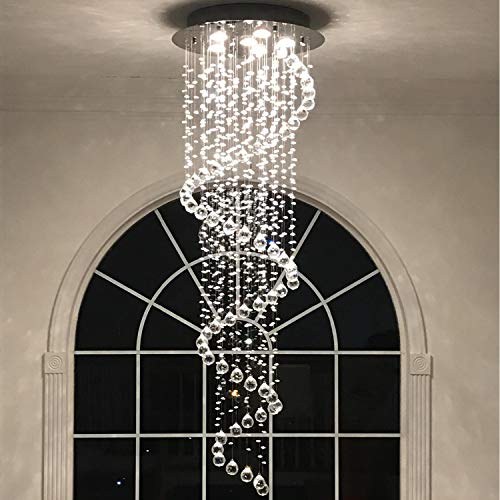
Calculating Height (Vertical Footprint): For standard ceilings, a good rule of thumb is to allocate 2.5 to 3 inches of fixture height per foot of ceiling height. A 10-foot ceiling can easily accommodate a fixture that is 25 to 30 inches tall. However, for grand two-story foyers (16 to 20 feet), you want a dramatic vertical draw. A cascading piece like the CRYSTOP Swirl Rain Drop Chandelier, which measures 20 inches in diameter by 61 inches in height, is specifically engineered to fill that empty vertical volume beautifully.
Door Swing Clearance: If your chandelier hangs near the front door, measure the top of your door frame. Ensure the lowest point of the hanging fixture sits at least 6 to 12 inches higher than the top of the open door to avoid accidental impacts.
Crystal Quality and Frame Materials
The term “crystal” is used loosely in online retail, but the material composition directly dictates how the fixture refracts light and how long it will last.
K9 Crystal vs. Glass vs. Acrylic: As we look at interior design trends for 2026, K9 optical crystal remains the gold standard for high-performance, accessible luxury. K9 is a high-grade borosilicate glass that is precision-cut and polished to maximize its refractive index. It splits light into brilliant rainbow prisms. Avoid “acrylic crystal” or “polyresin crystal” at all costs; these are fancy terms for plastic, which will yellow, scratch, and attract static dust within two years. High-quality glass is acceptable, but it lacks the sharp faceting and fire of K9 crystal.
Frame Finish and Durability: The frame holds the weight and defines the modern aesthetic. Electroplated iron and polished stainless steel are the best choices. Electroplating prevents rusting, which is vital for foyers that experience humidity changes whenever the front door opens. Modern trends lean toward two extremes: high-contrast matte black (seen in the Vezzio Modern Black Crystal Chandelier series) for a striking contemporary look, or warm, textured gold (such as the EGM Gold Tree Branch Chandelier) for an organic, modern-luxe vibe.
Construction, Weight, and Structural Safety
Never hang a heavy crystal fixture from a standard residential light box without verifying the weight ratings. You must match your fixture weight to your ceiling hardware:
Under 15 lbs: Can generally be hung from a standard, properly secured ceiling junction box.
15 to 50 lbs: Requires a heavy-duty metal ceiling box rated for ceiling fan support. Many Sputnik styles, like the Vezzio Modern Black Sputnik Globe ($168.99), fall into this manageable weight class, offering high visual impact without structural headaches.
Over 50 lbs: Requires a commercial-grade support bracket anchored directly into the wooden ceiling joists. Many extra-large raindrop spiral fixtures require this level of support.
Additionally, look for fixtures that utilize adjustable stainless steel aircraft cables rather than traditional link chains. Steel cables provide a sleeker, more modern aesthetic, and they allow you to micro-adjust the level of the chandelier to ensure it hangs perfectly straight, even if your ceiling is slightly uneven.
Lighting Performance: Bulbs, Lumens, and Color Temperature
A crystal chandelier is both a sculptural art piece and a functional light source. You must calculate the correct light output to ensure your foyer is bright enough to be safe, yet warm enough to feel inviting.
Lumen Calculations: For a foyer, aim for 30 to 40 lumens per square foot. If your entryway is 150 square feet, you need a total light output of 4,500 to 6,000 lumens. A multi-light fixture, such as a 10-light branch chandelier, easily achieves this using energy-efficient LED bulbs.
Bulb Types (G9 vs. E12 vs. GU10):
- E12 (Candelabra Base): The most common, offering easy bulb replacement and a classic look. Perfect for Sputnik and branch designs.
- G9 (Bi-pin): Incredibly compact bulbs that allow designers to create ultra-sleek, minimalist frames without bulky sockets showing.
- GU10 (Twist-lock): Frequently used in cascading raindrop chandeliers to project directional light straight down through the crystal spheres, maximizing the sparkle.
Color Temperature: Stick strictly to 2700K (warm white) or 3000K (soft white). Avoid 4000K or 5000K (daylight) bulbs, which make K9 crystals look icy blue and give your foyer the clinical feel of a commercial office lobby. Ensure your bulbs are explicitly labeled as “dimmable” and pair them with an LED-compatible ELV (electronic low voltage) dimmer switch.
Assembly, Installation, and Maintenance Reality
This is where many buyers experience extreme post-purchase regret. When you unbox a modern crystal chandelier, you are not unboxing a finished product; you are unboxing a construction project.
The Assembly Scale: Geometric and Sputnik fixtures usually require you to screw in a dozen metal arms and attach a pre-assembled crystal sphere to each. This takes roughly 30 to 60 minutes. Conversely, spiral raindrop chandeliers require you to hang the steel baseplate first, and then individually hook up to 100 separate wire strands, each loaded with heavy crystal balls. This can easily take 3 to 5 hours of working overhead on a ladder.
Installation Tips: Always leave the protective plastic wrap on the metal frame during the mounting process to avoid transferring finger oils. Only hang the individual crystals after the heavy frame is securely wired and mounted to the ceiling. Always wear the white cotton gloves usually provided by manufacturers to prevent leaving smudges on the K9 crystal facets.
Price Tiers and Value Proportions
The market for modern crystal chandeliers generally falls into three distinct price brackets, each offering a different balance of materials, size, and convenience.
Budget ($100 – $200): In this tier, you will find highly stylish, compact fixtures like the CRYSTOP Swirl Rain Drop ($149.99) or the Vezzio Sputnik Globe ($168.99). These fixtures utilize genuine K9 crystal, but the frames are typically lightweight iron, and they require complete, tedious self-assembly. They are excellent value options for standard-sized entryways where you are willing to invest your own sweat equity into assembly.
Mid-Range ($200 – $500): This is the sweet spot for durability and scale. Examples include the EGM Gold Tree Branch Chandelier ($249.99) and the Vezzio Modern Black Crystal Chandelier ($299.99). In this bracket, you get thicker metal frame construction, premium electroplated finishes, larger dimensions suitable for high ceilings, and a generous inclusion of spare crystals and higher-end mounting hardware.
Premium ($500+): At this level, fixtures feature solid brass or architectural-grade stainless steel frames, authentic hand-cut European crystals, integrated dimmable LED arrays, and pre-strung crystal elements that significantly cut down on installation time. These are built to last a lifetime and are ideal for grand, high-traffic commercial or luxury residential foyers.
Spec Checklist
Use this comparative checklist to determine which tier of modern crystal foyer chandelier aligns with your project scope and budget:
| Specification | Budget ($100 – $200) | Mid-Range ($200 – $500) | Premium ($500+) |
|---|---|---|---|
| Crystal Quality | Standard K9 or molded glass; raw cut edges. | Precision-cut K9 crystal; highly polished facets. | Strass, Swarovski, or hand-cut lead crystal. |
| Frame Material | Thin iron or lightweight alloy; painted finishes. | Thick iron or steel; electroplated or brushed finishes. | Solid brass, copper, or marine-grade stainless steel. |
| Average Weight | 8 to 18 lbs. | 18 to 40 lbs. | 40 to 100+ lbs. |
| Bulb Options | Standard sockets; bulbs rarely included. | High-quality ceramic sockets; sometimes includes starter bulbs. | Integrated LED arrays or premium ceramic sockets. |
| Assembly Time | 2 to 5 hours (completely unassembled strands). | 1 to 3 hours (partially pre-assembled components). | Under 1 hour (mostly pre-assembled; quick-connect crystals). |
Red Flags
When shopping online, look out for these deceptive listings and design flaws:
- “Acrylic Crystal” or “Resin Glass” Wording: If the listing uses these terms, the fixture is plastic. It will look cheap, dull, and fail to refract light into those signature rainbow prisms.
- Extremely Low Weight Specs: If a chandelier claims to be 30 inches wide but weighs under 8 pounds, the frame is made of ultra-thin, flimsy metal that may warp or sag under the weight of the crystals over time.
- No Spare Crystals Included: Crystals will inevitably break or get lost during unboxing and installation. If the manufacturer does not explicitly state that they include 2 to 5 spare crystal balls or drops, you run the risk of having an incomplete fixture.
- Lack of Safety Certifications: Look for UL (Underwriters Laboratories) or ETL certification. Uncertified electrical fixtures are a severe fire hazard and may violate your home insurance policy in the event of an electrical issue.
FAQ
How high should a chandelier hang in a two-story foyer?
In a grand two-story foyer, the chandelier should be positioned so that it is centered vertically within the space. Ideally, the bottom of the fixture should be level with the second-floor landing. If there is a large window above the front door, center the chandelier within the window frame so it is visible from the street at night, creating an inviting exterior view.
Can I use LED bulbs in a modern crystal chandelier?
Yes, and you absolutely should. However, you must buy LEDs that are specifically labeled as “dimmable” and compatible with your wall dimmer switch. To get the best sparkle out of your crystals, look for clear filament LED bulbs rather than frosted LED bulbs, as clear bulbs project sharp, direct light points that make crystal facets dance.
How do I clean a crystal chandelier without taking it down?
For regular maintenance, use a static-free microfiber duster on a telescoping pole. For a deep clean, turn off the power at the breaker. Spray a specialized “drip-dry” crystal cleaning solution onto the fixture until it is dripping wet (avoiding the light sockets), or use a lint-free microfiber glove dampened with a 1:3 mixture of isopropyl alcohol and distilled water to gently wipe each crystal. Place a drop cloth on the floor underneath to catch any drips.
Do modern crystal chandeliers look dated quickly?
While traditional “brass basket” crystal chandeliers can feel dated, modern designs are built to be timeless. Contemporary styles rely on sleek geometric frames, organic tree-branch shapes, or minimalist cascading raindrops that pair beautifully with transitional, modern farmhouse, and industrial chic aesthetics. They act more like functional glass sculptures than old-fashioned formal lighting.