Key takeaways
- Motor Count and Recline Range: A single-motor chair links backrest and footrest into one motion. Dual and triple motors unlock independent control, letting you fine-tune angles — critical when the room’s primary light source (say, a floor lamp positioned at 45 degrees to your seat) demands a slightly different recline than pure relaxation would suggest. More motors mean more micro-adjustments, which translates to better posture alignment and fewer awkward glare angles off a nearby television.
- Material Finish Under Room Lighting: Faux leather reads sleek and reflective — beautiful under warm 2700K pendants but prone to hotspots near windows or cool-white LEDs. Breathable fabric options like the MCombo 7040 in Admiral diffuse light softly, making them more forgiving in rooms with mixed or changing light throughout the day. Consider your dominant light temperature before choosing your upholstery.
- Lift Capacity and Frame Scale: “Big and tall” isn’t just marketing; it refers to reinforced steel frames, wider seat decks, and higher weight ratings (some models reach 400 lbs). Oversized silhouettes also have a design implication: they occupy more visual territory. In smaller rooms, a large-wide recliner can dominate the ambient layout, so measure floor space with the chair fully reclined before committing.
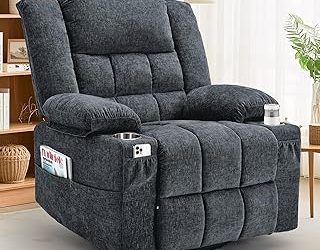
- Built-In Tech and Port Placement: USB and Type-C charging ports, cup holders, and side pockets are now standard on quality lift chairs. What most reviews miss is placement ergonomics — whether ports are reachable in the fully reclined position without breaking the room’s sight lines or casting device-screen light into your face during evening use.
- Heat and Massage Functionality: Dual heating zones (back and seat) paired with multi-node massage motors transform a recliner from passive furniture into an active recovery tool. From a comfort-design standpoint, the quality of vibration motors matters enormously — cheap single-point motors buzz; multi-point systems create rolling waves that feel intentional rather than mechanical.
What's inside
The search for the perfect recliner quickly spirals into decision fatigue. Dozens of brands claim throne-level comfort, yet most shoppers end up squinting at spec sheets trying to figure out which motor configuration actually matters, whether faux leather will glare under their living-room recessed cans, and if “zero gravity” is a real engineering feature or just marketing shimmer. The stakes are surprisingly high: a recliner is the room’s anchor piece — the surface that catches afternoon sidelight, frames movie-night shadows, and defines the warm focal plane every other element orbits around.
This 2026 roundup cuts through that noise. We zeroed in on MCombo’s power-lift lineup and the EONIX dual-motor contender — models purpose-built for elderly and big-and-tall users — and evaluated each not just on motor performance and ergonomic support but on how its materials, silhouette, and built-in tech integrate into a lived-in home environment. Think of it as a lighting designer’s lens applied to furniture selection: texture response under ambient and task lighting, visual weight in a room, and how small details like USB placement and cup-holder geometry affect the real-world ritual of daily use.
As an Amazon Associate we earn from qualifying purchases.


🛒 Best Price Today on Amazon
Prime members get fast, free shipping on everything above, plus member-only deals. New members get a 30-day free trial — cancel anytime.
How to Choose a Who Makes Best Recliner (2026)
- Motor Count and Recline Range: A single-motor chair links backrest and footrest into one motion. Dual and triple motors unlock independent control, letting you fine-tune angles — critical when the room’s primary light source (say, a floor lamp positioned at 45 degrees to your seat) demands a slightly different recline than pure relaxation would suggest. More motors mean more micro-adjustments, which translates to better posture alignment and fewer awkward glare angles off a nearby television.
- Material Finish Under Room Lighting: Faux leather reads sleek and reflective — beautiful under warm 2700K pendants but prone to hotspots near windows or cool-white LEDs. Breathable fabric options like the MCombo 7040 in Admiral diffuse light softly, making them more forgiving in rooms with mixed or changing light throughout the day. Consider your dominant light temperature before choosing your upholstery.
- Lift Capacity and Frame Scale: “Big and tall” isn’t just marketing; it refers to reinforced steel frames, wider seat decks, and higher weight ratings (some models reach 400 lbs). Oversized silhouettes also have a design implication: they occupy more visual territory. In smaller rooms, a large-wide recliner can dominate the ambient layout, so measure floor space with the chair fully reclined before committing.
- Built-In Tech and Port Placement: USB and Type-C charging ports, cup holders, and side pockets are now standard on quality lift chairs. What most reviews miss is placement ergonomics — whether ports are reachable in the fully reclined position without breaking the room’s sight lines or casting device-screen light into your face during evening use.
- Heat and Massage Functionality: Dual heating zones (back and seat) paired with multi-node massage motors transform a recliner from passive furniture into an active recovery tool. From a comfort-design standpoint, the quality of vibration motors matters enormously — cheap single-point motors buzz; multi-point systems create rolling waves that feel intentional rather than mechanical.
The Best Who Makes Best Recliner (2026)s Reviewed
MCombo Oversized Power Lift R7510
The flagship for big-and-tall users, this large-wide lift chair pairs a reinforced frame with dual heating zones and a full massage motor array. The grey faux leather has a muted sheen that absorbs overhead recessed lighting gracefully rather than bouncing it back into the room, making it a strong choice for open-plan spaces where ambient light levels fluctuate. USB and Type-C ports plus integrated cup holders round out a genuinely complete package.
MCombo Dual Motor Zero Gravity R7897
Zero-gravity recline redistributes body weight evenly — the chair’s mocha fabric develops a rich, warm tone under incandescent or warm LED lighting that anchors a room’s color story beautifully. Dual motors allow the backrest and footrest to move independently, giving users precise control over their viewing angle relative to room light sources. A smart pick for anyone who reads or watches screens from their recliner.
MCombo 3 Motor Lay Flat R7635
Triple motors push this model into truly infinite positioning territory, including a lay-flat mode rare in power-lift categories. The adjustable power headrest is a standout feature — it lets you tilt the upper cushion to avoid screen glare or align with a nearby reading lamp’s beam. The grey fabric has a heathered texture that reads beautifully under layered lighting, adding tactile depth to any seating arrangement.
MCombo Power Lift 7040 (Admiral Fabric)
The most versatile option in the lineup, available in multiple sizes and offered in a breathable Admiral fabric that resists heat buildup during extended use. The fabric’s matte finish diffuses light evenly, keeping the chair visually soft in both bright daylight and dim evening settings. FSC certification adds an eco-conscious angle that matters to design-forward buyers who care about material sourcing as much as aesthetics.
EONIX Dual Motor 400 lb Lift Recliner
The only non-MCombo entry earns its spot through a 175-degree recline range and a one-touch reset button — a small UX detail that makes a significant difference when you need to return to upright quickly under changing light conditions (like a door opening and flooding the room). The dark brown finish reads rich and grounded under warm-toned lighting, and the 400-lb capacity makes it the strongest frame in this roundup.
Frequently Asked Questions
What is the difference between single-motor and dual-motor recliners?
A single-motor recliner moves the backrest and footrest in one linked motion, offering limited positioning variety. Dual-motor models control each section independently, allowing you to adjust your recline angle without changing leg elevation — a meaningful advantage when optimizing your position relative to room lighting, screen angles, or personal comfort preferences throughout the day.
Are power-lift recliners difficult to assemble?
Most models in this roundup arrive in two to three boxes and require 20-30 minutes of assembly. The backrest typically slides onto a rail system, and the power cord connects to a single outlet. No special tools beyond what ships in the box are needed. Once assembled, the lift mechanism is entirely automated — a wired remote or built-in button panel handles all movement.
Which recliner material lasts longest?
Faux leather resists staining and wipes clean easily, making it ideal for households with spill risks. Breathable fabric options offer superior airflow and tend to show less surface wear over years of daily use. Both materials hold up well under proper care; the choice often comes down to your room’s lighting environment and aesthetic preference rather than pure durability.
Can a power-lift recliner fit in a small room?
Measure the full reclined footprint — most models need 18 to 24 inches of clearance behind the backrest and 2 to 3 feet in front for the extended footrest. The MCombo 7040 is available in medium sizing that occupies less floor area while still delivering lift functionality, making it the most apartment-friendly option in this roundup.
Final Thoughts
For most buyers, the MCombo Dual Motor Zero Gravity R7897 strikes the best balance of infinite positioning, material warmth under ambient lighting, and genuine zero-gravity comfort. If you need maximum size and capacity, the MCombo R7510 Oversized Lift Chair delivers the most complete feature set without compromise. And for budget-conscious shoppers who refuse to sacrifice quality, the MCombo 7040 in Admiral fabric offers a smartly scaled, FSC-certified option that fits gracefully into tighter rooms and softer lighting schemes alike.