Key takeaways
- Pocket coils, individually wrapped — the Mielmoon 10-inch and the 11-inch Liberty Hybrid both build on this, which is why they bend cleanly.
- Medium-firm as the default — soft mattresses exaggerate the fold and let you sink into the hinge; the Serta Perfect Sleeper Hybrid 12-inch medium is a fair reference point for the feel you want.
- CertiPUR-US certification on foam layers, as the Marsail NS1 set carries. It speaks to emissions and content, which matters in a closed room you breathe in for eight hours.
- A cover with some give — a tight, non-stretch ticking is often the first thing to pucker at the knee break.
What's inside
I spend my working life shaping how rooms feel after sunset — where the glow lands, how a 2200K bedside lamp softens a wall, how a dimmer curve tells a body it’s time to stop. And the thing I’ve learned from a decade of bedroom commissions is that the mattress is the largest, quietest piece of ambience in the room. It doesn’t emit light, but it governs everything downstream: whether you read at an incline or slump, whether you run hot at 2 a.m., whether the room reads as a retreat or just a place with a bed in it. Pair a rigid mattress with an articulating base and you get the sleep equivalent of a flickering fixture — technically functional, subtly wrong all night.
An adjustable base asks something specific of a mattress: it must hinge at the shoulders and knees thousands of times without cracking, bunching, or fighting the motors. Below, I’ll walk you through how flex actually works, how to read a spec sheet past the marketing, when split sizing earns its cost, why heat behaves differently on an incline, and how to make the mattress and base agree on height and grip. These are our recommended picks to orient you before we get into the reasoning.
As an Amazon Associate we earn from qualifying purchases.


Flex Is The Whole Job
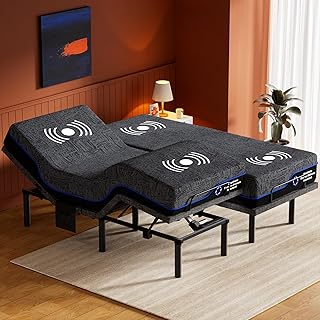
A mattress for an adjustable base has to fold in two places and return flat without memory of the crease. Foam does this natively — the cell structure compresses and recovers. Traditional innersprings, with connected wire units, resist and eventually deform. That’s why the reliable field splits into two camps: all-foam and pocket-coil hybrids where each coil sits in its own fabric sleeve and moves independently of its neighbors. The 14-inch cooling gel memory foam sets from Amada, EGOHOME, and Marsail sit in the first camp; the Liberty Hybrid and the Mielmoon hybrid sit in the second. Both work. What doesn’t work is a bonnell or offset coil unit, no matter how the listing photo poses it.
Read The Build, Not The Adjectives
Height is the first honest signal. Somewhere between 10 and 14 inches is the practical window: thinner mattresses articulate beautifully but can feel thin under the hips, and anything past 14 inches starts resisting the base’s range of motion. Beyond that, look for:
- Pocket coils, individually wrapped — the Mielmoon 10-inch and the 11-inch Liberty Hybrid both build on this, which is why they bend cleanly.
- Medium-firm as the default — soft mattresses exaggerate the fold and let you sink into the hinge; the Serta Perfect Sleeper Hybrid 12-inch medium is a fair reference point for the feel you want.
- CertiPUR-US certification on foam layers, as the Marsail NS1 set carries. It speaks to emissions and content, which matters in a closed room you breathe in for eight hours.
- A cover with some give — a tight, non-stretch ticking is often the first thing to pucker at the knee break.
Splits, And The Two-Person Problem
If two people share the bed and only one wants to sit up, a split configuration is not a luxury — it’s the entire point. Two independent mattresses on two independent halves means one of you reads at 40 degrees while the other lies flat, undisturbed. The Amada, EGOHOME, and Marsail sets all arrive as split king; the Mielmoon comes as a split queen for narrower rooms. If you sleep alone, or if you both want the same position always, a single mattress on a non-split base is simpler and cheaper. There’s also a middle path worth knowing: unusual footprints like the 70×75 Liberty Hybrid exist for RVs and short-king frames, so measure before you assume standard sizing.
Heat Reads Differently On An Incline
Here’s something I notice as a lighting person, because heat and light are cousins in how a room feels: when you raise the head of a bed, air circulates around your torso but pools under your lower back and thighs, where contact pressure is highest. Memory foam is an insulator by nature. That’s the reason nearly every credible adjustable-bed mattress now advertises gel infusion or graphite — the Liberty Hybrid’s graphite memory foam and the gel layers in the Amada and Marsail sets are both attempts at drawing heat sideways instead of trapping it. Hybrids have a structural advantage here, since the coil layer is mostly open air. If you sleep hot, weight that consideration heavily.
Make The Mattress And Base Agree
Two mismatches cause most complaints. First, retention: an articulating base tilts, and without a foot bar or a high-friction surface the mattress creeps toward the end of the bed over weeks. Second, total height — base plus mattress plus any legs. The EGOHOME set ships with 12-inch removable legs precisely so you can tune the deck height to your room and your knees. Buying a matched set, as with the Serta hybrid plus adjustable base, sidesteps both problems entirely, which is why I recommend it for anyone who doesn’t want to audit specifications.
Tips
- Run the base through its full range before you dress the bed. Watch for the mattress bowing outward at the knee break — that’s your early warning.
- Skip tight-fitting waterproof protectors with rigid backing. Use a stretch-knit protector so it moves with the fold.
- Give new foam two to four weeks to break in before judging firmness. Bodies recalibrate too.
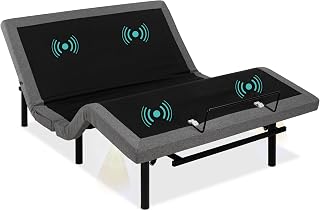
- If your base has a USB port and LED underlight, as the Amada set does, put a warm-dim bulb in your bedside lamp and let the underlight handle nighttime navigation. Overhead light after 10 p.m. undoes the whole room.
Frequently Asked Questions
Can I put my current mattress on an adjustable base?
If it’s all-foam, latex, or a pocket-coil hybrid in good condition, likely yes. If it’s a traditional innerspring with a connected coil unit, or if it’s already showing sag, don’t — you’ll damage it and get poor articulation.
Does a mattress on an adjustable base wear out faster?
A well-built one doesn’t meaningfully. Foams and pocket coils are designed for repeated flex. What shortens life is a mattress that was never intended to bend, or a base pushing beyond the mattress’s height tolerance.
Do I need a box spring?
No. The adjustable base replaces the foundation entirely. Adding a box spring blocks the articulation and voids most warranties.
Is split king worth the extra cost?
For couples with different schedules or different comfort needs, yes — it’s the difference between one person compromising nightly and neither of you noticing the other. For solo sleepers, put the money into mattress quality instead.
Conclusion
Choose flexible construction, land near medium-firm in the 10-to-14-inch range, take heat management seriously if you sleep warm, and make sure the base and mattress agree on height and grip. Get those four right and the bed disappears into the room the way good lighting does — you stop noticing it and simply feel better in the space.