Key takeaways
- Pedal depth over step count: Wide, deep treads let you stand flat-footed for long stretches instead of balancing on the ball of your foot. If you’re wiring a fixture or aligning a shade seam, a narrow rung becomes painful within minutes.
- Handrail geometry: A grab bar that sits too low forces you to stoop; one positioned at hip-to-waist height gives you a bracing point while both hands work above your head. Check the rail height relative to the top step, not just its presence.
- Material and electrical safety: Fiberglass is non-conductive, which matters any time you’re near live wiring, junction boxes, or a fixture you haven’t fully de-energized. Steel is fine for bulb swaps and hanging décor, but choose fiberglass for anything involving the electrical side.
- Load rating with margin: Add your body weight plus the fixture, tools, and hardware you’ll be holding. A 500 lb rating sounds generous until you’re carrying a heavy drum shade one-handed; 800 lb and up gives you real headroom for stability, not just capacity.
- Folded profile: Ambience projects come in waves, so the ladder lives in a closet or behind a door most of the year. Measure the gap you plan to slide it into before you buy, and favor a flat fold with a locking hinge.
What's inside
Anyone who has spent an afternoon swapping out pendant bulbs, adjusting track heads, or hanging a run of string lights over a patio knows the real bottleneck isn’t the fixture. It’s the ten inches of reach you don’t have. Kitchen chairs wobble on tile, counters put you at the wrong angle, and the cheap folding stool from the garage flexes every time you shift your weight to reach a socket at the far edge of a ceiling medallion. When you’re working overhead with both hands occupied by a shade ring and a set screw, the platform under you needs to be a non-issue.
This guide looks at step ladders through the lens of ambience work: the repeated, fiddly, look-up-for-twenty-minutes tasks that make a room feel finished. We’ve weighed pedal width against how long you can comfortably stand, handrails against the awkward one-hand reach, and folded footprint against where you’ll actually store the thing between projects. Below are six options spanning compact three-step stools to a full six-foot fiberglass ladder, with notes on which lighting jobs each one suits.
As an Amazon Associate we earn from qualifying purchases.


How to Choose a/an Step Ladder Best (2026)
- Pedal depth over step count: Wide, deep treads let you stand flat-footed for long stretches instead of balancing on the ball of your foot. If you’re wiring a fixture or aligning a shade seam, a narrow rung becomes painful within minutes.
- Handrail geometry: A grab bar that sits too low forces you to stoop; one positioned at hip-to-waist height gives you a bracing point while both hands work above your head. Check the rail height relative to the top step, not just its presence.
- Material and electrical safety: Fiberglass is non-conductive, which matters any time you’re near live wiring, junction boxes, or a fixture you haven’t fully de-energized. Steel is fine for bulb swaps and hanging décor, but choose fiberglass for anything involving the electrical side.
- Load rating with margin: Add your body weight plus the fixture, tools, and hardware you’ll be holding. A 500 lb rating sounds generous until you’re carrying a heavy drum shade one-handed; 800 lb and up gives you real headroom for stability, not just capacity.
- Folded profile: Ambience projects come in waves, so the ladder lives in a closet or behind a door most of the year. Measure the gap you plan to slide it into before you buy, and favor a flat fold with a locking hinge.
The Best Step Ladder Best (2026)s Reviewed
KINGRACK 5 Step Ladder with Tool Platform
The 900 lb rating and integrated tool tray make this the pick for extended overhead sessions, since you can park a screwdriver, wire nuts, and a set of Allen keys within reach rather than pocketing them. The extra step also brings standard eight-foot ceilings into comfortable working range without stretching.
KINGRACK 4 Step Ladder with Safe-Lock
The safe-lock hinge is the standout here: it eliminates the subtle rocking that makes fine work, like leveling a linear pendant, feel precarious. Four steps hits the sweet spot for most residential ceiling heights while still folding thin enough for a utility closet.
HBTower Folding Step Stool
Light enough to reposition one-handed as you work along a track run or a row of sconces, which matters more than it sounds when a job involves eight repositionings. The anti-slip pedals hold well on tile and sealed hardwood, and the handrail is usefully tall.
SocTone 3 Step Ladder
A clean white finish and compact frame make this the one you can leave out in a living space between tasks without it looking like equipment. Best suited to bulb changes, shelf-height fixtures, and hanging lightweight décor rather than heavy fixture installs.
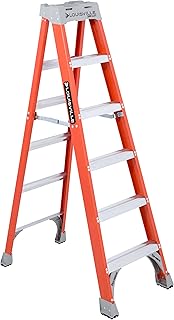
Louisville Ladder 6-Foot Fiberglass, FS1506
Non-conductive fiberglass and a Type IA duty rating make this the correct tool for actual electrical work, from replacing a canopy to adding a dimmer-compatible fixture on a vaulted ceiling. It’s heavier and needs real storage space, but nothing else here belongs near live wiring.
Frequently Asked Questions
Do I need fiberglass if I’m only changing bulbs?
For bulb swaps on a de-energized fixture, steel is perfectly adequate. Move to fiberglass as soon as your work involves opening a canopy, touching wiring, or working near an exposed junction box.
How high a ladder do I need for an eight-foot ceiling?
A four- or five-step ladder typically puts your hands at ceiling height comfortably. Aim to work with the fixture at chest-to-eye level rather than fully overhead, since sustained arms-up work tires you fast and degrades precision.
Is a handrail worth the extra bulk?
For lighting work, yes. It gives you a third point of contact when both hands are occupied, and it makes stepping down while holding a shade or diffuser far safer.
Can I use these on carpet or uneven patio stone?
Carpet is generally fine if the ladder’s feet are broad and you confirm all four are seated. On uneven stone, reposition until the frame sits flat rather than shimming, and avoid stretching sideways to reach string light hooks.
Final Thoughts
For most ambience projects, the KINGRACK 5 Step with tool platform is the most capable all-rounder, giving you height, a stable stance, and somewhere to set your hardware. If your work touches wiring, the Louisville FS1506 fiberglass ladder is the one to own outright. And for quick bulb changes or hanging light décor in tight spaces, the HBTower folding stool is easy to grab and easier to store.