Key takeaways
- Learn what makes a shade true macrame, distinguish knotted cord from woven rattan, and check floor-lamp fit, light output and bulb compatibility.
A macrame floor lamp has a shade or decorative covering made with knotted cord. A woven rattan or bamboo shade can suit a similar room style, but it is not automatically macrame. Museum of New Zealand Te Papa’s definition identifies knotting as the relevant technique.
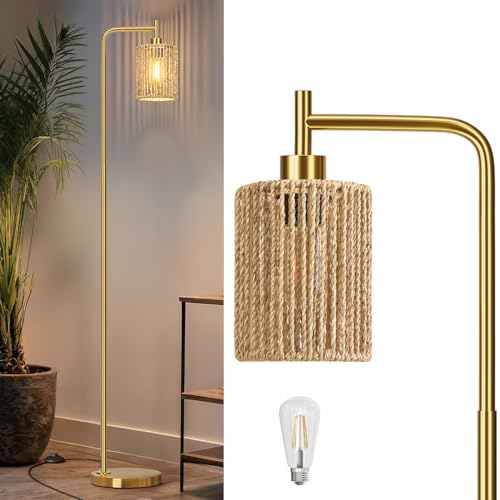
The retailer references on this page were originally grouped under “macrame,” although their listing names describe rattan, wicker, bamboo or floral designs. They are alternatives to investigate for a textured look; none is identified here as a verified knotted-cord macrame model. Start with the shade construction, then check whether the lamp fits your room and lighting task.
How to recognize the shade you want
| Listing description | What to look for |
|---|---|
| Macrame or knotted cord | Close-up photographs showing actual knots and a material description that identifies the cord. |
| Woven rattan, wicker or bamboo | The specified material and interlaced construction. Do not infer knotted textile construction from the word “boho.” |
| Floral or botanical shade | The attachment method and material description; floral decoration does not establish macrame construction. |
Ask the seller for a close-up if the photographs do not show how the shade is made. A fringe, natural color or handmade-style description alone does not establish the technique. Also check whether the listing supplies a complete floor lamp or only a replacement shade.
Choose the light for its job
Reading beside a chair
Check the shade’s position relative to your book and whether the bulb is visible from the seated position. An arc shape can place the shade above a seat, but the base and arm need room of their own. Measure both the base footprint and horizontal reach before ordering.
Ambient light in a corner
Look at the lamp switched on in a room, including the shadows cast by the shade. A photograph of an unlit shade cannot show the illumination you will get. This guide has no measured output-through-shade results for the products below.
Brightness and color appearance
The U.S. Department of Energy explains brightness in lumens. Compare the bulb’s lumen rating rather than treating its wattage as a brightness measurement. The number printed on the bulb does not establish how much light reaches your reading surface through a particular shade.
Color appearance is a separate specification, expressed in kelvins; the DOE’s bulb-buying guidance explains the Lighting Facts label. If adjustable color or dimming matters, confirm that the lamp, bulb and control support the feature together.
Fit and compatibility checklist
- Check total height, shade width, base dimensions and any arc reach against the available space.
- Confirm the socket type, permitted bulb shape and maximum actual wattage in the lamp instructions.
- Check whether the bulb is included and whether a dimmable bulb and compatible control are required.
- Follow the manufacturer’s assembly and placement instructions. Do not assume a lamp cannot tip because it has a weighted base.
- Check the shade’s cleaning instructions and whether replacements are available.
- Keep added cord or decoration away from the bulb and electrical parts; use only a shade configuration approved for the fixture.
Measure a replacement shade before ordering
For a macrame or woven replacement, write down the existing shade’s top width, bottom width and vertical height. Photograph how it attaches to the fixture. A similar silhouette does not establish that the attachment will fit.
Lamps Plus’s shade measuring guide distinguishes shade measurements and fitting types such as spider, uno and clip-on. Use that terminology to ask the seller a specific question, then confirm compatibility with your lamp’s own instructions.
- Complete lamp or shade only: Confirm what is included before comparing prices.
- Attachment: Match the fitter to the fixture; do not infer compatibility from a listing photograph.
- Shape: Measure the widest part and check nearby furniture, not just the top opening.
- Clearance: Use the approved bulb and shade configuration. A decorative proportion rule is not a heat-clearance specification.
- Construction: Ask for close-up photographs showing knots if actual macrame is the requirement; interlaced rattan is a different construction.
If your existing shade or lamp has a model number, send it with the measurements to the manufacturer before buying a replacement. That is more useful than asking whether a shade fits “a standard floor lamp.”
Existing woven and decorative alternatives
These retailer links are grouped for comparison, not ranked by tested brightness, stability or durability. Listing photographs and names help identify candidates, but confirm the selected model’s construction and current specifications before purchase.
Our top picks
 Hotsonic tree floor lamp
- 100% Hand-Woven Paper Cord Shade with Mesmerizing Light…
- Stepless Dimmable (0-100%): Customize your lighting experience effortlessly!…
- Instant Cozy Atmosphere, No Extra Bulbs Needed: Unbox…
 Ambimall arc floor lamp
- Smart Remote Control Boho Floor Lamp: Control your…
- 3 Color Temperatures and Full Range Dimming: Tailor…
- 4 Smart Modes with Flexible Light Direction: This…



As an Amazon Associate we earn from qualifying purchases at no extra cost to you.
Quick questions
Is a rattan lamp a macrame lamp?
Not solely because it uses a natural-looking shade. Macrame refers to knotting cord; inspect the actual construction and listing description.
Will any macrame shade fit my floor lamp?
Do not assume interchangeability. Match the shade attachment, dimensions and bulb clearances to the fixture instructions. A pendant shade is not automatically a floor-lamp replacement.
Can one woven lamp light the whole room?
That depends on the room, bulb, shade and placement. No measured room-lighting results are available in this guide, so it makes no whole-room performance promise.