Key takeaways
- Light placement over brightness: Integrated LEDs mounted under the top bunk’s frame or along guardrail undersides wash downward and stay out of sightlines. Strips facing outward at eye level create glare that reads as cheap and makes the lower bunk unpleasant. Check product photos for where the diffuser actually sits.
- Stair and ladder legibility in low light: Enclosed staircases with wide treads are far easier to navigate half-asleep than narrow rungs. If a ladder is the only option, look for a contrasting finish or a nearby light source so the first step is visible without a phone flashlight.
- Colour temperature and control: Warm white or dimmable RGB settings support winding down; cool blue-white pushes alertness at exactly the wrong hour. A frame with adjustable modes is genuinely more useful than one locked to a single bright preset.
- Finish reflectance: Matte black and dark espresso absorb light and make a small room feel tighter, though they hide scuffs well. Pale woods like pecan bounce ambient light around and keep a lower bunk from feeling closed in. Match the finish to how much natural light the room actually gets.
- Structural honesty: Solid wood slats, full-length guardrails, and a stated weight capacity matter more than any feature list. Verify these first, then judge on lighting and storage.
What's inside
Bunk beds get chosen in daylight and lived in after dark. That gap is where most purchases go wrong: a frame that photographs beautifully in a showroom becomes a hazard at 2 a.m., when a child on the top mattress has to find a ladder rung by feel, or when the only light source is a ceiling fixture bright enough to wake everyone in the room. Vertical sleeping stacks one bed inside another’s shadow, and the lower bunk in particular tends to become a cave with no usable reading light at all.
This guide evaluates bunk beds through that lens — integrated LED strips, glare direction, ladder and stair visibility, and whether the frame’s structure blocks or channels the light already in the room. Weight capacity, finish safety, and convertibility still matter, and they’re covered here. But the deciding factor between two structurally sound frames is usually how the room feels once the overhead light goes off.
As an Amazon Associate we earn from qualifying purchases.



How to Choose a Bunk Bed Best (2026)
- Light placement over brightness: Integrated LEDs mounted under the top bunk’s frame or along guardrail undersides wash downward and stay out of sightlines. Strips facing outward at eye level create glare that reads as cheap and makes the lower bunk unpleasant. Check product photos for where the diffuser actually sits.
- Stair and ladder legibility in low light: Enclosed staircases with wide treads are far easier to navigate half-asleep than narrow rungs. If a ladder is the only option, look for a contrasting finish or a nearby light source so the first step is visible without a phone flashlight.
- Colour temperature and control: Warm white or dimmable RGB settings support winding down; cool blue-white pushes alertness at exactly the wrong hour. A frame with adjustable modes is genuinely more useful than one locked to a single bright preset.
- Finish reflectance: Matte black and dark espresso absorb light and make a small room feel tighter, though they hide scuffs well. Pale woods like pecan bounce ambient light around and keep a lower bunk from feeling closed in. Match the finish to how much natural light the room actually gets.
- Structural honesty: Solid wood slats, full-length guardrails, and a stated weight capacity matter more than any feature list. Verify these first, then judge on lighting and storage.
The Best Bunk Bed Best (2026)s Reviewed
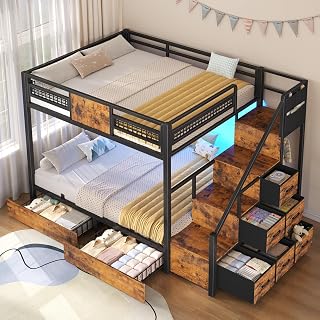
Twin Over Twin with Stairs, Storage Drawers and LED Lights
The strongest all-round option here: enclosed stairs remove the worst nighttime hazard, and the LED integration means a child can get down without turning on a room light and waking a sibling. Eight drawers plus a hanging area make it viable as a sole storage solution in a small bedroom.
Max & Lily Fundamental Twin Low Bunk Bed
No integrated lighting, and that’s fine — the low height and pale pecan finish do the ambience work instead, keeping the lower bunk open to whatever light the room already has. Solid wood construction with non-toxic finishes and a high weight capacity make this the pick for parents who’d rather add a clip-on reading lamp than trust a built-in electrical component.
Full Over Full Bunk Bed with Trundle, Grey
Three sleeping surfaces in one footprint, and the grey finish reflects enough light to stop the lower bunk from going dim. The conversion to two standalone platform beds gives it a genuine second life once the kids outgrow stacking, which is rare at this price.
Merax Twin Over Full Bunk Bed
The espresso finish is handsome but light-absorbing, so plan on a wall sconce or clamp light for the lower full bunk. Removable ladders and two storage drawers keep the frame practical, and the split-into-two-beds design is well executed.
Full Over Full Bunk Bed with Desk and Charging Station
The best-considered lighting package of the group: LEDs, storage pockets within reach of the mattress, and a charging station that keeps a device off the floor and out of the walkway. The integrated desk makes it the obvious choice for a shared teen room that doubles as a study space.
Frequently Asked Questions
Are built-in LED bunk bed lights bright enough to read by?
Usually not. Integrated strips are designed as ambient and orientation lighting — enough to find a ladder or set a mood, not enough for sustained reading. Pair them with a small clamp-on task lamp at each bunk.
Do LED bunk beds need to be plugged in constantly?
Most run off a low-voltage adapter that stays connected. Route the cable along a frame leg and secure it with adhesive clips so it never crosses a walkway or hangs where a child could pull it.
Should the top or bottom bunk get the better light?
The bottom. The top bunk is closer to whatever ceiling fixture exists and has open sightlines; the lower bunk sits under a solid platform and is the one that genuinely goes dark.
Is a staircase worth the extra floor space over a ladder?
If a younger child is using the top bunk, yes. Stairs are dramatically safer in low light and most staircase models recover the footprint as drawer storage.
Final Thoughts
For most shared rooms, the Twin Over Twin with Stairs, Storage Drawers and LED Lights is the best balance of safe nighttime navigation and real storage. Teens sharing a study space should look at the Full Over Full with Desk and Charging Station, while parents prioritising solid wood and a naturally bright room will be happiest with the Max & Lily Fundamental Low Bunk.