Our Top Picks
For most kitchens, the best Wüsthof Ikon Blackwood knife block collection is the seven-piece block: an 8-inch chef’s knife, a 7-inch santoku or an 8-inch bread knife, a 5-inch utility, a 3.5-inch paring, kitchen shears and a honing steel, sitting in a nine-slot block that measures roughly 10 × 4.5 × 9 inches and leaves about 19–20 inches of clear counter in front of it on a standard 24-inch-deep base cabinet. Step up to a nine- or ten-piece block if two or more people cook in the same kitchen, if you break down whole chickens and large roasts, or if you want steak knives living on the counter instead of in a drawer. Step down to a five- or six-piece block if your usable counter is shallower than about 18 inches, or if most of your cooking is vegetables, eggs, pasta and toast. The rest of this article breaks every Ikon Blackwood block configuration down by the five things that actually change the answer — blade selection, how the African blackwood handle feels in a wet hand, block footprint, storage capacity and real everyday coverage — so you can choose by situation rather than by the number on the box.
First, what “Ikon Blackwood” actually means on a box
Wüsthof is a Solingen, Germany knife maker, and Ikon is one of its forged lines. The signature of the line is the handle material: African blackwood, a dense, dark, oily timber also called grenadilla or mpingo, the same wood used for clarinets, oboes and bagpipes. It is a real wood, not a wood-look laminate and not a stained or printed finish, which means every handle has slightly different grain and every handle will age differently.

Wusthof IKON Blackwood 7 Piece Slim Knife Block Set
Picked as a relevant option in this category; details come from the product listing.
View on Amazon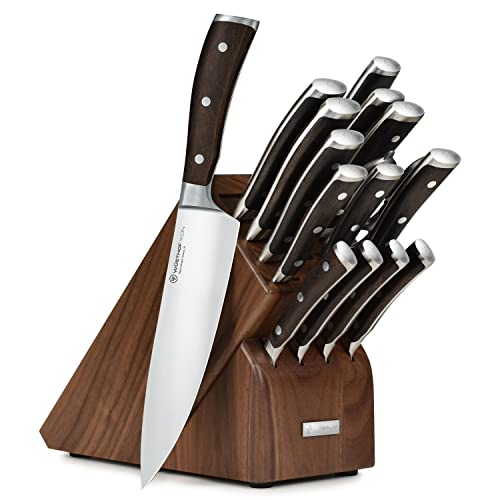
Wusthof IKON Blackwood 16 Piece Knife Block Set
Picked as a relevant option in this category; details come from the product listing.
View on Amazon
WÜSTHOF Ikon 7-Piece Knife Block Set
Picked as a relevant option in this category; details come from the product listing.
View on Amazon
Wusthof Ikon 8-Piece Knife Set with Blackwood Handles and Walnut Storage Block
Picked as a relevant option in this category; details come from the product listing.
View on AmazonThe naming is where people get tripped up. Wüsthof also sells a Classic Ikon line, which uses a black synthetic handle rather than wood. If a listing says “Classic Ikon,” you are not looking at blackwood, no matter how dark the handle looks in the photograph. The phrase “Wüsthof Ikon Blackwood” is the wood-handled line, and it is the one this article covers.
The second thing worth knowing before you spend money: in nearly every Ikon Blackwood block set, the block is not blackwood. It is almost always beech, sometimes rubberwood or acacia, finished with a clear coat and drilled with slots. That is not a downgrade — a solid-wood block is the right material for the job — but it means you are buying two different things, and they age on two different clocks. The knives are the expensive part and they last decades. The block is the part that will look tired first.
What a set actually contains
Wüsthof’s piece counts are inconsistent across retailers. Sometimes the block counts as a piece, sometimes it doesn’t, and shears and honing steels are almost always counted. A “seven-piece set” might be five knives plus a steel plus a block, or it might be four knives plus shears, steel and block. Always read the knife list, not the number. If a listing will not tell you exactly which blades are in the box, that is a reason to keep looking.
The blade side: what you are actually paying for
Every Ikon blade is forged from a single piece of steel rather than stamped from a sheet. The alloy is a standard German stainless — roughly 0.5% carbon, 15% chromium, with small amounts of molybdenum and vanadium, usually written as X50CrMoV15. It is hardened to about 58 on the Rockwell C scale. That number matters more than most marketing copy suggests, and it is a deliberate compromise.
At 58 HRC, a blade holds a working edge noticeably longer than the 54–56 HRC steel found on inexpensive stamped knives, but it stays tough enough that you are unlikely to chip it by hitting a chicken bone or a cutting board edge. Japanese knives frequently run 60–64 HRC: they take a finer, sharper edge and hold it longer, but they are brittle enough that a careless twist against a board can take a notch out of the edge. Fifty-eight is the middle of the road on purpose, and it is the right middle for a set that has to survive a household rather than a professional prep station.
The half bolster, and why it changes how you sharpen
Ikon knives use a forged half bolster — the thick metal collar between handle and blade stops short of the cutting edge instead of running all the way down to the heel. There are two practical consequences, and both are good.
First, you can sharpen the entire length of the blade on a whetstone or a pull-through, including the last half-inch near the handle. On a full-bolster knife, that section is effectively unsharpenable, and over a decade of home sharpening the blade gradually develops a visible dip just ahead of the bolster — a “smile” that no amount of honing fixes.
Second, the missing bolster leaves room for a pinch grip: thumb and forefinger on the blade itself, just ahead of the handle. That is the grip most cooks settle into because it gives far more control over the tip than holding the handle like a hammer. It is also the grip that blackwood handles make slightly harder to hold onto, which is the next section.
Edge geometry and blade thickness
Wüsthof ships these knives at roughly 14–15 degrees per side, which is thinner than the 20-degrees-per-side angle common on mass-market German knives and much thinner than a typical Western kitchen knife from a supermarket. The spine on the 8-inch chef’s knife runs about 2.5 mm thick and tapers toward the tip. In practice this means the knife moves through onions and carrots with less wedging than a heavier, thicker blade, but it also means the edge is fine enough that you should not use it to hack through a squash or a frozen block of anything.
The handle side: how African blackwood actually feels
This is the part no product listing can tell you, because it is a sensation rather than a specification. African blackwood has a density of roughly 1.20–1.35 g/cm³, which means a blackwood handle sinks in water — most woods float. Its Janka hardness is commonly quoted around 3,600–3,700 lbf, harder than hickory or hard maple. It is an oily, close-grained timber with almost no visible pores.
Hold one and you notice three things.
It feels cool and dense, more like a stone than a wood. It has almost no give, so vibration from the cut travels straight into your palm — some cooks find that gives them more feedback about what the edge is doing, and some find it tiring over a long prep session.
And it is smoother when wet than a synthetic handle. Acetal and other synthetic handle materials are slightly tacky, and they get grippier when your hands are damp. Blackwood, being oily and finely grained, does the opposite: a wet hand slides on it a little more. If you routinely cook with wet or oily hands and you are not confident in a pinch grip, this is the single most important thing to know about the line, and it is the reason a lot of professional cooks who love the look of blackwood still keep a synthetic-handled knife in the rotation for messy work.
The humidity caveat nobody puts on the box
Blackwood is a wood handle on a steel tang, and wood moves. In a kitchen that runs very dry — forced-air heat through a northern winter, relative humidity under 30% — a blackwood handle can shrink very slightly, and you may feel the rivets or the tang edges as a faint ridge. In a humid, un-air-conditioned kitchen it can swell slightly. Neither is a defect, and neither is dramatic, but it is the reason the care routine below matters more on this line than on a synthetic-handled knife.
Two rules cover almost all of it. Never put a blackwood-handled knife in a dishwasher; the heat and the prolonged soaking are the two things wood handles handle worst. And wipe the handle dry along with the blade after washing, rather than leaving it to air-dry on a rack where water sits against the wood.
How to read a block-set listing without getting fooled
Block sets are sold on piece count because piece count is easy to print on a box. What actually determines whether the set fits your kitchen is the block, and the block is the one thing listings rarely measure.
Three measurements decide it. The first is the counter depth in front of the block: a standard base cabinet is 24 inches deep with a 25.5-inch countertop, and a block sitting at the back of it eats 4.5–5 inches, leaving you roughly 19–20 inches of actual work surface. If your kitchen has a 20-inch-deep counter, a block takes a quarter of your prep area.
The second is clearance to the upper cabinet. Most upper cabinets sit 18 inches above the counter. A block that is 9 inches tall leaves 9 inches of clearance — fine. A tall angled block at 12–13 inches leaves 5–6 inches, which is enough to pull a knife out but not enough to lift the block for cleaning without tilting it.
The third is the wall gap. Blocks with knives stored handle-out need an inch or two behind them so the longest handle doesn’t foul the backsplash. Measure the longest handle in the set — usually the bread knife or the carving knife — and add an inch.
Slot count versus knife count
A nine-slot block is not a nine-knife block. Slots are sized and shaped for specific blades, and steak-knife slots are narrow. If a set ships with six knives in a nine-slot block, you have three empty slots — that is a feature, not an oversight, because it lets you add open-stock knives later. But check the slot widths before you assume a vacant slot will take the 10-inch carving knife you already own.
Material trade-offs, in numbers
The handle and the block are different materials doing different jobs, and it is worth seeing them side by side against the alternatives you will encounter at the same price level.
| Handle material | Density (g/cm³) | Janka hardness | Behavior in a wet hand | Humidity response |
|---|---|---|---|---|
| African blackwood (Ikon Blackwood) | 1.20–1.35 | ~3,600–3,700 lbf | Smooth, slightly slicker when wet | Moves slightly; needs occasional oiling |
| Synthetic acetal / POM | ~1.41 | Not applicable | Slightly tacky; grippier when damp | Dimensionally stable |
| Resin-stabilized wood | 1.05–1.25 | Not applicable | Firm, mildly tacky | Near-zero movement |
| Laminated pakkawood | 1.10–1.20 | Not applicable | Firm, uniform, low feedback | Low movement |
| Uncoated metal handle | ~7.8 (steel) | Not applicable | Cold, slippery when wet | None |
| Block material | Typical footprint (in) | Weight, empty (lb) | Wears first | Notes |
|---|---|---|---|---|
| Solid beech, horizontal | 8–12 × 4.5–5 × 8–10 | 3–5 | Slot mouths round over; finish dulls | Most common in Wüsthof sets |
| Rubberwood, angled | 9–11 × 5–6 × 11–13 | 4–6 | Swelling near the sink; cracked end grain | Needs more distance from the faucet |
| Acacia, horizontal | 9–13 × 4.5–5 × 8–10 | 3–5 | Finish wear; darker grain hides scratches | Harder than beech, more variable |
| Magnetic bar or magnetic block | 12–18 × 1–2 (bar) | 1–3 | Magnet strength; edge contact points | No slot geometry limits; edges exposed |
The trade-off is straightforward. Wood handles give you density, feedback and a look that improves with age, at the cost of a small maintenance routine and a slightly slicker grip when wet. Synthetic handles give you grip and zero maintenance, at the cost of feeling dead and looking the same in year ten as in year one. Neither is better; they suit different cooks.
The Ikon Blackwood collections, one at a time
Below, each configuration is broken down by blade selection, handle feel, block footprint, storage capacity and what it actually covers in a normal week of cooking. Footprints are approximate, because Wüsthof changes block designs between production runs and different retailers bundle different blocks with the same knives.
1. The three-knife open-stock starter
Blades: 8-inch chef’s knife, 5-inch utility knife, 3.5-inch paring knife. No block, no steel, no shears.
Handle feel: This is the cheapest way to find out whether you like blackwood in your hand. Three knives is enough to cook a full week of ordinary meals, and it is also enough to learn whether the density and the smoothness under a wet hand suit you. If you buy a full block set and discover you dislike the handle, you have made an expensive discovery.
Block footprint: None — which is the point for some kitchens. These three live comfortably in a drawer with a $15 in-drawer insert, or on a magnetic bar.
Storage capacity: Three knives. Nothing more.
Everyday coverage: The chef’s knife does about 80% of everything — onions, carrots, proteins, herbs, garlic. The utility knife handles shallots, small fruit, sandwich duty and trimming. The paring knife handles hulling, peeling and in-hand work. What you are missing is a serrated edge, which means bread, tomatoes and citrus rind get torn or crushed rather than cut. If you bake or eat a lot of crusty bread, this trio will annoy you within a month.
Typical market range: usually $300–$500 for the three knives.
2. The five-piece block collection
Blades: Usually an 8-inch chef’s knife, a 5-inch utility, a 3.5-inch paring, a honing steel and the block. Sometimes the santoku replaces the utility, and sometimes a 6-inch chef’s knife replaces the 8-inch — check before buying.
Handle feel: The steel gets used more than you expect. Honing realigns the edge rather than removing metal, and with five knives’ worth of blackwood handles on the counter, the steel becomes the object you reach for every second or third session. It has a synthetic or wood handle depending on the set, so it may not match the knives.
Block footprint: A five- to seven-slot horizontal block runs roughly 8–9 inches wide, 4.5 inches deep and 8–9 inches tall. That is the smallest footprint that still keeps knives off the counter and out of a drawer.
Storage capacity: Five to seven slots for five pieces — you generally get one or two spare slots, which is useful.
Everyday coverage: This is the minimum honest answer for a household that cooks most nights. It covers chopping, slicing, mincing and peeling. It does not cover bread, carving a roast, or breaking down a chicken cleanly. It also has no shears, which matters more than people expect: kitchen shears cut through poultry skin and bone, snip herbs, open packaging and trim dough. Without them you will use the chef’s knife for jobs it is bad at.
Typical market range: usually $450–$750.
3. The six-piece block collection
Blades: Typically the 8-inch chef’s knife, an 8-inch bread knife, a 5-inch utility, a 3.5-inch paring, a honing steel and the block.
Handle feel: The bread knife is the odd one out in a blackwood set, and it is worth understanding why. Serrated blades are usually thinner and more flexible than forged chef’s knives, and some bread knives in forged lines are stamped rather than forged to keep the flex. The handle is still blackwood, so the set looks uniform on the block, but the blade will feel lighter and whippier in the hand than the rest of the set. That is normal, not a defect.
Block footprint: Roughly 9 × 4.5 × 9 inches. The extra width over a five-piece is entirely to accommodate the longer bread knife slot.
Storage capacity: Six to eight slots.
Everyday coverage: Adding the serrated blade closes the biggest single gap in the five-piece set. Bread, tomatoes, citrus, cake layers and anything with a tough skin and soft interior all get dramatically better. This is the smallest set that genuinely covers a normal omnivorous kitchen, and for a one- or two-person household it is often the right answer rather than the seven-piece.
Typical market range: usually $550–$850.
4. The seven-piece block collection
Blades: Commonly an 8-inch chef’s knife, a 7-inch santoku or a second chef’s knife, an 8-inch bread knife, a 5-inch utility, a 3.5-inch paring, a honing steel and the block. Some bundles swap the santoku for a 6-inch utility or add shears and drop a knife.
Handle feel: This is the configuration where the blackwood handle’s density becomes a real advantage rather than a curiosity. Seven knives on a counter means you are switching tools constantly, and the Ikon handle’s weight sits forward enough that the knife balances near the bolster. A knife that balances at the bolster feels lighter in use than its actual weight suggests, which reduces wrist fatigue over a long prep session — the trade-off being that a handle-heavy knife feels steadier for chopping. The Ikon leans toward the former.
Block footprint: Roughly 10 × 4.5 × 9 inches for a nine-slot horizontal block. That is the number to measure against your counter before ordering.
Storage capacity: Nine to eleven slots, so you have two to four spare. Spare slots matter more than they sound: they are the difference between adding a 10-inch carving knife in three years and having nowhere to put it.
Everyday coverage: This is the configuration most kitchens should buy. The santoku’s flatter profile and hollow-edge indentations make it the better tool for thin slicing and for anything that would otherwise stick to the blade — cucumbers, potatoes, cured meat. The chef’s knife does the rocking cuts and the heavy work. Between them, plus the serrated knife, the utility and the paring, there is essentially no ordinary home cooking task without a proper tool. What is still missing is shears and steak knives.
Typical market range: usually $700–$1,100.
5. The eight-piece block collection
Blades: Usually the seven-piece knife lineup plus kitchen shears — so a chef’s knife, santoku, bread knife, utility, paring, shears, honing steel and block.
Handle feel: Shears are the piece you will grip hardest and longest, and they are the piece that most often has a plastic or composite handle rather than blackwood, because shears take loads that wood handles are not ideal for. Expect a visual mismatch on the block. It is a functional decision, not a cost-cutting one.
Block footprint: Roughly 10 × 4.5 × 9 inches, same as the seven-piece, because the shears usually occupy a slot that was already there or hang from a dedicated hook on the side.
Storage capacity: Nine to eleven slots plus a shear slot or hook.
Everyday coverage: Shears close a gap most people don’t notice until they have them. Spatchcocking a chicken, cutting through the ribs of a whole bird, snipping herbs directly over a pan, cutting pizza, trimming pastry, opening vacuum-sealed packaging — shears do all of it faster and more safely than a knife. For anyone who cooks whole poultry regularly, this is the set that stops you reaching for a knife you shouldn’t be using.
Typical market range: usually $800–$1,200.
6. The nine-piece block collection
Blades: Typically a chef’s knife, santoku, bread knife, a carving or slicing knife, utility, paring, shears, honing steel and block. Some configurations substitute a second paring knife or a 6-inch chef’s knife for the carving knife.
Handle feel: The carving knife is where the blackwood handle earns its keep. A long slicing knife is used in a single, long drawing stroke rather than a rocking motion, and handle density helps you keep that stroke level and consistent. A light handle on a long blade encourages the tip to wander, which is how you end up with uneven slices of roast.
Block footprint: Roughly 11 × 5 × 9.5 inches. The carving knife slot adds an inch of width and a half-inch of depth to the block.
Storage capacity: Eleven to thirteen slots.
Everyday coverage: This is the first configuration that is genuinely about cooking for a group. A carving knife is close to useless for a single person cooking weeknight dinners, and close to essential for anyone who roasts a joint or a bird for four or more people. If you host regularly — holidays, Sunday dinners, a standing monthly gathering — the carving knife is the difference between serving presentable slices and serving a pile of uneven chunks.
Typical market range: usually $950–$1,400.
7. The ten-piece block collection
Blades: The nine-piece lineup plus steak knives, usually two to four of them, or the nine-piece lineup with the steel replaced by two additional steak knives.
Handle feel: Steak knives in the Ikon Blackwood line are a strange purchase, and it is worth being honest about it. They are used for a few minutes at a time, at a table, and they get washed and put away rather than left on a block. The blackwood handle is a pleasure but not a necessity, and four steak knives at Ikon pricing can be a significant fraction of the whole set. If you want the visual consistency on a table, buy them. If you want value, buy a cheaper serrated steak knife set and put the money into a better chef’s knife.
Block footprint: Roughly 11 × 5 × 9.5 inches, or larger if the steak knife slots are in the block rather than on a separate rack.
Storage capacity: Thirteen to sixteen slots.
Everyday coverage: Everything the nine-piece covers, plus table service. This is the configuration for a household that regularly feeds four to six people and wants one object on the counter to handle prep and service.
Typical market range: usually $1,100–$1,700.
8. The large-capacity block, bought empty
Blades: None. You buy a block with 16–22 slots and fill it with open-stock Ikon Blackwood knives over time.
Handle feel: Irrelevant at purchase, decisive at year three. Buying open-stock lets you choose the exact blade lengths and profiles you actually use rather than accepting a bundle. If you have large hands and prefer a 10-inch chef’s knife, or you cook mostly Japanese-leaning food and want a 7-inch santoku as your primary, this is the only route that gets you there.
Block footprint: A 20-slot block runs roughly 14–16 inches wide, 5–6 inches deep and 10–12 inches tall. That is a substantial piece of real estate: on a 24-inch counter it takes well over half the depth and more than half the width of a typical prep zone. Measure before you buy, and consider an angled block against a corner, where it consumes less linear counter.
Storage capacity: 16–22 slots, with a mix of wide chef’s-knife slots and narrow utility and steak slots.
Everyday coverage: Whatever you decide. The risk is real, though: most people who buy a 20-slot block fill eight slots and look at twelve empty holes for a decade. Buy the block for the knives you own plus three, not for the knives you imagine buying.
Typical market range: usually $150–$400 for the block alone, depending on size and wood.
9. The steak knife collection
Blades: Four or six steak knives, sold with or without a small block or a wooden tray.
Handle feel: At a table, the blackwood handle’s density reads as heft and quality, and the darker wood looks good against most table linens. The trade-off is that a dense, smooth handle in a greasy hand after cutting a steak is exactly the wet-hand scenario where blackwood is at its least grippy. It is a minor thing over a dinner, and worth knowing anyway.
Block footprint: A four-knife tray is typically 8 × 3 × 2 inches, or the knives may store horizontally in a drawer insert at about 10 × 5 × 1.5 inches.
Storage capacity: Four or six knives.
Everyday coverage: Table service only. These do not replace any prep knife.
Typical market range: usually $250–$500 for four.
10. The everyday pair, with a magnetic alternative
Blades: An 8-inch chef’s knife and a 3.5-inch paring knife, stored on a magnetic bar or in a magnetic block rather than a slotted wooden one.
Handle feel: Identical to any other Ikon Blackwood knife. What changes is the storage, and it changes the care routine: on a magnetic bar the blade’s flat face is fully exposed to air, so it dries completely and there is no slot for moisture or crumbs to collect in. For a blackwood handle, that is genuinely better than a slotted block, because the handle is not sitting in a dark cavity next to a blade that was just rinsed.
Block footprint: A 12–18 inch magnetic bar takes essentially no counter at all if mounted on the wall, at the cost of needing a wall with clear space and enough stud or anchor capacity to hold roughly 5–8 lb of steel. A magnetic block, by contrast, uses about the same counter as a small wooden block but has no slot geometry, so any knife fits anywhere.
Storage capacity: Two to eight knives, depending on bar length.
Everyday coverage: For a single cook in a small kitchen, a chef’s knife, a paring knife and a wall-mounted bar is a complete, honest answer that costs a fraction of a block set and leaves the counter clear. It is also the setup that stores worst for anyone with children, because the edges are exposed.
Typical market range: usually $250–$400 for the two knives, plus $30–$120 for the storage.
Side by side: every configuration at a glance
| Collection | Knives included | Block footprint (in) | Slots | Ships at roughly (lb) | Typical range |
|---|---|---|---|---|---|
| 3-piece open stock | Chef’s, utility, paring | None | 0 | 1.5–2 | $300–$500 |
| 5-piece block | Chef’s, utility, paring | 8–9 × 4.5 × 8–9 | 5–7 | 4–6 | $450–$750 |
| 6-piece block | Chef’s, bread, utility, paring | 9 × 4.5 × 9 | 6–8 | 5–7 | $550–$850 |
| 7-piece block | Chef’s, santoku, bread, utility, paring | 10 × 4.5 × 9 | 9–11 | 6–8 | $700–$1,100 |
| 8-piece block | As above plus shears | 10 × 4.5 × 9 | 9–11 + shear hook | 6–8 | $800–$1,200 |
| 9-piece block | As above plus carving knife | 11 × 5 × 9.5 | 11–13 | 8–10 | $950–$1,400 |
| 10-piece block | As above plus steak knives | 11 × 5 × 9.5 | 13–16 | 9–12 | $1,100–$1,700 |
| Large block, empty | None | 14–16 × 5–6 × 10–12 | 16–22 | 5–9 (block only) | $150–$400 |
| Steak knives | 4 or 6 steak knives | 8 × 3 × 2 (tray) | 4–6 | 1–2 | $250–$500 |
| Everyday pair + magnet | Chef’s, paring | 12–18 × 1–2 (bar) | 2–8 | 1–2 + bar | $280–$520 |
Read that table by column, not by row. If you are shopping a specific kitchen, the footprint and slot columns decide it. If you are shopping a specific cook,