Our Top Picks
 GAIOUS Metal Wardrobe Cabinet with 2 Drawers17.71"D x 31.5"W x 71"H17.71 x 31.5 x 71 inches96.58 poundsCheck on Amazon
For a small room, the best wardrobe is usually a slim sliding-door or shallow-depth unit that stops swinging doors from eating floor space, a tall narrow wardrobe if the footprint is tight but the ceiling is high, or a fabric or open-rail wardrobe if you are renting and want the lowest budget tier. Which suits you depends on door clearance, how much hanging space you need, and whether the unit must move with you.
Small-room wardrobe types at a glance
| Type | Best for | Key points | Limits |
|---|---|---|---|
| Sliding-door wardrobe (IKEA PAX sliding-door configurations, similar ranges) | Rooms where a swinging door would hit the bed | Doors run on a track; makers publish depth and width options | Only part of the interior is open at once; tracks need cleaning |
| Hinged-door tall wardrobe (IKEA BRIMNES and similar) | Full access to the interior; lower budget tier | Standard sizes, often with a drawer or shelf option | Needs door swing clearance; freestanding tall units must be anchored as instructed |
| Shallow or slim wardrobe | Hallways, landings and narrow bedrooms | Shallower depth than standard; garments may hang sideways on pull-out rails | Less capacity; bulky coats may not fit |
| Open clothing rail with shelves | Rentals, studios, quick set-up | Metal or wood frames, no doors | Items are exposed to dust and light; needs tidy habits |
| Fabric or canvas wardrobe (Songmics and similar) | Temporary storage, student rooms | Light frame with zip cover | Lower weight limits; less durable over time |
| Over-bed or bridge storage | Using wasted height above a bed | Cabinets spanning the bed alcove | Needs strong wall fixing; best fitted by a professional |
Start with the room, not the wardrobe
Small-room storage fails most often because the buyer chooses a wardrobe by capacity and then discovers the doors cannot open. Before browsing, measure the usable wall width, ceiling height, the position of any radiator, window or socket, and the distance from the wall to the nearest piece of furniture. A standard hinged door typically needs a clear arc equal to the width of the door; a sliding door needs none.
GAIOUS Metal Wardrobe Cabinet with 2 Drawers, 71" Clothing Storage Cabinets | with 2 Doors, 1 Adjustable Shelf, Steel Armoire Wardrobe Closet with Hanging Rod for Bedroom, Gym, Cloak Room (Black)
Chosen because it specifies 71" Clothing Storage Cabinets and with 2 Doors.
View on Amazon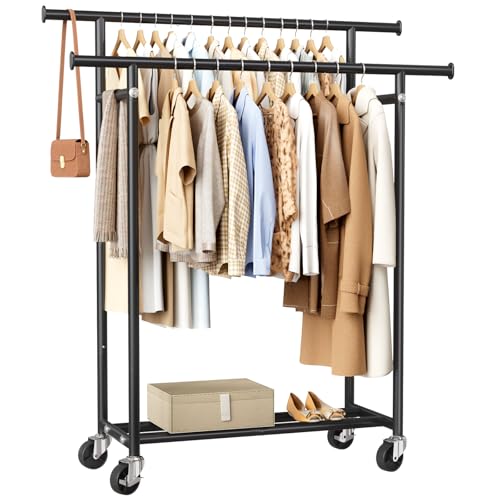
HYSEYY Clothes Rack, Double Rods Rolling Clothing Rack for Hanging Clothes, Portable Garment Rack with Wheels, Coat Rack Wardrobe Closet Load 240 LBS for Bedroom Laundry Room (Black, L)
Chosen because it specifies Double Rods Rolling Clothing Rack for Hanging Clothes and Portable Garment Rack with Wheels.
View on Amazon
HOMIDEC Closet Organizers and Storage, 9 Cube Storage Organizer, Black | Portable Closet Organizer, Storage Cubes Shelves, for Bedroom, Kids Room, Bathroom, Wardrobe, Clothes Rack
Chosen because it specifies 9 Cube Storage Organizer and Black.
View on AmazonIt also helps to count what you actually need to hang. Many people find that a short hanging rail, a few shelves and a drawer unit hold more than a single tall hanging space because shirts and trousers do not need full height. Splitting a unit into double-hang and shelf sections is one of the cheapest ways to add capacity without adding footprint.
Doors and depth
Sliding doors
Sliding doors suit narrow bedrooms and alcoves. Their trade-off is that each door covers part of the opening, so you do not see the whole interior at once. Look for smooth runners, a bottom or top track that the maker describes as suitable for your door weight, and, with mirrored doors, safety-backed glass that the maker states.
Hinged doors
Hinged doors cost less in many ranges and show the full interior. In tight rooms, consider hinged doors that fold or doors that open to 90 degrees only, or place the wardrobe on the wall where the door arc does not meet the bed or door.
Depth
Standard wardrobe depth accommodates garments hanging front to back. Where depth is short, some makers offer shallower units or rails that pull out sideways. Check the stated internal depth against the width of your hangers; compact hangers help in shallow units.
Height, anchoring and safety notes
- Tall freestanding wardrobes can tip if not secured. Use the wall fixings that come with the unit, matched to your wall type, and keep heavy items low.
- Check the maker’s rail weight limit; a crowded rail can sag or pull brackets from the carcass.
- Do not climb on drawers or shelves, and do not open several drawers at once on units that the maker warns can tip.
- Leave a few centimetres behind the unit if you are placing it near a radiator or an external wall prone to damp, and keep it clear of heat sources.
- If a child or pet uses the room, take extra care with anchoring and with zip-up fabric wardrobes, which can collapse if overloaded.
Budget tiers
At the budget tier you will mostly see fabric wardrobes, open rails, and basic flat-pack hinged units. The mid-range tier adds sliding doors, better runners, interior fittings and the option to configure a system from modules. The premium tier covers made-to-measure sliding-door wardrobes, built-in or fitted units, and joinery that follows the shape of the room. In a very small room, a premium option may be worthwhile if it adds the ability to use every centimetre, but only when you expect to stay long enough to benefit.
Pick X if you …
| Pick this | If you … |
|---|---|
| A sliding-door wardrobe | Cannot spare space for a door swing and want a clean look |
| A hinged-door tall unit | Have clearance, want full interior access and a lower budget tier |
| A shallow or slim wardrobe | Are fitting storage into a hall, landing or narrow room |
| An open rail with shelves | Rent, move often, or want the quickest, simplest set-up |
| A fabric wardrobe | Need temporary storage and are mindful of weight limits |
| Over-bed or alcove storage | Have unused height and are prepared for professional fitting |
Layout ideas that make small rooms feel larger
Choose a wardrobe in a colour close to the wall to reduce visual weight. A mirrored door can bounce light around and double as a dressing mirror, which removes the need for a separate floor mirror. Keep the top of the wardrobe tidy or use matching boxes for seasonal items, since clutter above eye level makes ceilings appear lower. If the room has a window alcove, consider fitting a shallow unit or shelves on either side of it rather than placing a single large block against one wall.
Combining storage types often works better than relying on one: a slim wardrobe for hanging, a drawer unit under a bed or a bed with storage underneath for folded items, and wall hooks for daily bags and coats. Underbed drawers or lidded boxes hold out-of-season items without taking wall space. Check the bed manufacturer’s notes before adding heavy storage to a bed frame.
Alternatives to buying a wardrobe
Dress rail on a wall
A wall-fixed rail with a shelf above is a minimal and low-cost way to hang clothes, if the wall can take the load. Use fixings rated for the wall type and the weight you plan to hang.
Ottoman or storage bed
Beds with lift-up bases or drawers hold folded clothes and bedding, freeing a wall for a smaller wardrobe.
Curtained alcove
A rail and curtain across an alcove gives hidden storage with no door swing, and is simple to remove when you move.
Care and upkeep
Dust runners and tracks regularly. Wipe laminate or foil surfaces with a damp cloth and mild cleaner, and avoid soaking edges, where moisture can lift the finish. Re-tighten screws after the first few weeks of use and a couple of times a year after that. Rotate clothes so heavy items are not always on the same rail section, and follow the maker’s care sheet for fabric covers and zips.
Frequently Asked Questions
What is the best wardrobe type for a very small bedroom?
A sliding-door wardrobe is often the most practical, since it needs no swing space. If the wall is short, a tall narrow unit or a shallow wardrobe can make use of height instead of width.
How deep should a wardrobe be?
Standard hanging space usually needs the depth of a hanger turned front to back, which is why many wardrobes are around that depth. In tight rooms, look for shallow units with pull-out sideways rails, and confirm the maker’s stated depth before ordering.
Do I need to anchor a freestanding wardrobe to the wall?
The maker’s instructions usually say yes for tall units, and it is a good safety habit, especially with children in the home. Use fixings suited to your wall type and follow the manual.
Are fabric wardrobes strong enough for everyday use?
They suit light loads and temporary storage, but their frames and rails have lower limits than wood-based wardrobes. Check the stated weight capacity and avoid heavy coats on a single rail.
Are mirrored sliding doors a good idea in a small room?
Many buyers like them because they reflect light and double as a full-length mirror. Look for doors the maker describes as safety-backed and follow fixing and assembly instructions closely.
Can I make a small wardrobe hold more?
Yes, by using double-hang rails for short garments, slim hangers, stackable shelf dividers and boxes for folded items. Moving out-of-season clothes to underbed storage also frees space.
More from Amazon
Programs that pair well with the guide above. Offers and eligibility are set by Amazon and may change.
Collect the home and kitchen items you want in one registry that guests can shop from.
Create a wedding registrySet up recurring deliveries of everyday items on eligible products. Terms and savings are set by Amazon.
Explore Subscribe & SaveFree shipping on eligible items, Prime Video and more. Eligible new members can start with a free trial.
Start a Prime free trialAudiobooks and podcasts to listen to on the go. Eligible new members can start with a free trial.
Try Audible freeAs an Amazon Associate we earn from qualifying purchases.