Key takeaways
- Finish and light reflectance: Matte black frames absorb light and recede visually, which suits bright rooms with good daylight. White or pale wood systems bounce light back into the interior and make dim corners far more usable. Pick the finish that compensates for what your room lacks.
- Open frame versus fabric cover: Covered wardrobes protect against dust but kill every bit of borrowed light from the room. If your space has a single overhead fixture, an open rack keeps garments legible. If you’re storing seasonal pieces you rarely see, the cover wins.
- Shelf depth and shadow lines: Deep shelves cast their own shadows over whatever sits below. Look for systems with 12 to 15 inches of depth rather than 18-plus, unless you plan to light each tier independently.
- Load rating against real weight: Winter coats, boots, and stacked knits add up fast. Check the rated capacity per rod, not just the total, and favor steel tubing at 19mm diameter or thicker for anything holding outerwear.
- Mounting surfaces for accent lighting: Flat horizontal shelf undersides and squared vertical uprights give adhesive LED strips something to grip. Round tubing and textured particleboard do not. This detail decides whether you can upgrade the ambience later.
What's inside
Most closet frustration isn’t really a storage problem. It’s a visibility problem. You stand in front of a rail at 6:40 a.m., squinting into a cave where the only light source is somewhere behind your head, and every garment reads as the same murky charcoal. Fabric texture disappears. Navy and black become indistinguishable. You pull three shirts before finding the one you actually wanted, and the pile on the chair grows. Open-frame wardrobe systems change that equation, because they stop trapping shadow the way a closed cabinet does — but only if you choose one that works with the light in your room rather than against it.
This guide evaluates six freestanding and modular wardrobe systems through a lens most furniture roundups skip: how they handle ambient light, how their finishes read under warm versus cool bulbs, and how easily you can add a strip light or puck fixture without the whole thing looking like a hardware store display. We also cover the practical fundamentals — load capacity, footprint, assembly effort, and whether the shelving actually holds up under folded denim. Whether you’re outfitting a rental bedroom, staging a walk-in, or building out a cloakroom corner, there’s a match here.
As an Amazon Associate we earn from qualifying purchases.


🛒 Best Price Today on Amazon
Prime members get fast, free shipping on everything above, plus member-only deals. New members get a 30-day free trial — cancel anytime.
How to Choose a Wardrobe Solutions (2026)
- Finish and light reflectance: Matte black frames absorb light and recede visually, which suits bright rooms with good daylight. White or pale wood systems bounce light back into the interior and make dim corners far more usable. Pick the finish that compensates for what your room lacks.
- Open frame versus fabric cover: Covered wardrobes protect against dust but kill every bit of borrowed light from the room. If your space has a single overhead fixture, an open rack keeps garments legible. If you’re storing seasonal pieces you rarely see, the cover wins.
- Shelf depth and shadow lines: Deep shelves cast their own shadows over whatever sits below. Look for systems with 12 to 15 inches of depth rather than 18-plus, unless you plan to light each tier independently.
- Load rating against real weight: Winter coats, boots, and stacked knits add up fast. Check the rated capacity per rod, not just the total, and favor steel tubing at 19mm diameter or thicker for anything holding outerwear.
- Mounting surfaces for accent lighting: Flat horizontal shelf undersides and squared vertical uprights give adhesive LED strips something to grip. Round tubing and textured particleboard do not. This detail decides whether you can upgrade the ambience later.
The Best Wardrobe Solutions (2026)s Reviewed
HOMIDEC Portable Wardrobe Closet
The four-tier shelf stack paired with a hanging rod gives you clear zoning, and the black steel frame all but vanishes against a painted wall so your clothing becomes the visual subject. Worth noting: the open sides let side-cast lamp light reach the hanging section, which closed units simply can’t do.
E10 Freestanding Clothes Rack
The stretchable rod spanning 73 to 97 inches makes this the most adaptable option here, and an 800-pound load ceiling means you’re not rationing hangers. Because it’s almost entirely rod and upright, nothing casts shadow across the garments — this is the brightest-reading rack of the group under a single ceiling fixture.
Custom Closet System with 6 Drawers
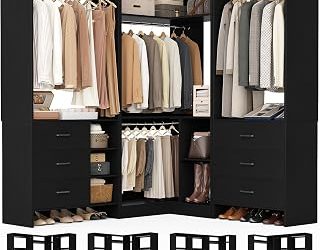
Two modular towers in white, expandable from 5 to 14 feet, with eight adjustable rods and six drawers — this is genuine built-in performance without the contractor invoice. The white wood surfaces are the best light-bouncers reviewed here, and the flat shelf undersides take adhesive LED strips cleanly for a boutique glow.
E1 Heavy Duty Closet Garment Rack
Six adjustable tiers and four rods on an expandable steel frame, with assembly straightforward enough to finish in an afternoon. The tier spacing is generous enough that upper shelves don’t smother the ones beneath in shadow, which is rarer than it should be at this price.
LOKEME Steel Wardrobe Closet
The 19mm steel tubing is the reassuring detail — three rods and six shelves that won’t sag under a season of heavy coats. Side pockets keep small items visible instead of buried, and the frame’s slim profile means less bulk blocking whatever natural light your bedroom gets.
Frequently Asked Questions
Can I add lighting to an open wardrobe system safely?
Yes. Low-voltage USB or battery LED strips run cool and pose no fire risk against fabric. Choose 2700K to 3000K for a warm, flattering cast, or 4000K if accurate color matching matters more than atmosphere.
Do fabric-covered wardrobes make a room feel smaller?
Visually, yes — a solid covered mass reads as a wall and blocks light transmission. Open frames let sightlines and illumination pass through, which keeps compact bedrooms feeling less compressed.
How much clearance should I leave around a freestanding wardrobe?
Allow at least 30 inches in front for comfortable access, and a few inches at the back so air circulates and any rear-mounted light can wash the wall behind it.
Are modular closet towers worth it over a simple rack?
If you’re staying put for a few years and want drawers plus adjustable shelving, yes. For rentals or short-term setups, a freestanding rack delivers most of the function at a fraction of the assembly time.
Final Thoughts
For maximum flexibility and sheer capacity, the E10 freestanding clothes rack is hard to beat, and its minimal frame keeps garments visible under almost any lighting. If you want a genuinely built-in result with drawers and light-reflecting white surfaces, the Custom Closet System with 6 Drawers is the strongest investment here. And for a sturdy, budget-conscious middle ground, the LOKEME wardrobe closet’s 19mm steel tubing and side pockets earn their keep.