Key takeaways
- Frame openness: Open steel racks let ambient room light pass through from multiple angles, which dramatically reduces the shadow cast across hanging garments. Enclosed cabinetry looks tidier but requires its own light source to be usable after dark.
- Finish reflectance: White and light-wood interiors bounce roughly two to three times more light back at you than matte black. If you want black for the aesthetic, plan on adding illumination rather than hoping the room will carry it.
- Mounting surfaces for light: Look for flat shelf undersides, a solid top panel, or square-profile tubing. These give adhesive LED strips and magnetic pucks somewhere to sit. Round tubing and mesh shelves make clean light mounting genuinely difficult.
- Shelf depth versus rod position: A deep shelf directly above a hanging rod acts as a light blocker. Adjustable shelving lets you leave a gap for light to reach shoulder height, where you actually identify garments.
- Load and stability: Any system carrying a lighting accessory, however light, should already be over-specified for your clothing weight. Wobble is the enemy of both safety and neat cable runs.
What's inside
Most wardrobe frustration is misdiagnosed as a storage problem when it is really a visibility problem. I spend my working life measuring how light lands on surfaces, and closets are where lighting design fails hardest: a single overhead bulb sits behind you, your body blocks the beam, and every garment on the rod falls into its own shadow. Navy reads as black, charcoal reads as navy, and you end up dressing by memory. Add a matte finish that swallows what little light arrives, and even a well-organized closet feels like a cave you rummage through.
This guide looks at freestanding and modular wardrobe systems through that lens — how open the frame is, whether the shelves bounce or block light, how the finish handles reflectance, and where you can realistically mount a strip light or puck without fighting the structure. I have flagged which units take supplementary lighting gracefully, which ones create usable ambient glow on their own, and which are better suited to rooms where the wardrobe needs to disappear rather than announce itself.
As an Amazon Associate we earn from qualifying purchases.


🛒 Best Price Today on Amazon
Prime members get fast, free shipping on everything above, plus member-only deals. New members get a 30-day free trial — cancel anytime.
How to Choose a Wardrobe Solution (2026)
- Frame openness: Open steel racks let ambient room light pass through from multiple angles, which dramatically reduces the shadow cast across hanging garments. Enclosed cabinetry looks tidier but requires its own light source to be usable after dark.
- Finish reflectance: White and light-wood interiors bounce roughly two to three times more light back at you than matte black. If you want black for the aesthetic, plan on adding illumination rather than hoping the room will carry it.
- Mounting surfaces for light: Look for flat shelf undersides, a solid top panel, or square-profile tubing. These give adhesive LED strips and magnetic pucks somewhere to sit. Round tubing and mesh shelves make clean light mounting genuinely difficult.
- Shelf depth versus rod position: A deep shelf directly above a hanging rod acts as a light blocker. Adjustable shelving lets you leave a gap for light to reach shoulder height, where you actually identify garments.
- Load and stability: Any system carrying a lighting accessory, however light, should already be over-specified for your clothing weight. Wobble is the enemy of both safety and neat cable runs.
The Best Wardrobe Solutions (2026) Reviewed
VIPEK V5 Heavy Duty Modular Closet System
The 890 lb rating is the headline, but for lighting purposes the real win is the fully open modular frame with eight shelves, two of them adjustable — you can leave a deliberate light gap above each of the four rods. Square-section steel and expansion accessories make it the easiest unit here to wire cleanly with strip lighting.
HOMIDEC 4-Tier Portable Wardrobe Closet
A tidy open-steel design where the four tiers of shelving stack to one side, leaving the hanging section unobstructed and open to ambient light from the room. Best placed adjacent to an existing lamp or window rather than in a dark corner, since the black finish gives very little back.
E10 Freestanding Rack with Stretchable Rod
The 73–97″ adjustable width is unusually useful for lighting: you can stretch the rod to sit under an existing ceiling fixture instead of accepting whatever shadow line a fixed frame imposes. Minimal shelving means almost nothing blocks light, though you get little surface to mount to.
Modular Wood Closet System with 6 Drawers
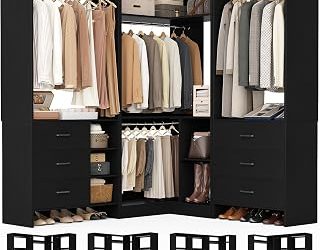
The white finish and 5–14 ft expandable configuration make this the strongest performer for perceived brightness — light bounces between the vertical panels and shelves rather than dying on them. The solid shelf undersides and drawer towers are ideal for discreet puck lights and motion sensors.
LOKEME Portable Steel Wardrobe
Sturdy 19mm tubing with three rods, six shelves, and side pockets keeps small items off the shelf surfaces, which matters more than it sounds — clutter on shelves is what casts the messy secondary shadows. A dependable, budget-conscious frame that responds well to a single battery strip along the top shelf.
Frequently Asked Questions
Can I add lighting to a freestanding wardrobe safely?
Yes, with low-voltage USB or battery LED strips and pucks. Keep adhesive off fabric covers, run cable along the frame rather than across rods, and avoid halogen or any fixture that runs warm near textiles.
What color temperature works best for a closet?
Aim for 3500–4000K with a CRI of 90 or above. Warmer light distorts blues and greys; cooler light is accurate but unflattering in a bedroom. High CRI matters more than brightness for telling similar shades apart.
Does a fabric cover make a wardrobe darker inside?
It blocks nearly all ambient light, so a covered unit needs its own internal source. The upside is that a light-colored cover diffuses any interior light into a soft glow rather than a harsh spill.
How much light do I actually need?
Roughly 150–300 lux at garment level is enough for confident color identification. That is far less than most people install, and a single well-placed strip usually beats several scattered pucks.
Final Thoughts
If you want a wardrobe that stays usable after sunset, the modular wood closet system with six drawers is the easiest to light well thanks to its reflective white panels and solid mounting surfaces. For sheer capacity with room to retrofit lighting, the VIPEK V5 is the more capable frame, while the E10 remains the smartest choice when you need to position a rod under existing light rather than around it.