Key takeaways
- Carbon weight over carbon coating: HEPA handles particles; only activated carbon adsorbs gases. A thin carbon-dusted mesh saturates in weeks. Look for thick carbon beds or wraps measured in pounds, and treat “carbon layer” language with suspicion.
- Night-time light discipline: An AQI display that glows all night is an unwanted nightlight. Insist on a full display-off mode, and check whether the power LED dims too — a single blue pinpoint at 2am is enough to disturb sleep architecture.
- Noise measured in dB, not adjectives: Anything under about 25dB on low disappears into a bedroom. Between 30 and 40dB you’ll hear it during conversation lulls. Above that, it dictates the mood of the room instead of supporting it.
- Coverage with air changes in mind: A “2400 ft²” rating usually means one air change per hour. For VOC-heavy spaces — a newly furnished living room, a home office with a laser printer — size up so you’re getting three or four changes.
- Form and finish: Matte white or fabric-wrapped cylinders sit quietly beside furniture. Glossy black plastic catches every raking light from a window or wall sconce and reads as equipment. Also check the air outlet direction so you’re not aiming a draft at seating.
What's inside
Anyone who designs rooms for a living learns to read a space with more than their eyes. You can dim the pendants, warm the color temperature to 2700K, layer in a floor lamp behind the reading chair — and the room still refuses to relax. Nine times out of ten the culprit is the air. New cabinetry off-gassing formaldehyde, a freshly sealed floor, upholstery adhesives, candle soot, that faint chemical sharpness from a paint job three weeks ago. VOCs don’t announce themselves the way dust on a shade does, but they flatten a room’s mood the same way a harsh overhead fixture does.
This guide looks at VOC-capable air purifiers the way I look at fixtures: what they do to the atmosphere of a room, not just what the spec sheet claims. We cover carbon mass (the part that actually captures gases), noise floors that won’t compete with quiet evenings, display glow that won’t wreck a dark bedroom, and footprints that sit comfortably next to a console table or credenza. Below are the units worth your money in 2026.
As an Amazon Associate we earn from qualifying purchases.


How to Choose a Voc Air Purifier (2026)
- Carbon weight over carbon coating: HEPA handles particles; only activated carbon adsorbs gases. A thin carbon-dusted mesh saturates in weeks. Look for thick carbon beds or wraps measured in pounds, and treat “carbon layer” language with suspicion.
- Night-time light discipline: An AQI display that glows all night is an unwanted nightlight. Insist on a full display-off mode, and check whether the power LED dims too — a single blue pinpoint at 2am is enough to disturb sleep architecture.
- Noise measured in dB, not adjectives: Anything under about 25dB on low disappears into a bedroom. Between 30 and 40dB you’ll hear it during conversation lulls. Above that, it dictates the mood of the room instead of supporting it.
- Coverage with air changes in mind: A “2400 ft²” rating usually means one air change per hour. For VOC-heavy spaces — a newly furnished living room, a home office with a laser printer — size up so you’re getting three or four changes.
- Form and finish: Matte white or fabric-wrapped cylinders sit quietly beside furniture. Glossy black plastic catches every raking light from a window or wall sconce and reads as equipment. Also check the air outlet direction so you’re not aiming a draft at seating.
The Best Voc Air Purifier (2026)s Reviewed
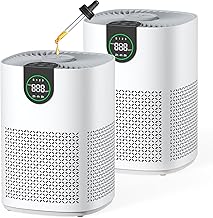
HAP603 Large Room Purifier with Aromatherapy
The 360° outlet and 2X-purification path make this a strong candidate for open-plan rooms where furniture blocks a single-direction airflow. At 22dB in sleep mode it’s genuinely quiet, and the aromatherapy pad is a rare feature that respects ambience — though use essential oils sparingly, since scent is not the same as clean air.
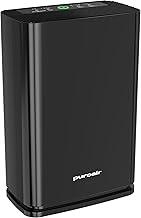
PuroAir 240 HEPA Purifier
PuroAir’s CarbonTech media is the real reason to buy this one: it punches well above its 1,000 ft² class on odors, cooking smells, and solvent residue. The compact tower footprint tucks beside a nightstand or under a desk without visual bulk.
Austin Air C100CC1 VOC Carbon Wrap
This is the specialist. The VOC carbon wrap holds serious media mass, which is why it stays effective on chemical off-gassing long after coated-filter units have given up. Steel construction, no display glow, and a tabletop scale that reads as an object rather than an appliance.
JF999 Large Space Purifier with App and Alexa
At 4,575 ft² it’s the coverage champion here, and app scheduling lets you run hard while you’re out and drop to whisper mode by evening — exactly how I’d program a lighting scene. Pair it with the widest room in the house.
KNKA APH4000
AHAM-verified numbers are worth paying for, because they’re independently measured rather than marketing math. The washable pre-filter meaningfully extends carbon life, and the pet mode earns its place in homes where dander and VOCs overlap.
Frequently Asked Questions
Will a HEPA filter alone remove VOCs?
No. HEPA captures particles down to 0.3 microns, but VOCs are gas molecules that pass straight through. You need activated carbon, and enough of it to matter.
Where should I place the unit in a furnished room?
Roughly a foot from walls, out of alcoves, and never behind a sofa back. Corners look tidy but starve the intake.
How often do carbon filters need replacing?
Every six to twelve months in normal use, but as little as three months during renovations or after new furniture arrives. If odors return, the carbon is saturated.
Do these help with new furniture smell?
Considerably. Run one continuously in the room for the first few weeks after delivery, alongside periodic ventilation.
Final Thoughts
For serious chemical off-gassing, the Austin Air C100CC1 remains the honest choice thanks to its carbon mass and quiet steel presence. The PuroAir 240 is my recommendation for bedrooms and studies where discretion matters, while the JF999 is the one to reach for when a single unit has to handle a large open-plan floor.