Key takeaways
- Surface finish and glare: Bare cast aluminum bounces light straight into your eyes when a lamp sits low; a matte or lightly textured tabletop diffuses it instead. If your shop light is a single fixture rather than a spread of tubes, the duller surface will serve you better.
- Scale contrast: Look for rip-fence and bevel scales with deep black markings on a pale ground, or engraved numerals rather than printed ones. Low-contrast decals disappear entirely under warm 2700K bulbs, which is exactly what most garages have.
- Dust collection port: Airborne fines scatter light and turn a clean beam into a haze. A saw with a real 2-1/2 inch port that mates to a shop vac keeps the air clear, which does more for visibility than adding another lamp.
- Throat plate design: A zero-clearance or near-zero plate reduces the dark gap around the blade where your cut line vanishes. It also keeps offcuts from dropping into shadow at the worst moment.
- Stand height and stability: A saw that sits too low forces you to lean over the work and cast your own shadow across the blade. Roughly 34 to 36 inches puts the cut line in view without hunching, and a stand that doesn’t flex means your clamp-on light stays aimed where you put it.
What's inside
Anyone who has cut a sheet of maple at nine in the evening under a single bare bulb knows the real hazard in a home shop isn’t the blade — it’s the shadow the blade throws. Table saw buying guides talk endlessly about rip capacity and motor amps, and skip the fact that you will spend most of your time squinting at a pencil line where your own body blocks the light. If you build furniture in a garage, a basement corner, or a spare room with one overhead fixture, the saw you choose changes how much you can actually see.
This guide looks at six of the strongest table saws available in 2026 through that lens: how the table surface handles glare, whether the fence and miter scale stay readable in dim conditions, how much dust the saw pushes into the air to scatter your light, and how the machine behaves when you clamp a work lamp nearby. Cutting accuracy, portability, and build quality are all covered too — but sightlines get equal weight, because a cut you can’t see clearly is a cut you’ll make twice.
As an Amazon Associate we earn from qualifying purchases.


How to Choose a Table Saw (2026)
- Surface finish and glare: Bare cast aluminum bounces light straight into your eyes when a lamp sits low; a matte or lightly textured tabletop diffuses it instead. If your shop light is a single fixture rather than a spread of tubes, the duller surface will serve you better.
- Scale contrast: Look for rip-fence and bevel scales with deep black markings on a pale ground, or engraved numerals rather than printed ones. Low-contrast decals disappear entirely under warm 2700K bulbs, which is exactly what most garages have.
- Dust collection port: Airborne fines scatter light and turn a clean beam into a haze. A saw with a real 2-1/2 inch port that mates to a shop vac keeps the air clear, which does more for visibility than adding another lamp.
- Throat plate design: A zero-clearance or near-zero plate reduces the dark gap around the blade where your cut line vanishes. It also keeps offcuts from dropping into shadow at the worst moment.
- Stand height and stability: A saw that sits too low forces you to lean over the work and cast your own shadow across the blade. Roughly 34 to 36 inches puts the cut line in view without hunching, and a stand that doesn’t flex means your clamp-on light stays aimed where you put it.
The Best Table Saw (2026)s Reviewed
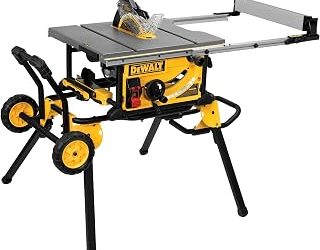
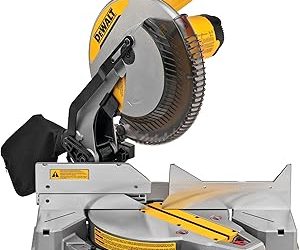
DEWALT DWE7491RS 10-Inch with Rolling Stand
The 32-1/2 inch rip capacity handles full sheet breakdown, and the rack-and-pinion fence carries crisp, high-contrast markings that stay legible under a single warm overhead. Dust extraction is genuinely effective here, which keeps the air clear enough that one clamp light does the work of two.
SKIL TS6307-00 15 Amp Portable
SKIL’s tabletop has a subdued finish that scatters rather than mirrors a low work light, a real advantage if your only fixture sits off to one side. The folding stand sets up at a comfortable working height, so you aren’t leaning into your own shadow on long rips.
DEWALT DWE7485 8-1/4 in. Compact
The smaller footprint suits a shop where the saw shares space with an assembly table and you’re working under one fixture. Less mass to shift means you can reposition the whole saw to suit your light rather than rearranging the lighting to suit the saw.
Evolution R10TS 10″ Jobsite
The included zero-clearance throat plate closes the dark void around the blade, giving you an unbroken sightline to your cut line — a real benefit on thin stock and veneered panels. The dado plate ships in the box, which is unusual at this price point.
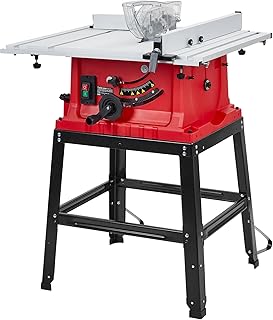
10 Inch 15 Amp Table Saw with Stand and Cover
A generous 36 by 25 inch tabletop supports wide furniture panels without an outfeed roller, and the protective cover keeps dust off the surface between sessions so glare stays predictable. Sensible pick if you want capacity without a premium price.
Frequently Asked Questions
Where should I position a work light around a table saw?
Mount it high and slightly behind the blade, angled forward, so the beam lands on your cut line rather than on your hands. A light placed in front of you will put your own silhouette across the work.
Does bulb colour temperature matter for accuracy?
Yes. Neutral white around 4000K to 5000K renders pencil marks and scale numerals with far better contrast than warm household bulbs, which wash out fine graduations.
Is 8-1/4 inch enough for furniture work?
For most case goods and shelving, yes — the DWE7485 handles standard hardwood stock comfortably. Step up to 10 inch if you regularly cut thick slabs or tall tenon shoulders.
Do I really need dust collection in a small shop?
For visibility alone, absolutely. Suspended dust turns any focused beam into diffuse haze within minutes, and no amount of extra lighting compensates.
Final Thoughts
For a home furniture shop with modest lighting, the DEWALT DWE7491RS is the strongest all-round choice — readable scales, real dust extraction, and the capacity for sheet goods. The Evolution R10TS earns its place for the zero-clearance plate and the clean sightline it gives you, while the SKIL TS6307-00 is the one to pick if glare from a single side-mounted lamp has been driving you off your cut line.