Key takeaways
- Fence accuracy over fence length: A rack-and-pinion fence that stays parallel through its full travel matters more than raw rip capacity. Check for lockdown that does not shift the front of the fence when you clamp the rear.
- Rip capacity you will actually use: 32-inch capacity handles full sheet goods for casework and diffuser panels. If you build small, 24 to 26 inches is plenty and saves footprint.
- Depth of cut at 90 and 45 degrees: A 10-inch blade gives you roughly 3-1/8 inches upright, which covers thick stock and beveled reveals. Compact 8-1/4-inch saws trade a little of that for real portability.
- Stand and stability: Rolling folding stands are worth the premium if the saw shares space with a car. Wobble at the legs shows up in the cut, so test the deployed stand for rock before you trust it.
- Dust control and sightlines: A shrouded blade with a rear port keeps the cut line visible, which is half of accurate work. Pair it with a task light aimed across the table, not down onto it, so the blade casts a readable shadow.
What's inside
In lighting work, you learn quickly that a surface never lies. A grazing sconce or a low-angle track head will find every hairline gap in a mitered lamp box, every whisper of tearout along a shelf edge, every joint that drifted a half degree off square. That is the frustration most first-time saw buyers run into: the cut looks fine on the bench under flat overhead light, then reads as a shadow line the moment the piece lands in a real room. The problem is rarely skill. It is usually a fence that wanders, a blade that flexes, or a table with just enough deflection to turn a rip into a taper.
This guide covers starter table saws that hold a line well enough to survive raking light. All of them are portable jobsite or benchtop machines, priced and sized for a garage or a shared studio rather than a dedicated shop. Below you will find how to evaluate the specs that actually affect surface quality, short reviews of five saws worth your attention, and answers to the questions that come up once the box is open.
As an Amazon Associate we earn from qualifying purchases.



How to Choose a Starter Table Saw (2026)
- Fence accuracy over fence length: A rack-and-pinion fence that stays parallel through its full travel matters more than raw rip capacity. Check for lockdown that does not shift the front of the fence when you clamp the rear.
- Rip capacity you will actually use: 32-inch capacity handles full sheet goods for casework and diffuser panels. If you build small, 24 to 26 inches is plenty and saves footprint.
- Depth of cut at 90 and 45 degrees: A 10-inch blade gives you roughly 3-1/8 inches upright, which covers thick stock and beveled reveals. Compact 8-1/4-inch saws trade a little of that for real portability.
- Stand and stability: Rolling folding stands are worth the premium if the saw shares space with a car. Wobble at the legs shows up in the cut, so test the deployed stand for rock before you trust it.
- Dust control and sightlines: A shrouded blade with a rear port keeps the cut line visible, which is half of accurate work. Pair it with a task light aimed across the table, not down onto it, so the blade casts a readable shadow.
The Best Starter Table Saws (2026) Reviewed
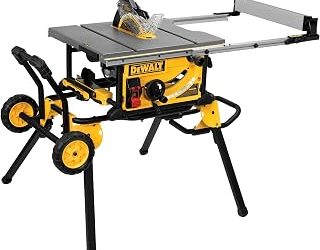
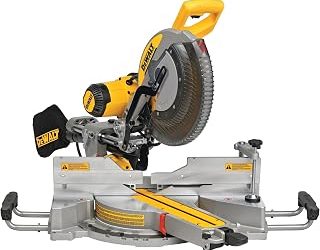
DEWALT DWE7491RS 10-Inch with Rolling Stand
The benchmark for a first serious saw: a 15-amp motor, 4800 RPM, and a 32-1/2-inch rip capacity that swallows a half sheet without drama. Its rack-and-pinion fence is the reason people keep recommending it, holding parallel well enough that glue lines disappear under directional light.
SKIL TS6307-00 15 Amp Portable Jobsite Saw
A strong value pick with a genuinely useful folding stand and a fence that adjusts more precisely than the price suggests. Its integrated dust port and worm-drive-style power delivery make it a comfortable saw for repeat rips on shelving and trim stock.
Evolution R10TBLX 10-Inch Jobsite Saw
The standout here is the included dado plate and zero-clearance throat plate, which means you can cut clean housed joints and grooves for LED channel out of the box. With 26-inch rip capacity and a 3-3/8-inch cut, it punches above its class for detail work.
DEWALT DWE7485 8-1/4-Inch Compact
Lighter, quieter to move, and easier to store, this compact saw keeps DEWALT’s fence quality while shedding bulk. Best for anyone working in a shared or seasonal space where the saw has to come off a shelf and go back.
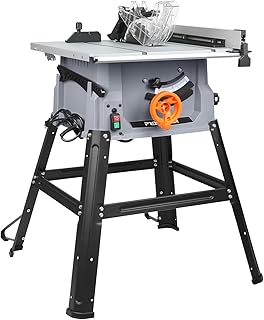
Prostormer 10-Inch Table Saw with Stand
A budget entry that still delivers 15 amps, 5000 RPM, and 45-degree bevel capacity on a stand. Expect to spend an hour truing the fence and swapping in a better blade, after which it handles decking, trim, and DIY furniture stock reliably.
Frequently Asked Questions
Do I need a cabinet saw for furniture work?
No. A well-tuned jobsite saw with a quality blade produces joinery-grade edges. Cabinet saws buy you mass, quieter operation, and less tuning, not fundamentally better cuts.
Should I replace the stock blade?
Yes, and it is the highest-return upgrade you can make. A 40 to 60 tooth ATB combination blade cuts the tearout that shows up as a bright edge under wall grazing.
Is an 8-1/4-inch saw big enough?
For most furniture and lighting fixture work, yes. You lose some depth at bevels, so if you regularly cut thick beveled stock, stay with a 10-inch machine.
What safety features should I insist on?
A functioning riving knife, blade guard, and anti-kickback pawls, all present on the saws above. Add a push stick and never rip freehand against the fence without one.
Final Thoughts
If your budget allows one purchase to last, the DEWALT DWE7491RS is the safest bet for accuracy and capacity. The SKIL TS6307-00 gets you close for meaningfully less, and the compact DEWALT DWE7485 is the right answer when storage space, not capability, is the real constraint.