Key takeaways
- Match capacity to the room, not the label: BTU figures come in two flavors — ASHRAE (higher) and DOE (more conservative). A unit sold as 12,000 BTU ASHRAE may be 8,000 BTU DOE. Compare like with like, and size against the square footage the manufacturer quotes rather than the headline number.
- Confirm how “self-evaporating” is defined: Most units evaporate condensate in ordinary conditions but include a drain port for humid climates. If you live somewhere genuinely damp, expect occasional draining even on a drainage-free model, and check that the port is accessible without moving the unit.
- Judge noise by what the room is for: A living room tolerates a compressor cycling at conversational volume. A bedroom does not. Look for a dedicated sleep mode that steps down fan speed rather than simply raising the setpoint.
- Look at the display after dark: This is the detail spec sheets never mention. Panels that dim or switch off in sleep mode preserve a low-light scheme; those that stay lit at full brightness become the dominant light source in the room.
- Plan the hose route before you buy: The exhaust hose dictates placement, and placement dictates whether the unit blocks a lamp, a vent, or a walkway. Measure from your window to the spot you actually want the unit to live, then confirm the included kit reaches.
What's inside
Anyone who has fitted a room with warm-toned lamps, dimmers on a timer, and a carefully layered wash of light knows how quickly a portable air conditioner can undo the effect. A bright blue LED panel throwing cold light across the floor at 2 a.m., a bucket of condensate to empty every evening, a plastic monolith parked in the corner where a floor lamp used to sit — these are ambience problems, not just cooling problems. Self-evaporating units solve the most disruptive one: instead of collecting water in a tank, they push most of the moisture out through the exhaust hose, so the machine largely tends to itself.
This guide looks at self-evaporating portable ACs the way I look at any object added to a finished room — how loudly it announces itself, how it behaves in the dark, and whether it earns the floor space. Below you’ll find the models worth shortlisting for 2026, a short primer on what actually matters when you compare specs, and honest notes on where each unit fits: bedroom, home office, or an open living area that needs real capacity.
As an Amazon Associate we earn from qualifying purchases.


How to Choose a Self-Evaporating Portable Air Conditioner (2026)
- Match capacity to the room, not the label: BTU figures come in two flavors — ASHRAE (higher) and DOE (more conservative). A unit sold as 12,000 BTU ASHRAE may be 8,000 BTU DOE. Compare like with like, and size against the square footage the manufacturer quotes rather than the headline number.
- Confirm how “self-evaporating” is defined: Most units evaporate condensate in ordinary conditions but include a drain port for humid climates. If you live somewhere genuinely damp, expect occasional draining even on a drainage-free model, and check that the port is accessible without moving the unit.
- Judge noise by what the room is for: A living room tolerates a compressor cycling at conversational volume. A bedroom does not. Look for a dedicated sleep mode that steps down fan speed rather than simply raising the setpoint.
- Look at the display after dark: This is the detail spec sheets never mention. Panels that dim or switch off in sleep mode preserve a low-light scheme; those that stay lit at full brightness become the dominant light source in the room.
- Plan the hose route before you buy: The exhaust hose dictates placement, and placement dictates whether the unit blocks a lamp, a vent, or a walkway. Measure from your window to the spot you actually want the unit to live, then confirm the included kit reaches.
The Best Self-Evaporating Portable Air Conditioners (2026) Reviewed
14,000 BTU 3-in-1 Portable AC for Large Rooms
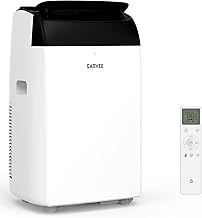
With coverage up to 700 sq. ft., this is the pick for open-plan spaces where a smaller unit would run continuously and never quite catch up. Auto swing helps distribute air across a wide room, though at this capacity expect a physical presence you’ll want to place deliberately rather than tuck away.
DREO 515S Smart Portable AC
The 515S is the most considered unit here for a room you actually live in: 12,000 BTU ASHRAE capacity, genuinely drainage-free operation, and app, voice, and remote control so you can adjust it without crossing the room and breaking the mood. Its quiet sleep mode and restrained control panel make it the one I’d put in a bedroom without hesitation.
Antarctic Star 10,000 BTU 5-in-1
A well-rounded 450 sq. ft. performer that covers cooling, fan, dehumidification, sleep, and timer functions, with child lock as a welcome addition for family rooms. The five-mode flexibility means it earns its footprint year-round rather than sitting idle for nine months.
12,000 BTU Smart Portable AC with Auto Evaporation
Rated for 600 sq. ft., this sits in the sweet spot between bedroom units and large-room machines — enough capacity for a big living space, with a silent sleep mode that keeps it viable overnight. Energy-saving operation makes it a sensible choice if it will run most of the day.
DREO 318S Smart Portable AC
The compact sibling to the 515S, tuned for single bedrooms and home offices at 8,000 BTU ASHRAE. Same drainage-free design and app control in a smaller cabinet, which matters when floor space is already committed to furniture.
Frequently Asked Questions
Do self-evaporating units ever need draining?
Usually not in normal humidity, but most retain a drain port for very damp conditions or continuous operation. Check yours after a run of humid days.
Can I use one without venting out a window?
No. Every unit here needs the exhaust hose routed outside, otherwise it dumps its own heat back into the room and cools nothing.
How much noise should I expect?
Roughly the level of a fan on medium, with the compressor adding a low cycle underneath. Sleep modes reduce this noticeably.
Is a portable AC a fair substitute for a window unit?
It’s less efficient per BTU but far more flexible — worth it for renters, rooms with awkward windows, or spaces you don’t want permanently altered.
Final Thoughts
For most bedrooms, the DREO 515S is the unit I’d choose: quiet, genuinely drainage-free, and controllable from your phone so you never have to get up and squint at a bright panel. Smaller rooms are well served by the DREO 318S, and if you’re cooling an open living area, the 14,000 BTU 3-in-1 has the capacity to keep up where the others will simply run flat out.