Key takeaways
- Tooth Count: Higher tooth counts (60–120T) produce smoother finish cuts with minimal tearout, while lower counts (32T) remove material faster but leave rougher edges — match the teeth to the job, not the price tag.
- Blade Diameter: Most benchtop and sliding compound miter saws accept 10-inch or 12-inch blades; verify your saw’s arbor size (typically 5/8-inch) before ordering, since a mismatch means a wasted purchase.
- Kerf Width: Thin-kerf blades (around 0.090–0.100 inch) waste less material and require less motor power, but full-kerf blades resist vibration better on heavier stock — a trade-off worth weighing for furniture-scale projects.
- Carbide Quality: C3-grade carbide tips hold an edge noticeably longer than economy C1 inserts, especially in hardwoods and plywood; the upfront premium pays for itself in fewer blade swaps per year.
- Gullet Design: Deeper gullets between teeth evacuate sawdust efficiently during long rip-style cuts, while shallower gullets on high-tooth blades keep the cut line stable during delicate crosscuts — look for designs balanced to your dominant cut type.
What's inside
Every miter-saw owner knows the sinking feeling: you line up a crosscut on a piece of finished oak or walnut, the blade screams through the stock, and the resulting edge looks like it lost a fight with sandpaper. Tearout, burn marks, and ragged fibers turn what should be a furniture-worthy cut into a patch-up job. The root cause almost always traces back to the blade — its tooth count, carbide grade, and kerf design matter far more than most woodworkers realize.
As someone who designs lighting installations and custom fixture housings for a living, I obsess over how surfaces interact with light. A clean, burn-free cut edge diffuses ambient light softly and evenly; a rough one creates harsh micro-shadows that telegraph “homemade” from across the room. This guide breaks down the best miter-saw blades available in 2026, focusing on the specs that genuinely affect finish quality, and recommends five options worth your money.
As an Amazon Associate we earn from qualifying purchases.


How to Choose Saw Blades for Miter Saws (2026)
- Tooth Count: Higher tooth counts (60–120T) produce smoother finish cuts with minimal tearout, while lower counts (32T) remove material faster but leave rougher edges — match the teeth to the job, not the price tag.
- Blade Diameter: Most benchtop and sliding compound miter saws accept 10-inch or 12-inch blades; verify your saw’s arbor size (typically 5/8-inch) before ordering, since a mismatch means a wasted purchase.
- Kerf Width: Thin-kerf blades (around 0.090–0.100 inch) waste less material and require less motor power, but full-kerf blades resist vibration better on heavier stock — a trade-off worth weighing for furniture-scale projects.
- Carbide Quality: C3-grade carbide tips hold an edge noticeably longer than economy C1 inserts, especially in hardwoods and plywood; the upfront premium pays for itself in fewer blade swaps per year.
- Gullet Design: Deeper gullets between teeth evacuate sawdust efficiently during long rip-style cuts, while shallower gullets on high-tooth blades keep the cut line stable during delicate crosscuts — look for designs balanced to your dominant cut type.
The Best Saw Blades for Miter Saws (2026) Reviewed
WEN BL1080 10-Inch 80-Tooth
This blade hits the sweet spot between affordability and finish quality. The 80 carbide-tipped teeth leave edges that require almost no sanding — I’ve used it on poplar and maple fixture components straight off the saw with satisfying, light-ready results. It runs noticeably quieter than budget blades at the same RPM, which matters more than people expect during long shop sessions.
WEN BL1280 12-Inch 80-Tooth
If your miter saw accommodates a 12-inch blade, this is the one to buy for wider stock. The larger diameter provides deeper crosscut capacity without sacrificing the fine-finish tooth geometry of its 10-inch sibling. Resawing wider hardwood boards for shelving and mantels, I noticed virtually zero chipping on end grain — exactly the kind of clean surface that catches warm accent lighting without revealing flaws.
WEN BL1060 10-Inch 60-Tooth
A solid mid-range option for woodworkers who split time between finish cuts and slightly rougher dimensioning work. The 60-tooth configuration trades a small amount of surface smoothness for faster feed rates and cooler running temperatures. For furniture projects where edges will receive edge banding or a roundover anyway, this blade delivers more than enough quality at a lower price point than 80-tooth alternatives.
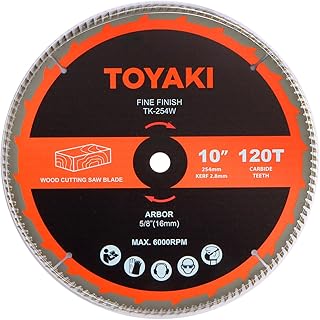
10-Inch 120-Tooth Fine-Finish
The highest tooth count in this roundup, and it shows. Cuts on hardwood look almost sanded straight off the blade — end grain on walnut and cherry comes out glass-smooth with zero tearout. The trade-off is a slower feed rate and more heat buildup, so it demands patience and steady hands. For show-facing furniture components where every millimeter of surface finish matters under display lighting, this blade justifies its place.
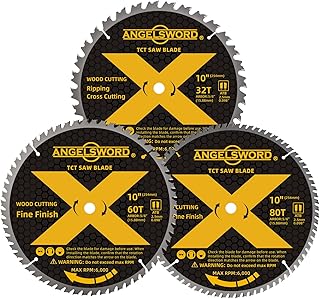
10-Inch 3-Pack (32T / 60T / 80T)
A pragmatic bundle for woodworkers building a blade collection from scratch. The 32-tooth blade handles rough framing and demolition cuts, the 60-tooth handles general workshop tasks, and the 80-tooth handles finish work — all with a consistent 5/8-inch arbor and kerf profile. Having all three matched to the same saw eliminates the guesswork of swapping between mismatched brands.
Frequently Asked Questions
What tooth count is best for finish cuts on a miter saw?
For furniture-grade finish cuts, 60 to 80 teeth is the ideal range on a 10-inch blade. Below 60T, tearout becomes visible on hardwoods without extensive sanding. Above 80T, you gain marginal smoothness but risk heat buildup and slower cuts — the 120-tooth option is worthwhile only for show surfaces where absolutely no post-cut finishing is acceptable.
Can I use table-saw blades on my miter saw?
Yes, as long as the diameter, arbor hole size, and RPM rating match your miter saw’s specifications. Most 10-inch miter saws and table saws share the same 5/8-inch arbor standard. However, blades optimized purely for ripping (low tooth count, deep gullets) will produce poor crosscut quality on a miter saw — always choose blades with enough teeth for the crosscut application.
How often should I replace my miter-saw blade?
A quality carbide-tipped blade typically lasts through 200 to 400 linear feet of hardwood cuts before edge degradation becomes noticeable. Signs you need a new blade include increased burning on the cut face, visible chipping that wasn’t present when the blade was new, and the motor working harder to push through the same stock. Keeping blades clean with pitch remover extends their serviceable life significantly.
Do thin-kerf blades cut as cleanly as full-kerf blades?
Modern thin-kerf blades with quality carbide tips produce virtually identical surface finish to their full-kerf counterparts on stock up to about 2 inches thick. The main difference appears on very thick or dense hardwoods, where a thin-kerf blade may deflect slightly under heavy feed pressure, causing a subtle washboard pattern. For typical miter-saw crosscuts in furniture stock, thin-kerf performs excellently.
Final Thoughts
For most furniture builders working on a miter saw, the WEN BL1080 represents the best all-around choice — its 80-tooth finish quality rivals blades costing twice as much. Woodworkers with larger saws should look to the WEN BL1280 for wider capacity without compromise. And if budget is tight but you need versatility, the 10-Inch 3-Pack gives you three matched blades covering every cut type you are likely to encounter. Whichever you choose, the difference a proper blade makes under the right light will remind you why the details matter.