Key takeaways
- Pile height under downlight: Low pile is non-negotiable in a dining room. Beyond the obvious chair-glide and crumb reasons, tall fibers cast thousands of tiny shadows under a pendant, which reads as visual noise and makes the floor look dirty even when it’s spotless. Anything under half an inch stays calm.
- Undertone versus bulb temperature: Warm bulbs (2700K–3000K) push beige and taupe toward orange and can turn a cool grey rug faintly green. If your fixture is warm, lean into warm neutrals or deep greens that gain richness. If you run 3500K or higher, cooler beiges and greys hold their intended color.
- Pattern density as glare management: A distressed or medallion pattern breaks up the specular hot spot a low-hanging fixture creates on the floor. Solid or near-solid rugs show that bright ring plainly. Vintage-style patterning is genuinely functional here, not just decorative.
- Size beyond the table footprint: Measure your table, then add 24 to 30 inches on every side so chair legs stay on the rug when pulled out. An 8×10 suits most six-seat rectangular tables; 6×9 fits compact four-to-six-seaters; 5×7 works for small square or round tables and breakfast nooks.
- Washability and how color survives it: Machine-washable construction is the single best feature in this category. Check that the rug is stain resistant as well as washable, since surface treatments mean fewer full washes and less cumulative fading under daily light exposure.
What's inside
Dining rooms are lit differently than any other room in the house. You’ve got a pendant or chandelier hanging low over the table, throwing a hard pool of light straight down, and usually very little else. That single overhead source does something unkind to flooring: it flattens texture, exaggerates every crumb and coffee splash, and drops a hot ring of brightness onto whatever sits under the table. Buyers pick a rug they loved in a showroom, get it home, and find it reads muddy in the evening or bleached and busy at lunch. The rug wasn’t wrong. The light was never accounted for.
This guide looks at dining room rugs the way a lighting designer would: how a pile height behaves under raking downlight, which palettes hold their depth at 2700K, and how pattern density either absorbs a chandelier’s glare or fights it. All six picks below are washable and low pile, which matters here for practical reasons as much as visual ones. Below you’ll find the products, then a selection framework, short reviews of the top five, and answers to the questions that come up most.
As an Amazon Associate we earn from qualifying purchases.


🛒 Best Price Today on Amazon
Prime members get fast, free shipping on everything above, plus member-only deals. New members get a 30-day free trial — cancel anytime.
How to Choose a Rug For Dining Room (2026)
- Pile height under downlight: Low pile is non-negotiable in a dining room. Beyond the obvious chair-glide and crumb reasons, tall fibers cast thousands of tiny shadows under a pendant, which reads as visual noise and makes the floor look dirty even when it’s spotless. Anything under half an inch stays calm.
- Undertone versus bulb temperature: Warm bulbs (2700K–3000K) push beige and taupe toward orange and can turn a cool grey rug faintly green. If your fixture is warm, lean into warm neutrals or deep greens that gain richness. If you run 3500K or higher, cooler beiges and greys hold their intended color.
- Pattern density as glare management: A distressed or medallion pattern breaks up the specular hot spot a low-hanging fixture creates on the floor. Solid or near-solid rugs show that bright ring plainly. Vintage-style patterning is genuinely functional here, not just decorative.
- Size beyond the table footprint: Measure your table, then add 24 to 30 inches on every side so chair legs stay on the rug when pulled out. An 8×10 suits most six-seat rectangular tables; 6×9 fits compact four-to-six-seaters; 5×7 works for small square or round tables and breakfast nooks.
- Washability and how color survives it: Machine-washable construction is the single best feature in this category. Check that the rug is stain resistant as well as washable, since surface treatments mean fewer full washes and less cumulative fading under daily light exposure.
The Best Rug For Dining Room (2026)s Reviewed
Washable Ultra Soft Faux Wool 8×10
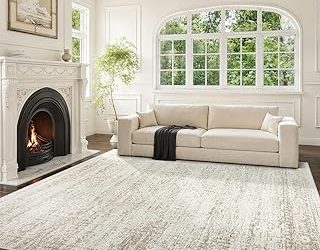
The faux wool surface has a subtle irregularity that scatters overhead light instead of bouncing it back, so the floor under your fixture stays soft rather than glossy. Non-shedding and pet-friendly, which makes it the most forgiving option here for households where the dining room does double duty.
Soalmost Washable Beige 8×10
A genuinely well-judged beige — it holds a neutral read under warm bulbs instead of going peachy, which is rarer than you’d expect. The lightweight, foldable build makes wash day painless, and the vintage patterning hides the inevitable dropped-fork moments.
Dark Green Oriental 6×9
Dark green is the smartest color choice in a dining room lit by a single warm pendant: it deepens under low light and gives the table something to sit against rather than float on. The 6×9 footprint suits a four-to-six-seat table with proper chair clearance.
cotiled Distressed Oriental 5×7 Beige
Built for smaller rooms and round tables, where an oversized rug would visually crowd the space. The distressed traditional motif does quiet work diffusing the bright circle a low fixture throws, and the soft handfeel is welcome in a room where people sit barefoot.
Vintage Boho Medallion 8×10
The central medallion aligns naturally with a centered pendant, which creates a satisfying vertical relationship between fixture, table, and floor. Retro coloring stays warm without turning yellow under 2700K, and the low pile keeps chairs sliding freely.
Frequently Asked Questions
What size rug do I need for a dining table?
Add at least 24 inches to every side of your table’s dimensions, 30 if your chairs are bulky or on casters. The test is simple: every chair should remain fully on the rug when pushed back to seat someone.
Will a washable rug hold up to real dining room use?
Yes, and it will outlast a traditional rug in this room specifically. Spills near a table are constant, and a rug you can put through a machine gets cleaned properly rather than spot-treated indefinitely.
Do I need a rug pad?
Most of these are non-slip backed, but a thin pad is still worth adding. It stops edge curl at chair-leg contact points and adds a small amount of acoustic damping, which noticeably softens conversation in a hard-surfaced room.
Light or dark — which hides more?
Mid-tone and dark patterned rugs conceal daily use better under focused overhead light, since a bright fixture reveals every mark on a pale solid surface. Distressed patterning is more forgiving than color alone.
Final Thoughts
For most dining rooms, the Washable Ultra Soft Faux Wool 8×10 is the safest all-round choice — generous sizing, light-diffusing texture, easy maintenance. If your room runs warm and dim, the Dark Green Oriental 6×9 gains real depth under a low pendant, while the Farmhouse Dark Taupe Brown 6×9 offers a similarly forgiving mid-tone with a quieter geometric character.