Key takeaways
- Reclined depth, not resting depth: Measure the open position and add four to six inches behind the headrest. A chair that clears the wall but ends up under a wall sconce will put your reading light behind your skull instead of over the page.
- Fabric reflectance: Chenille has a broken, low-sheen surface that diffuses warm light and hides shadow lines, while velvet catches a directional highlight along every crown and roll. Smooth polyester sits between the two and photographs flat, which suits rooms with a single overhead fixture.
- A swivel earns its keep: In a room with one window, 360-degree rotation means one chair serves morning daylight, evening lamplight, and the television without being dragged across the floor. Treat the swivel as a lighting feature, not a novelty.
- Seat height versus shade height: Low seats drop your eyeline below most floor lamp shades, which sends glare straight at you. Pair a low-slung recliner with a taller lamp or an adjustable arm, and check the numbers before you buy both.
- Quiet hardware and cable discipline: Manual mechanisms make less noise than motors in a nursery, and any heated or massage model needs a plan for its cord so you are not running it past a lamp base. Side pockets keep the remote off the floor in low light.
What's inside
Most small-space furniture advice stops at the tape measure, which is why so many rocker recliners end up technically fitting and still ruining a room. A chair with a 30-inch footprint can behave like a 40-inch object once it reclines, and worse, it can sit directly in the path of your only good light source. I spend my working hours arranging lamps, sconces, and reflected light in tight rooms, and the recliner is almost always the piece that decides whether a corner reads as cozy or as a dead zone. Bulk blocks throw; the wrong upholstery drinks every lumen you give it; a fixed base traps you facing away from the window.
This guide looks at compact swivel rocker recliners through that lens: how much clearance they actually need when open, how their fabrics behave under warm bulbs, and whether the swivel lets you chase daylight instead of committing to one direction forever. Below you will find the models worth considering in 2026, a short checklist for choosing between them, and answers to the questions that come up most once the chair is in the room.
As an Amazon Associate we earn from qualifying purchases.




🛒 Best Price Today on Amazon
Prime members get fast, free shipping on everything above, plus member-only deals. New members get a 30-day free trial — cancel anytime.
How to Choose a Rocker Recliner For Small Spaces (2026)
- Reclined depth, not resting depth: Measure the open position and add four to six inches behind the headrest. A chair that clears the wall but ends up under a wall sconce will put your reading light behind your skull instead of over the page.
- Fabric reflectance: Chenille has a broken, low-sheen surface that diffuses warm light and hides shadow lines, while velvet catches a directional highlight along every crown and roll. Smooth polyester sits between the two and photographs flat, which suits rooms with a single overhead fixture.
- A swivel earns its keep: In a room with one window, 360-degree rotation means one chair serves morning daylight, evening lamplight, and the television without being dragged across the floor. Treat the swivel as a lighting feature, not a novelty.
- Seat height versus shade height: Low seats drop your eyeline below most floor lamp shades, which sends glare straight at you. Pair a low-slung recliner with a taller lamp or an adjustable arm, and check the numbers before you buy both.
- Quiet hardware and cable discipline: Manual mechanisms make less noise than motors in a nursery, and any heated or massage model needs a plan for its cord so you are not running it past a lamp base. Side pockets keep the remote off the floor in low light.
The Best Rocker Recliner For Small Spaces (2026)s Reviewed
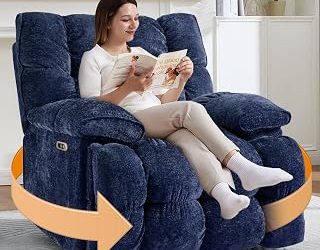
Korser 360 Swivel Rocker Recliner, Upholstered Fabric Glider
A genuinely narrow silhouette with a smooth rocking arc, which makes it my default suggestion for a nursery corner lit by nothing more than a dimmed table lamp. The plain upholstered surfaces keep shadows soft rather than carving them into hard lines.
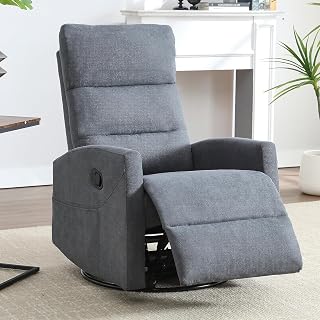
Small Swivel Rocker Recliner, Dark Grey
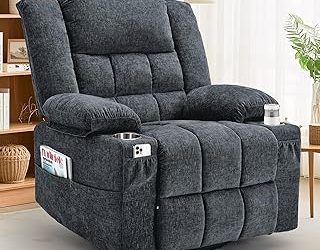
Built tight enough for an RV or a bedroom alcove, and the dark grey reads as an intentional anchor rather than a hole in the room, provided you have some reflected light nearby from a pale wall or a shaded lamp. Best in spaces where you want the chair to recede and the lighting to lead.
360° Swivel Rocker Recliner, Polyester Dark Grey
The manual mechanism is unfussy and quiet, and the flat-finish polyester handles overhead lighting better than a plush pile would, avoiding the patchy sheen that ceiling fixtures tend to expose. A sensible pick for a bedroom or a small living room with mixed light sources.
Small Swivel Rocker Recliner with Massage and Heat, Light Brown
Heat, massage, and real lumbar support in a compact frame, with a light brown tone that bounces warm light around instead of absorbing it, which matters in rooms that get dim early. Plan the cord run before you settle on the corner.
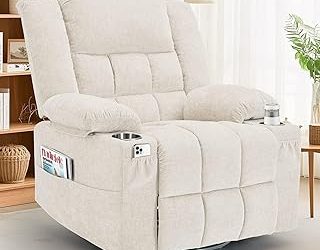
Korser Chenille Swivel Rocker Recliner, Beige
The chenille and beige combination is the most forgiving pairing here under 2700K bulbs, keeping the chair luminous without turning glossy. Side pockets and a simple manual recline round out a piece that quietly raises the light level in a small room.
Frequently Asked Questions
How much clearance does a small rocker recliner need?
Allow four to six inches behind the chair for the recline and rocking motion, plus a few inches on each side if it swivels. Check what hangs above that arc, since a low shade or floating shelf will interfere long before the wall does.
Will a dark chair make a small room feel darker?
It will absorb rather than bounce light, so a dark grey recliner needs help from a pale wall, a light rug, or a second lamp. In a room with one fixture, a beige or light brown chair does measurable work for the ambience.
Velvet, chenille, or polyester in a tight space?
Chenille diffuses light most gracefully and hides wear, velvet adds depth but shows directional highlights and pressure marks, and polyester stays visually flat under overhead lighting. Choose based on your primary light source, not just the swatch in daylight.
Are these suitable for a nursery night routine?
Manual swivel gliders are well suited to it because there is no motor noise, and the swivel lets you turn away from a nightlight without moving the chair. Keep the recline path clear so you are not reaching for a lamp in the dark.
Final Thoughts
For most small rooms I would start with the Korser Chenille Swivel Rocker Recliner in beige, which handles warm lamplight better than anything else here, or the Korser 360 Swivel Glider if you want the narrowest workable footprint. If comfort features matter more than footprint alone, the heated massage model in light brown delivers both support and a tone that keeps a dim corner feeling open.