Key takeaways
- Sheen before color: A fabric’s surface finish decides more than its hue. Matte weaves scatter light and stay one even tone across the whole seat; glossy or coated faces produce a bright hot spot wherever a bulb or window sits opposite them. If your recliner faces a lamp, choose matte first and pick the color second.
- Reflectance, not just shade: Pale covers bounce a large share of the light that lands on them, which quietly brightens the floor and wall nearby — useful in a dim room with one lamp. Deep navy or chocolate absorbs most of it, so the chair recedes and the room needs more fill light to avoid feeling cave-like. Decide which job the chair is doing.
- Texture reads as shadow: Jacquard patterning and quilted channels create thousands of tiny shadows, and that is a feature. Broken surfaces disguise creases, pet hair, and the faint traffic marks that show on flat fabric. On a low chair lit from above, texture is the most forgiving finish you can buy.
- Fit controls wrinkle lines: Slack fabric is the real enemy. A sagging seat panel folds, folds catch grazing light, and the eye reads those folds as dirt or wear. Measure across the backrest at its widest point, respect the stated range, and prefer covers with strong recovery and an elastic or tucked hem.
- Coated backings versus glare: Waterproof layers are worth it around dogs and toddlers, but laminated backings often stiffen the face fabric and add a faint plastic shine. Look for a brushed or micro-suede top surface over the barrier so you get the spill protection without the vinyl highlight.
What's inside
Most recliner slipcovers get chosen the way paint gets chosen: on a screen, at midday, from a thumbnail. Then the cover arrives, goes on the chair, and by 8 p.m. it reads completely differently. The gray looks green under warm bulbs. The “soft” fabric throws a hard highlight every time the floor lamp hits it. Every wrinkle across the seat becomes a dark line, because a recliner sits low and catches light at a grazing angle rather than head-on. Nothing is defective. The fabric is just doing what fabric does in a real light field.
I specify surfaces for a living, and a recliner is one of the highest-stakes surfaces in a den: it is large, it is close to the lamp, and it usually faces a glowing screen. This guide looks at the current crop of stretch and waterproof recliner covers through that lens — how each one handles sheen, how its color holds up under 2700K bulbs, and how its texture behaves when light rakes across it. Protection from dogs, kids, and spilled coffee is the baseline. How the chair looks after sunset is the part nobody plans for.
As an Amazon Associate we earn from qualifying purchases.


🛒 Best Price Today on Amazon
Prime members get fast, free shipping on everything above, plus member-only deals. New members get a 30-day free trial — cancel anytime.
How to Choose a Recliner Slipcover (2026)
- Sheen before color: A fabric’s surface finish decides more than its hue. Matte weaves scatter light and stay one even tone across the whole seat; glossy or coated faces produce a bright hot spot wherever a bulb or window sits opposite them. If your recliner faces a lamp, choose matte first and pick the color second.
- Reflectance, not just shade: Pale covers bounce a large share of the light that lands on them, which quietly brightens the floor and wall nearby — useful in a dim room with one lamp. Deep navy or chocolate absorbs most of it, so the chair recedes and the room needs more fill light to avoid feeling cave-like. Decide which job the chair is doing.
- Texture reads as shadow: Jacquard patterning and quilted channels create thousands of tiny shadows, and that is a feature. Broken surfaces disguise creases, pet hair, and the faint traffic marks that show on flat fabric. On a low chair lit from above, texture is the most forgiving finish you can buy.
- Fit controls wrinkle lines: Slack fabric is the real enemy. A sagging seat panel folds, folds catch grazing light, and the eye reads those folds as dirt or wear. Measure across the backrest at its widest point, respect the stated range, and prefer covers with strong recovery and an elastic or tucked hem.
- Coated backings versus glare: Waterproof layers are worth it around dogs and toddlers, but laminated backings often stiffen the face fabric and add a faint plastic shine. Look for a brushed or micro-suede top surface over the barrier so you get the spill protection without the vinyl highlight.
The Best Recliner Slipcovers (2026) Reviewed
Navy Blue 1-Piece Stretch Recliner Cover
A genuinely matte navy that swallows light instead of glinting, which makes it the safest pick for a chair sitting directly under or beside a lamp. Fits 24″–37″ backs, and the single-piece cut plus elastic hem keeps the seat taut enough that you avoid the shadow creases that plague looser covers.
VANSOFY Stretch Recliner Cover, Dark Gray
The high-stretch knit hugs the frame tightly, so the surface stays smooth and reads as one continuous tone rather than a patchwork of highlights. Worth knowing that this dark gray leans slightly warm under incandescent-style bulbs — flattering next to wood and leather, less crisp in a cool-white room.
Chocolate Jacquard Recliner Slipcover
The woven jacquard is the standout here: its raised motif breaks up reflected light into fine micro-shadow, hiding creases and shedding better than any flat fabric in this group. A strong choice for rooms lit by a single overhead fixture, where grazing light would expose a smoother cover.
H.VERSAILTEX Velvet 4-Piece Recliner Cover, Ivory
Velvet’s pile makes it directional, so the ivory shifts between soft cream and near-white as you move around the chair — a real depth effect that flat cotton cannot produce. The four-piece construction and thick, non-slip hand give the tightest fit of the bunch, though brush the pile in one direction after washing.
Ameritex Waterproof Nonslip Recliner Cover, Beige
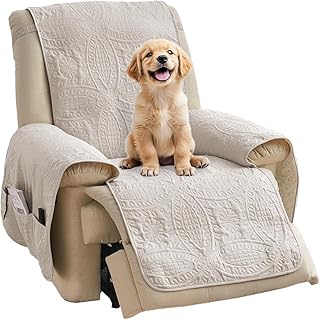
The most practical option for households with dogs, with a barrier layer that stays put instead of shifting under a moving pet. Its brushed face keeps the sheen low despite the waterproofing, and the beige has enough reflectance to keep a dim corner from going flat.
Frequently Asked Questions
Will a dark slipcover make my room feel dimmer?
Yes, measurably. A large dark surface absorbs light your walls and floor would otherwise bounce around. If you go navy or chocolate, add a second low-level source nearby — a table lamp or wall sconce — rather than pushing your main bulb brighter.
Why does my new cover look shiny in the evening?
You are seeing specular reflection from a light source positioned opposite the chair. Move the lamp so it lights the chair from the side rather than straight on, or switch to a shade that diffuses more broadly. A textured cover like a jacquard or quilted weave largely eliminates the effect.
Does velvet work in a low-light room?
Very well, if it is pale. Velvet’s pile reads as gentle gradation rather than a flat block, which gives a dim room visual depth. Dark velvet in a dim room, though, tends to disappear into a silhouette.
One-piece or multi-piece?
Multi-piece sets like the H.VERSAILTEX fit tighter and wrinkle less, which matters most on light or smooth fabrics where creases show. One-piece stretch covers are faster to remove and rewash — the better call if pets are the primary reason you are buying.
Final Thoughts
For most rooms, the Chocolate Jacquard slipcover is the smartest surface in this lineup: its texture forgives creases, shedding, and imperfect lighting alike. If your chair sits in a brighter, more designed space, the H.VERSAILTEX Velvet in ivory gives the most depth under lamplight, while the Ameritex Waterproof cover is the one to buy when a dog claims the recliner as its own.